Department of Podiatry, Faculty of Health Sciences, La Trobe University, Victoria, Australia.
J Foot Ankle Res. 2009 Nov 13;2:32. doi: 10.1186/1757-1146-2-32.
Chronic plantar heel pain (CPHP) is a generalised term used to describe a range of undifferentiated conditions affecting the plantar heel. Plantar fasciitis is reported as the most common cause and the terms are frequently used interchangeably in the literature. Diagnostic imaging has been used by many researchers and practitioners to investigate the involvement of specific anatomical structures in CPHP. These observations help to explain the underlying pathology of the disorder, and are of benefit in forming an accurate diagnosis and targeted treatment plan. The purpose of this systematic review was to investigate the diagnostic imaging features associated with CPHP, and evaluate study findings by meta-analysis where appropriate.
Bibliographic databases including Medline, Embase, CINAHL, SportDiscus and The Cochrane Library were searched electronically on March 25, 2009. Eligible articles were required to report imaging findings in participants with CPHP unrelated to inflammatory arthritis, and to compare these findings with a control group. Methodological quality was evaluated by use of the Quality Index as described by Downs and Black. Meta-analysis of study data was conducted where appropriate.
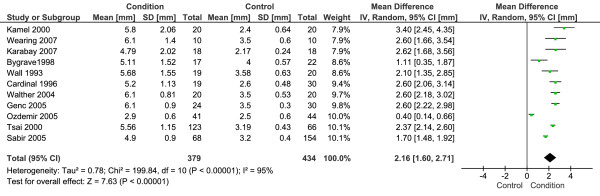
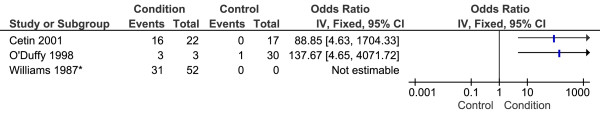
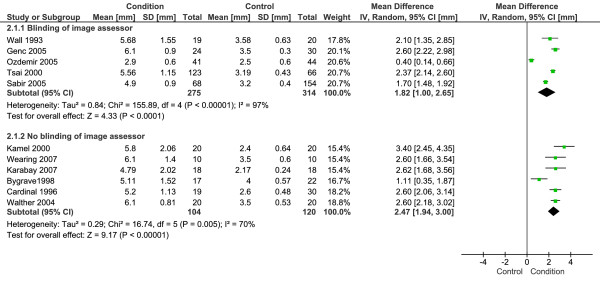
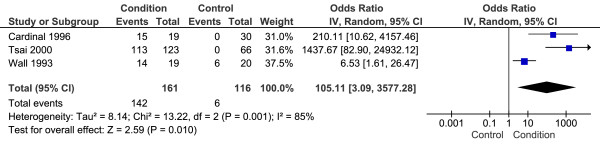
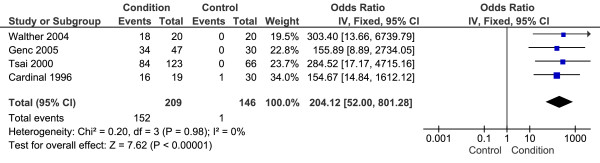
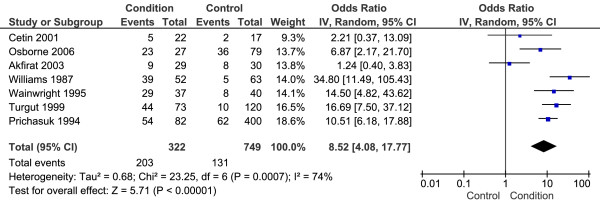
Plantar fascia thickness as measured by ultrasonography was the most widely reported imaging feature. Meta-analysis revealed that the plantar fascia of CPHP participants was 2.16 mm thicker than control participants (95% CI = 1.60 to 2.71 mm, P < 0.001) and that CPHP participants were more likely to have plantar fascia thickness values greater than 4.0 mm (OR = 105.11, 95% CI = 3.09 to 3577.28, P = 0.01). CPHP participants were also more likely to show radiographic evidence of subcalcaneal spur than control participants (OR = 8.52, 95% CI = 4.08 to 17.77, P < 0.001).
This systematic review has identified 23 studies investigating the diagnostic imaging appearance of the plantar fascia and inferior calcaneum in people with CPHP. Analysis of these studies found that people with CPHP are likely to have a thickened plantar fascia with associated fluid collection, and that thickness values >4.0 mm are diagnostic of plantar fasciitis. Additionally, subcalcaneal spur formation is strongly associated with pain beneath the heel.
慢性足底跟痛(CPHP)是一个通用术语,用于描述一系列影响足底跟的未分化病症。足底筋膜炎是最常见的原因,并且在文献中经常互换使用这些术语。许多研究人员和从业者使用诊断影像学来研究 CPHP 中特定解剖结构的参与情况。这些观察结果有助于解释该疾病的潜在病理学,并有助于做出准确的诊断和制定有针对性的治疗计划。本系统评价的目的是研究与 CPHP 相关的诊断影像学特征,并在适当的情况下通过荟萃分析评估研究结果。
电子检索了 Medline、Embase、CINAHL、SportDiscus 和 The Cochrane Library 等文献数据库,检索日期为 2009 年 3 月 25 日。符合条件的文章必须报告与炎症性关节炎无关的 CPHP 参与者的影像学发现,并将这些发现与对照组进行比较。使用 Downs 和 Black 描述的质量指数评估方法学质量。在适当的情况下,对研究数据进行荟萃分析。
超声测量的足底筋膜厚度是最广泛报道的影像学特征。荟萃分析显示,CPHP 参与者的足底筋膜比对照组参与者厚 2.16 毫米(95%CI=1.60 至 2.71 毫米,P<0.001),并且 CPHP 参与者更有可能出现大于 4.0 毫米的足底筋膜厚度值(OR=105.11,95%CI=3.09 至 3577.28,P=0.01)。CPHP 参与者也更有可能显示跟骨下骨刺的放射影像学证据,而对照组参与者则不然(OR=8.52,95%CI=4.08 至 17.77,P<0.001)。
本系统评价共纳入了 23 项研究,调查了 CPHP 患者足底筋膜和跟骨下表面的诊断影像学表现。对这些研究的分析发现,CPHP 患者的足底筋膜可能增厚并伴有积液,厚度值>4.0 毫米可诊断为足底筋膜炎。此外,跟骨下骨刺的形成与足跟下疼痛密切相关。