Division of Basic Sciences, Fred Hutchinson Cancer Research Center, Seattle, WA, USA.
PLoS One. 2009 Nov 13;4(11):e7839. doi: 10.1371/journal.pone.0007839.
The Myc oncoprotein, a transcriptional regulator involved in the etiology of many different tumor types, has been demonstrated to play an important role in the functions of embryonic stem (ES) cells. Nonetheless, it is still unclear as to whether Myc has unique target and functions in ES cells.
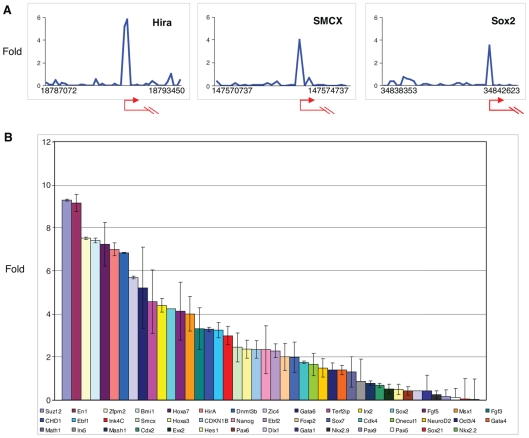
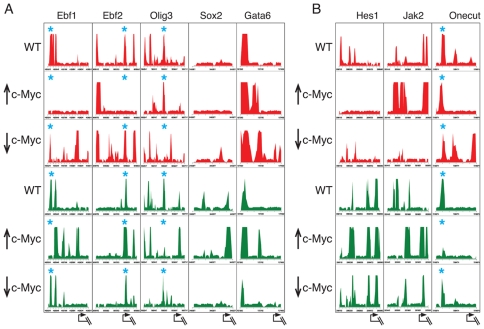
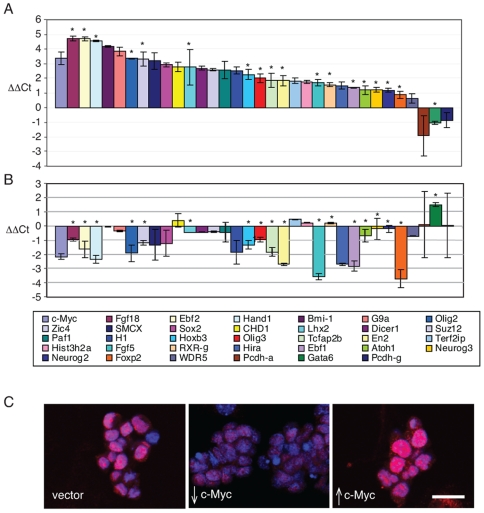
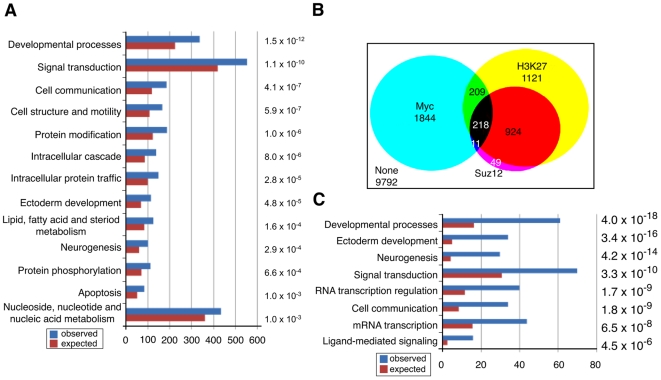
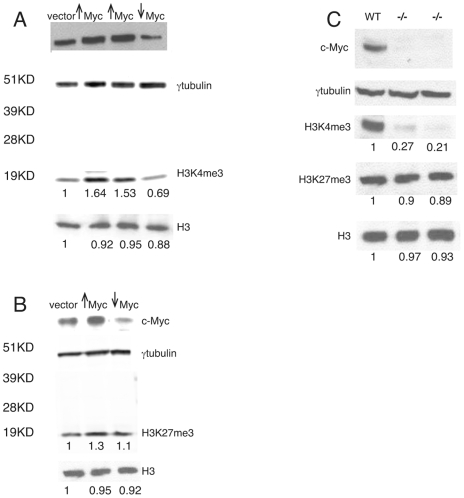
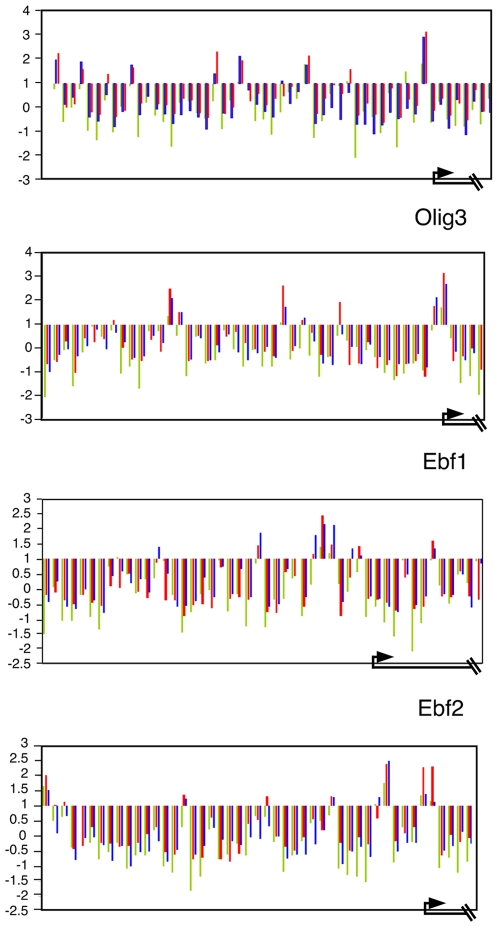
METHODOLOGY/PRINCIPAL FINDINGS: To elucidate the role of c-Myc in murine ES cells, we mapped its genomic binding sites by chromatin-immunoprecipitation combined with DNA microarrays (ChIP-chip). In addition to previously identified targets we identified genes involved in pluripotency, early development, and chromatin modification/structure that are bound and regulated by c-Myc in murine ES cells. Myc also binds and regulates loci previously identified as Polycomb (PcG) targets, including genes that contain bivalent chromatin domains. To determine whether c-Myc influences the epigenetic state of Myc-bound genes, we assessed the patterns of trimethylation of histone H3-K4 and H3-K27 in mES cells containing normal, increased, and reduced levels of c-Myc. Our analysis reveals widespread and surprisingly diverse changes in repressive and activating histone methylation marks both proximal and distal to Myc binding sites. Furthermore, analysis of bulk chromatin from phenotypically normal c-myc null E7 embryos demonstrates a 70-80% decrease in H3-K4me3, with little change in H3-K27me3, compared to wild-type embryos indicating that Myc is required to maintain normal levels of histone methylation.
CONCLUSIONS/SIGNIFICANCE: We show that Myc induces widespread and diverse changes in histone methylation in ES cells. We postulate that these changes are indirect effects of Myc mediated by its regulation of target genes involved in chromatin remodeling. We further show that a subset of PcG-bound genes with bivalent histone methylation patterns are bound and regulated in response to altered c-Myc levels. Our data indicate that in mES cells c-Myc binds, regulates, and influences the histone modification patterns of genes involved in chromatin remodeling, pluripotency, and differentiation.
Myc 癌基因蛋白是一种参与多种不同肿瘤类型发病机制的转录调节剂,已被证明在胚胎干细胞 (ES) 细胞的功能中发挥重要作用。尽管如此,Myc 是否在 ES 细胞中有独特的靶标和功能仍不清楚。
方法/主要发现:为了阐明 c-Myc 在小鼠 ES 细胞中的作用,我们通过染色质免疫沉淀结合 DNA 微阵列 (ChIP-chip) 绘制了其基因组结合位点。除了先前鉴定的靶标外,我们还鉴定了参与多能性、早期发育和染色质修饰/结构的基因,这些基因在小鼠 ES 细胞中被 c-Myc 结合和调节。Myc 还结合并调节先前鉴定为多梳 (PcG) 靶标的基因,包括含有双价染色质结构域的基因。为了确定 c-Myc 是否影响 Myc 结合基因的表观遗传状态,我们评估了含有正常、增加和减少 c-Myc 水平的 mES 细胞中组蛋白 H3-K4 和 H3-K27 的三甲基化模式。我们的分析揭示了 Myc 结合位点近端和远端广泛而令人惊讶的不同的抑制性和激活性组蛋白甲基化标记的变化。此外,与野生型胚胎相比,表型正常的 c-myc 缺失 E7 胚胎的大量染色质分析显示 H3-K4me3 降低了 70-80%,而 H3-K27me3 变化不大,表明 Myc 是维持正常组蛋白甲基化水平所必需的。
结论/意义:我们表明 Myc 在 ES 细胞中诱导了广泛而多样的组蛋白甲基化变化。我们推测这些变化是 Myc 通过调节参与染色质重塑的靶基因的间接作用。我们进一步表明,具有双价组蛋白甲基化模式的 PcG 结合基因的一部分响应改变的 c-Myc 水平而被结合和调节。我们的数据表明,在 mES 细胞中,c-Myc 结合、调节并影响涉及染色质重塑、多能性和分化的基因的组蛋白修饰模式。