Sag Can M, Wadsack Daniel P, Khabbazzadeh Sepideh, Abesser Marco, Grefe Clemens, Neumann Kay, Opiela Marie-Kristin, Backs Johannes, Olson Eric N, Brown Joan Heller, Neef Stefan, Maier Sebastian K G, Maier Lars S
Department of Cardiology and Pneumology, Heart Center, Georg-August-University, Göttingen, Germany.
Circ Heart Fail. 2009 Nov;2(6):664-75. doi: 10.1161/CIRCHEARTFAILURE.109.865279. Epub 2009 Jul 31.
Transgenic (TG) Ca/calmodulin-dependent protein kinase II (CaMKII)delta(C) mice have heart failure and isoproterenol (ISO)-inducible arrhythmias. We hypothesized that CaMKII contributes to arrhythmias and underlying cellular events and that inhibition of CaMKII reduces cardiac arrhythmogenesis in vitro and in vivo.
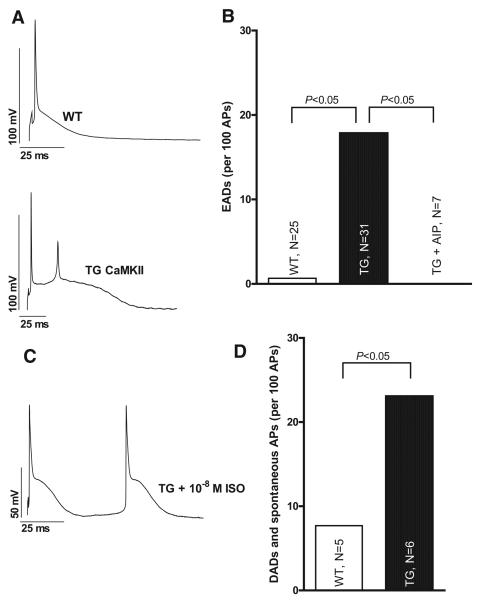
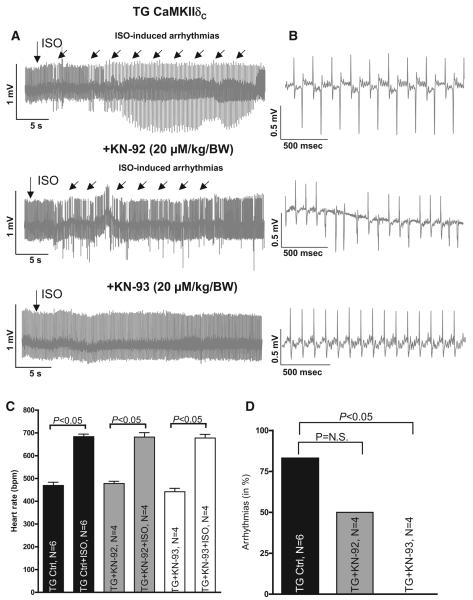
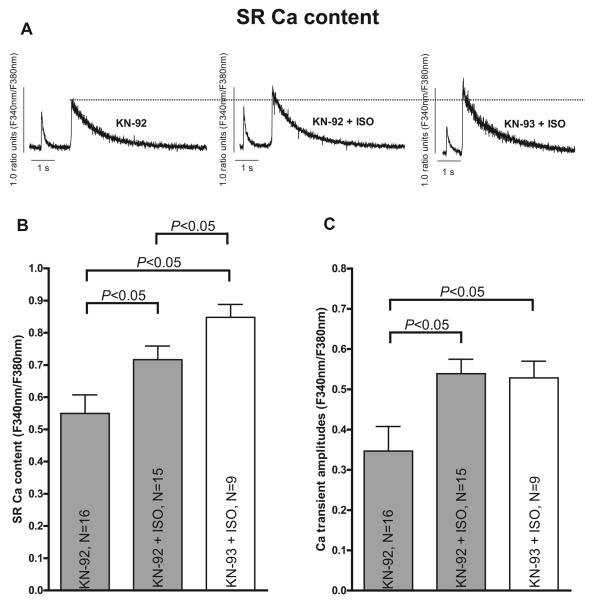
Under baseline conditions, isolated cardiac myocytes from TG mice showed an increased incidence of early afterdepolarizations compared with wild-type myocytes (P<0.05). CaMKII inhibition (AIP) completely abolished these afterdepolarizations in TG cells (P<0.05). Increasing intracellular Ca stores using ISO (10(-8) M) induced a larger amount of delayed afterdepolarizations and spontaneous action potentials in TG compared with wild-type cells (P<0.05). This seems to be due to an increased sarcoplasmic reticulum (SR) Ca leak because diastolic Ca rose clearly on ISO in TG but not in wild-type cells (+20+/-5% versus +3+/-4% at 10(-6) M ISO, P<0.05). In parallel, SR Ca leak assessed by spontaneous SR Ca release events showed an increased Ca spark frequency (3.9+/-0.5 versus 2.0+/-0.4 sparks per 100 microm(-1).s(-1), P<0.05). However, CaMKII inhibition (either pharmacologically using KN-93 or genetically using an isoform-specific CaMKIIdelta-knockout mouse model) significantly reduced SR Ca spark frequency, although this rather increased SR Ca content. In parallel, ISO increased the incidence of early (54% versus 4%, P<0.05) and late (86% versus 43%, P<0.05) nonstimulated events in TG versus wild-type myocytes, but CaMKII inhibition (KN-93 and KO) reduced these proarrhythmogenic events (P<0.05). In addition, CaMKII inhibition in TG mice (KN-93) clearly reduced ISO-induced arrhythmias in vivo (P<0.05).
We conclude that CaMKII contributes to cardiac arrhythmogenesis in TG CaMKIIdelta(C) mice having heart failure and suggest the increased SR Ca leak as an important mechanism. Moreover, CaMKII inhibition reduces cardiac arrhythmias in vitro and in vivo and may therefore indicate a potential role for future antiarrhythmic therapies warranting further studies.
转基因(TG)钙/钙调蛋白依赖性蛋白激酶II(CaMKII)δ(C)小鼠存在心力衰竭和异丙肾上腺素(ISO)诱导的心律失常。我们假设CaMKII促成心律失常及潜在的细胞事件,并且抑制CaMKII可在体外和体内降低心脏心律失常的发生。
在基线条件下,与野生型心肌细胞相比,来自TG小鼠的分离心肌细胞早期后除极的发生率增加(P<0.05)。CaMKII抑制(AIP)完全消除了TG细胞中的这些后除极(P<0.05)。与野生型细胞相比,使用ISO(10^(-8) M)增加细胞内钙储备在TG细胞中诱导出大量延迟后除极和自发性动作电位(P<0.05)。这似乎是由于肌浆网(SR)钙泄漏增加,因为在TG细胞中,ISO作用下舒张期[Ca]i明显升高,而野生型细胞中则没有(在10^(-6) M ISO时,分别为+20±5%和+3±4%,P<0.05)。同时,通过自发性SR钙释放事件评估的SR钙泄漏显示钙火花频率增加(每100微米^(-1)·秒^(-1)为3.9±0.5次火花与2.0±0.4次火花,P<0.05)。然而,CaMKII抑制(无论是使用KN-93进行药物抑制还是使用亚型特异性CaMKIIδ基因敲除小鼠模型进行基因抑制)均显著降低了SR钙火花频率,尽管这反而增加了SR钙含量。同时,与野生型心肌细胞相比,ISO增加了TG心肌细胞中早期(54%对4%,P<0.05)和晚期(86%对43%,P<0.05)非刺激事件的发生率,但CaMKII抑制(KN-93和基因敲除)减少了这些促心律失常事件(P<0.05)。此外,在TG小鼠中抑制CaMKII(KN-93)明显降低了ISO在体内诱导的心律失常(P<0.05)。
我们得出结论,CaMKII在患有心力衰竭的TG CaMKIIδ(C)小鼠的心脏心律失常发生中起作用,并表明SR钙泄漏增加是一个重要机制。此外,抑制CaMKII在体外和体内均能减少心律失常,因此可能表明其在未来抗心律失常治疗中的潜在作用,值得进一步研究。