School of Biosciences and Bioengineering, IIT Bombay, Powai, Mumbai 400076, India.
Nucleic Acids Res. 2010 Jan;38(2):570-84. doi: 10.1093/nar/gkp993. Epub 2009 Nov 17.
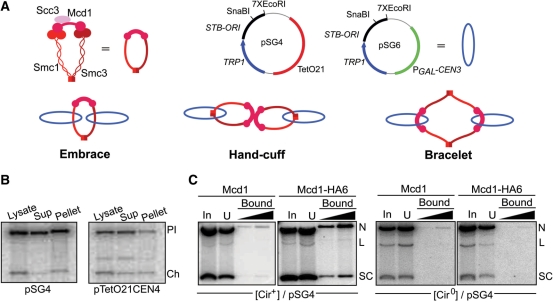
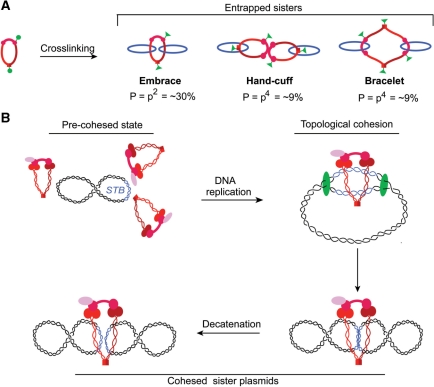
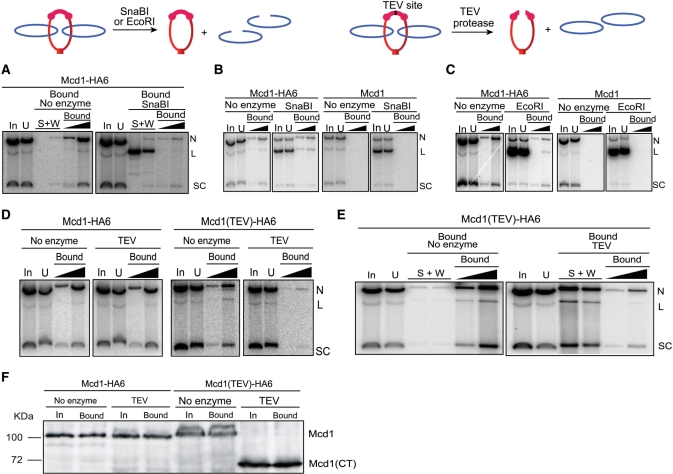
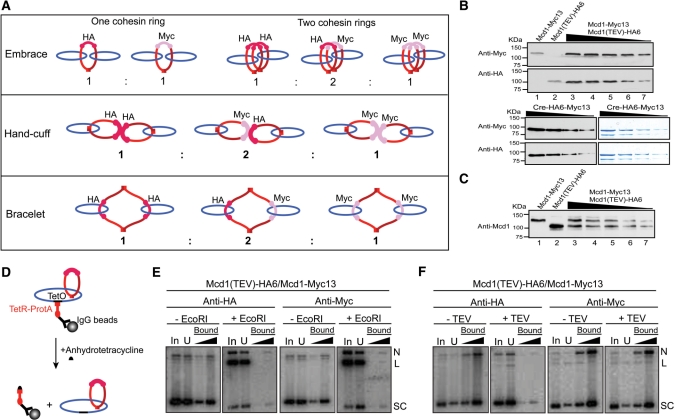
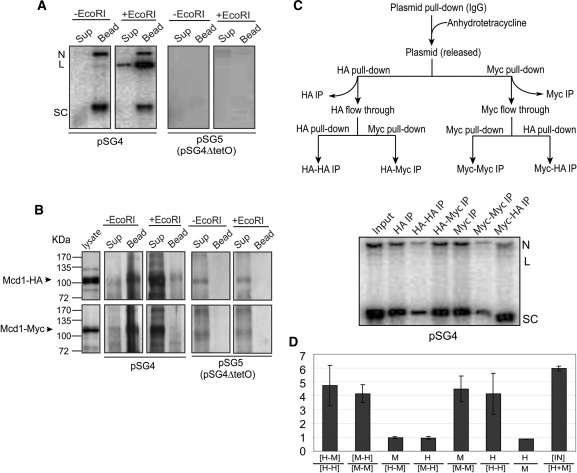
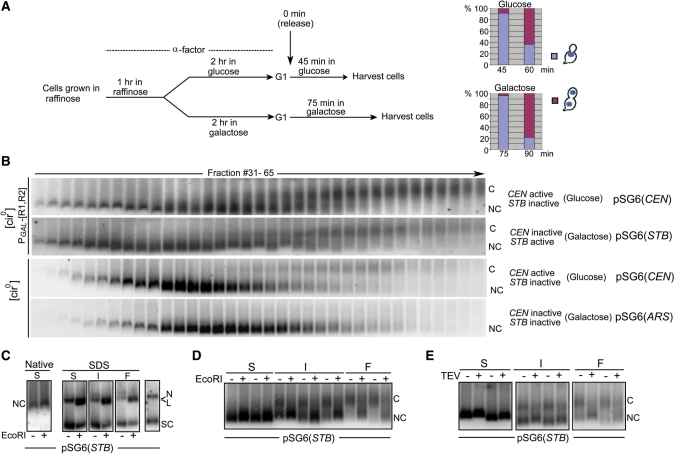
Sister chromatid cohesion, crucial for faithful segregation of replicated chromosomes in eukaryotes, is mediated by the multi-subunit protein complex cohesin. The Saccharomyces cerevisiae plasmid 2 micron circle mimics chromosomes in assembling cohesin at its partitioning locus. The plasmid is a multi-copy selfish DNA element that resides in the nucleus and propagates itself stably, presumably with assistance from cohesin. In metaphase cell lysates, or fractions enriched for their cohesed state by sedimentation, plasmid molecules are trapped topologically by the protein ring formed by cohesin. They can be released from cohesin's embrace either by linearizing the DNA or by cleaving a cohesin subunit. Assays using two distinctly tagged cohesin molecules argue against the hand-cuff (an associated pair of monomeric cohesin rings) or the bracelet (a dimeric cohesin ring) model as responsible for establishing plasmid cohesion. Our cumulative results most easily fit a model in which a single monomeric cohesin ring, rather than a series of such rings, conjoins a pair of sister plasmids. These features of plasmid cohesion account for its sister-to-sister mode of segregation by cohesin disassembly during anaphase. The mechanistic similarities of cohesion between mini-chromosome sisters and 2 micron plasmid sisters suggest a potential kinship between the plasmid partitioning locus and centromeres.
姐妹染色单体黏合对于真核生物中复制染色体的忠实分离至关重要,它是由多亚基蛋白复合物黏合蛋白介导的。酿酒酵母质粒 2 微米环在其分配位点模拟染色体组装黏合蛋白。该质粒是一种多拷贝自私 DNA 元件,存在于细胞核中,并通过黏合蛋白的帮助稳定地自我复制。在有丝分裂中期细胞裂解物或通过沉降富集其黏合状态的部分中,质粒分子通过由黏合蛋白形成的蛋白质环被拓扑地捕获。它们可以通过线性化 DNA 或切割黏合蛋白亚基从黏合蛋白的怀抱中释放出来。使用两种明显标记的黏合蛋白分子的测定方法表明,手铐(相关的一对单体黏合蛋白环)或手镯(二聚体黏合蛋白环)模型都不能负责建立质粒黏合。我们的累积结果最符合这样一种模型,即一个单体黏合蛋白环,而不是一系列这样的环,连接一对姐妹质粒。这些质粒黏合的特征解释了其通过有丝分裂后期黏合蛋白解聚的姐妹到姐妹的分离模式。小型染色体姐妹体和 2 微米质粒姐妹体之间黏合的机制相似,表明质粒分配位点与着丝粒之间存在潜在的亲缘关系。