Fujii Akira, Yasui-Furukori Norio, Nakagami Taku, Niioka Takenori, Saito Manabu, Sato Yasushi, Kaneko Sunao
Department of Neuropsychiatry, Hirosaki University School of Medicine, Hirosaki, Japan.
Drug Des Devel Ther. 2009 Feb 6;2:139-44. doi: 10.2147/dddt.s3556.
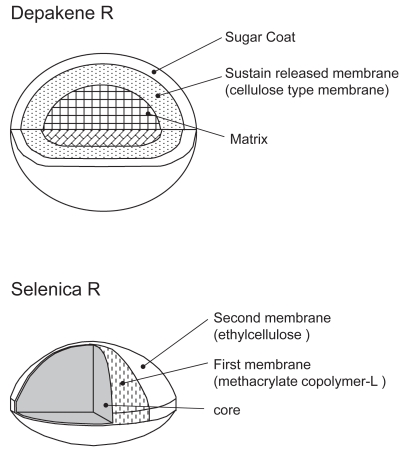
A study was conducted to establish the bioequivalence between different sustained-release formulations of valproic acid (Depakene R and Selenica R), which were developed in Japan.
The clinical investigation was designed in a randomized, crossover fashion with a single dose given to 12 healthy subjects. The subjects were administered a single 600 mg dose of valproic acid in one of two formulations. Serial venous blood samples were obtained over 72 hours after each administration to measure valproic acid in serum by enzyme immunoassay (EIA). In addition, a dissolution test was performed. Each sample was analyzed by an high-performance liquid chromatography to determine the dissolution rate of valproic acid.
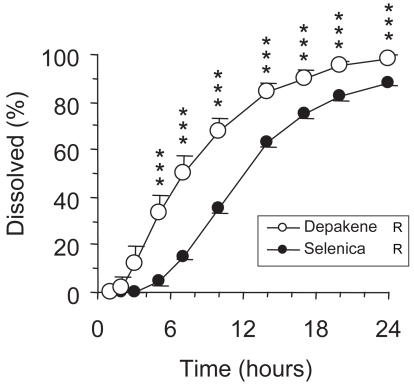
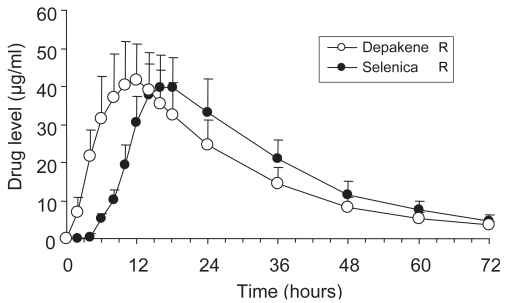
No difference in maximum concentration or area under the curve was found between the two formulations. The time to maximum concentration of the new formation was significantly delayed compared with the conventional formulation (10.8 +/- 1.7 versus 17.6 +/- 1.8 hours, p < 0.001). Apparent clearance or elimination half-life did not differ between the two formulations. An in vitro dissolution study showed that Depakene R was significantly more dissoluble than Selenica R.
Based on the results, the present study demonstrated a significant difference between the two sustained-release formulations in the absorption profile, and also demonstrated that the bioavailability of valproic acid in the two formulations was similar but absorption speed (lag time) was very different.
开展一项研究以确立在日本研发的丙戊酸不同缓释制剂(德巴金R和司利平R)之间的生物等效性。
临床研究采用随机交叉设计,对12名健康受试者给予单剂量药物。受试者以两种制剂之一接受600mg丙戊酸单剂量给药。每次给药后72小时内采集系列静脉血样,通过酶免疫分析法(EIA)测定血清中的丙戊酸。此外,进行了溶出度试验。每个样品通过高效液相色谱法进行分析,以确定丙戊酸的溶出速率。
两种制剂在最大浓度或曲线下面积方面未发现差异。新制剂达到最大浓度的时间与传统制剂相比显著延迟(10.8±1.7对17.6±1.8小时,p<0.001)。两种制剂在表观清除率或消除半衰期方面没有差异。体外溶出度研究表明,德巴金R的溶解性明显高于司利平R。
基于这些结果,本研究证明了两种缓释制剂在吸收曲线方面存在显著差异,并且还证明了两种制剂中丙戊酸的生物利用度相似,但吸收速度(滞后时间)差异很大。