Albert-Ludwigs-University Freiburg, Institute of Forest Botany and Tree Physiology, Chair of Tree Physiology, Georges-Köhler-Allee 053/054, Freiburg, Germany.
J Exp Bot. 2010;61(2):609-22. doi: 10.1093/jxb/erp327. Epub 2009 Nov 18.
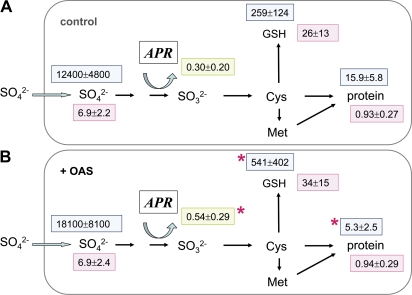
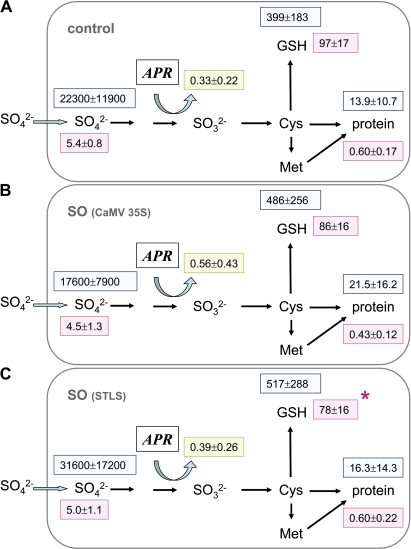
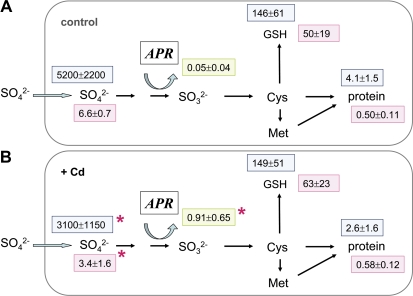
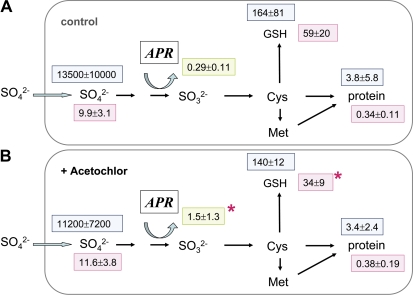
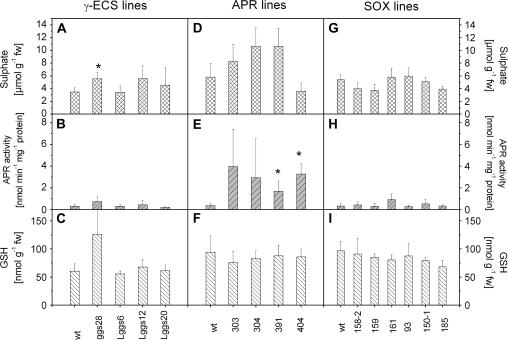
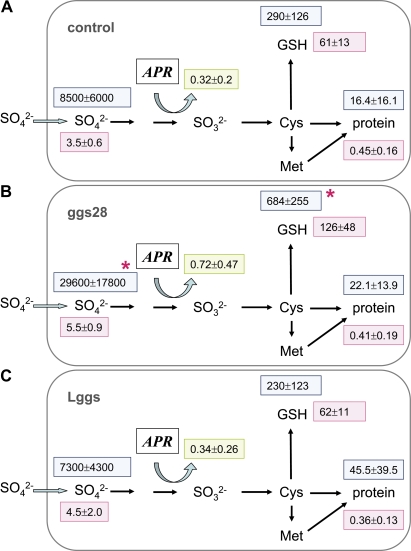
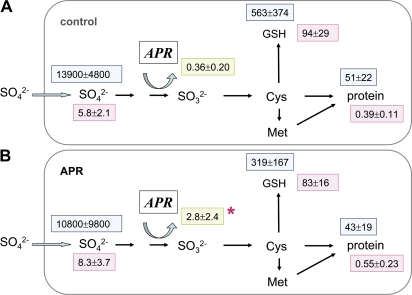
Sulphate assimilation provides reduced sulphur for the synthesis of cysteine, methionine, and numerous other essential metabolites and secondary compounds. The key step in the pathway is the reduction of activated sulphate, adenosine 5'-phosphosulphate (APS), to sulphite catalysed by APS reductase (APR). In the present study, [(35)S]sulphur flux from external sulphate into glutathione (GSH) and proteins was analysed to check whether APR controls the flux through the sulphate assimilation pathway in poplar roots under some stress conditions and in transgenic poplars. (i) O-Acetylserine (OAS) induced APR activity and the sulphur flux into GSH. (ii) The herbicide Acetochlor induced APR activity and results in a decline of GSH. Thereby the sulphur flux into GSH or protein remained unaffected. (iii) Cd treatment increased APR activity without any changes in sulphur flux but lowered sulphate uptake. Several transgenic poplar plants that were manipulated in sulphur metabolism were also analysed. (i) Transgenic poplar plants that overexpressed the gamma-glutamylcysteine synthetase (gamma-ECS) gene, the enzyme catalysing the key step in GSH formation, showed an increase in sulphur flux into GSH and sulphate uptake when gamma-ECS was targeted to the cytosol, while no changes in sulphur flux were observed when gamma-ECS was targeted to plastids. (ii) No effect on sulphur flux was observed when the sulphite oxidase (SO) gene from Arabidopsis thaliana, which catalyses the back reaction of APR, that is the reaction from sulphite to sulphate, was overexpressed. (iii) When Lemna minor APR was overexpressed in poplar, APR activity increased as expected, but no changes in sulphur flux were observed. For all of these experiments the flux control coefficient for APR was calculated. APR as a controlling step in sulphate assimilation seems obvious under OAS treatment, in gamma-ECS and SO overexpressing poplars. A possible loss of control under certain conditions, that is Cd treatment, Acetochlor treatment, and in APR overexpressing poplar, is discussed.
硫酸盐同化为半胱氨酸、蛋氨酸和许多其他必需代谢物和次生化合物的合成提供了还原硫。该途径的关键步骤是由腺苷 5'-磷酸硫酸盐(APS)还原酶(APR)催化将活化硫酸盐 APS 还原为亚硫酸盐。在本研究中,分析了从外部硫酸盐进入谷胱甘肽(GSH)和蛋白质的[(35)S]硫通量,以检查 APR 是否在某些胁迫条件下和在转基因杨树中控制硫酸盐同化途径中的通量。(i)O-乙酰丝氨酸(OAS)诱导 APR 活性和 GSH 中的硫通量。(ii)除草剂乙草胺诱导 APR 活性并导致 GSH 下降。因此,GSH 或蛋白质中的硫通量不受影响。(iii)Cd 处理增加了 APR 活性,而硫酸盐摄取量没有变化。还分析了一些在硫代谢中受到操作的转基因杨树植物。(i)过表达 γ-谷氨酰半胱氨酸合成酶(γ-ECS)基因的转基因杨树植物,该酶催化 GSH 形成的关键步骤,当 γ-ECS 靶向细胞质时,GSH 中的硫通量和硫酸盐摄取量增加,而当 γ-ECS 靶向质体时,硫通量没有变化。(ii)当拟南芥亚硫酸盐氧化酶(SO)基因过表达时,该基因催化 APR 的逆反应,即从亚硫酸盐到硫酸盐的反应,硫通量没有变化。(iii)当在杨树中过表达小浮萍 APR 时,APR 活性如预期的那样增加,但硫通量没有变化。对于所有这些实验,都计算了 APR 的通量控制系数。在 OAS 处理、γ-ECS 和 SO 过表达的杨树中,APR 似乎是硫酸盐同化的控制步骤。在某些条件下,例如 Cd 处理、乙草胺处理和 APR 过表达的杨树中,可能会失去控制。