Division of Chemistry and Structural Biology, Institute for Molecular Bioscience, University of Queensland, Brisbane, Queensland, Australia.
PLoS One. 2009 Nov 16;4(11):e7851. doi: 10.1371/journal.pone.0007851.
Protein crystallisation screening involves the parallel testing of large numbers of candidate conditions with the aim of identifying conditions suitable as a starting point for the production of diffraction quality crystals. Generally, condition screening is performed in 96-well plates. While previous studies have examined the effects of protein construct, protein purity, or crystallisation condition ingredients on protein crystallisation, few have examined the effect of the crystallisation plate.
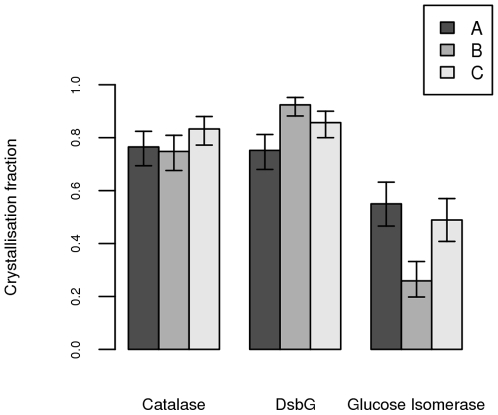
METHODOLOGY/PRINCIPAL FINDINGS: We performed a statistically rigorous examination of protein crystallisation, and evaluated interactions between crystallisation success and plate row/column, different plates of same make, different plate makes and different proteins. From our analysis of protein crystallisation, we found a significant interaction between plate make and the specific protein being crystallised.
CONCLUSIONS/SIGNIFICANCE: Protein crystal structure determination is the principal method for determining protein structure but is limited by the need to produce crystals of the protein under study. Many important proteins are difficult to crystallize, so that identification of factors that assist crystallisation could open up the structure determination of these more challenging targets. Our findings suggest that protein crystallisation success may be improved by matching a protein with its optimal plate make.
蛋白质结晶筛选涉及大量候选条件的平行测试,目的是确定适合作为产生衍射质量晶体起点的条件。通常,在 96 孔板中进行条件筛选。虽然以前的研究已经研究了蛋白质结构、蛋白质纯度或结晶条件成分对蛋白质结晶的影响,但很少有研究检查结晶板的影响。
方法/主要发现:我们对蛋白质结晶进行了严格的统计检验,并评估了结晶成功率与板行/列、同品牌的不同板、不同品牌的板和不同蛋白质之间的相互作用。通过对蛋白质结晶的分析,我们发现板品牌与正在结晶的特定蛋白质之间存在显著的相互作用。
结论/意义:蛋白质晶体结构测定是确定蛋白质结构的主要方法,但受到需要产生研究中蛋白质晶体的限制。许多重要的蛋白质难以结晶,因此确定有助于结晶的因素可能会为这些更具挑战性的目标的结构确定开辟道路。我们的研究结果表明,通过将蛋白质与最佳的板品牌相匹配,可以提高蛋白质结晶的成功率。