Center for Cancer Genome Discovery, Dana-Farber Cancer Institute and Harvard Medical School, Boston, Massachusetts, USA.
PLoS One. 2009 Nov 18;4(11):e7887. doi: 10.1371/journal.pone.0007887.
Detection of critical cancer gene mutations in clinical tumor specimens may predict patient outcomes and inform treatment options; however, high-throughput mutation profiling remains underdeveloped as a diagnostic approach. We report the implementation of a genotyping and validation algorithm that enables robust tumor mutation profiling in the clinical setting.
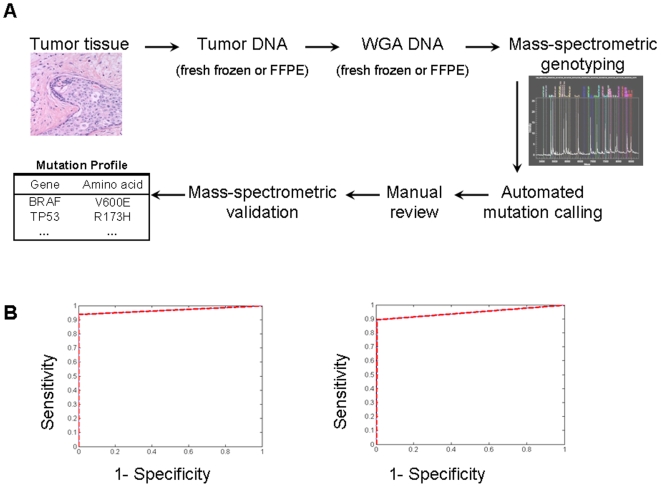
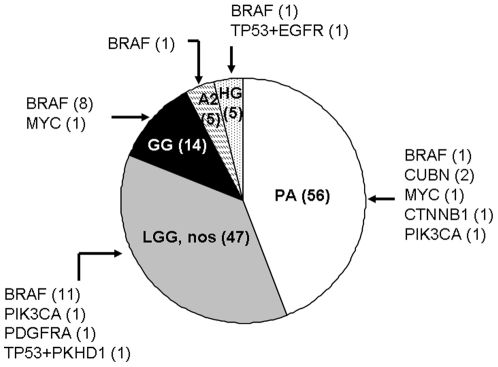
We developed and implemented an optimized mutation profiling platform ("OncoMap") to interrogate approximately 400 mutations in 33 known oncogenes and tumor suppressors, many of which are known to predict response or resistance to targeted therapies. The performance of OncoMap was analyzed using DNA derived from both frozen and FFPE clinical material in a diverse set of cancer types. A subsequent in-depth analysis was conducted on histologically and clinically annotated pediatric gliomas. The sensitivity and specificity of OncoMap were 93.8% and 100% in fresh frozen tissue; and 89.3% and 99.4% in FFPE-derived DNA. We detected known mutations at the expected frequencies in common cancers, as well as novel mutations in adult and pediatric cancers that are likely to predict heightened response or resistance to existing or developmental cancer therapies. OncoMap profiles also support a new molecular stratification of pediatric low-grade gliomas based on BRAF mutations that may have immediate clinical impact.
Our results demonstrate the clinical feasibility of high-throughput mutation profiling to query a large panel of "actionable" cancer gene mutations. In the future, this type of approach may be incorporated into both cancer epidemiologic studies and clinical decision making to specify the use of many targeted anticancer agents.
在临床肿瘤标本中检测关键癌症基因突变可以预测患者的预后,并为治疗方案提供信息;然而,高通量突变分析作为一种诊断方法仍未得到充分发展。我们报告了一种基因分型和验证算法的实施情况,该算法可在临床环境中实现稳健的肿瘤突变分析。
我们开发并实施了一种优化的突变分析平台(“OncoMap”),以检测 33 个已知致癌基因和肿瘤抑制基因中的大约 400 个突变,其中许多突变已知可预测对靶向治疗的反应或耐药性。使用来自不同癌症类型的冷冻和 FFPE 临床标本分析了 OncoMap 的性能。随后对组织学和临床注释的儿科脑肿瘤进行了深入分析。在新鲜冷冻组织中,OncoMap 的灵敏度和特异性分别为 93.8%和 100%;在 FFPE 衍生的 DNA 中分别为 89.3%和 99.4%。我们在常见癌症中检测到了预期频率的已知突变,以及在成人和儿科癌症中可能预测对现有或开发中的癌症治疗反应增强或耐药的新突变。OncoMap 图谱还支持基于 BRAF 突变的儿科低级别脑肿瘤的新分子分层,这可能具有直接的临床影响。
我们的结果证明了高通量突变分析查询大量“可操作”癌症基因突变的临床可行性。在未来,这种方法可能会被纳入癌症流行病学研究和临床决策中,以指定许多靶向抗癌药物的使用。