Pharmacology Institute, University of Heidelberg, Im Neuenheimer Feld 366, 69120 Heidelberg, Germany.
Mol Pain. 2009 Nov 19;5:68. doi: 10.1186/1744-8069-5-68.
gamma-aminobutyric acid (GABA) is an important inhibitory neurotransmitter which mainly mediates its effects on neurons via ionotropic (GABA(A)) and metabotropic (GABA(B)) receptors. GABA(B) receptors are widely expressed in the central and the peripheral nervous system. Although there is evidence for a key function of GABA(B) receptors in the modulation of pain, the relative contribution of peripherally- versus centrally-expressed GABA(B) receptors is unclear.
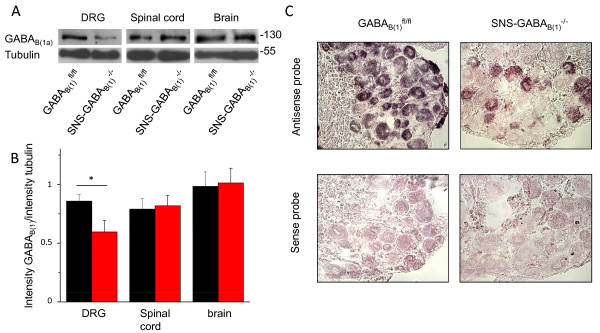
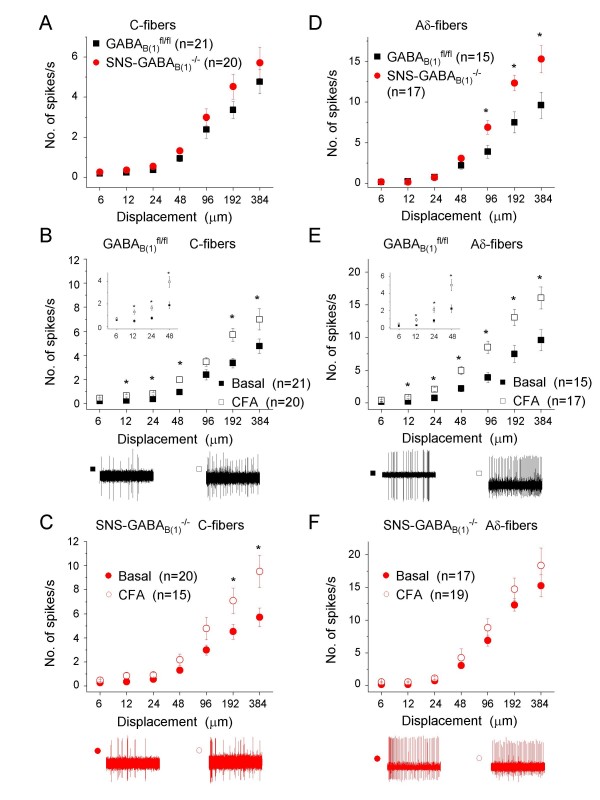
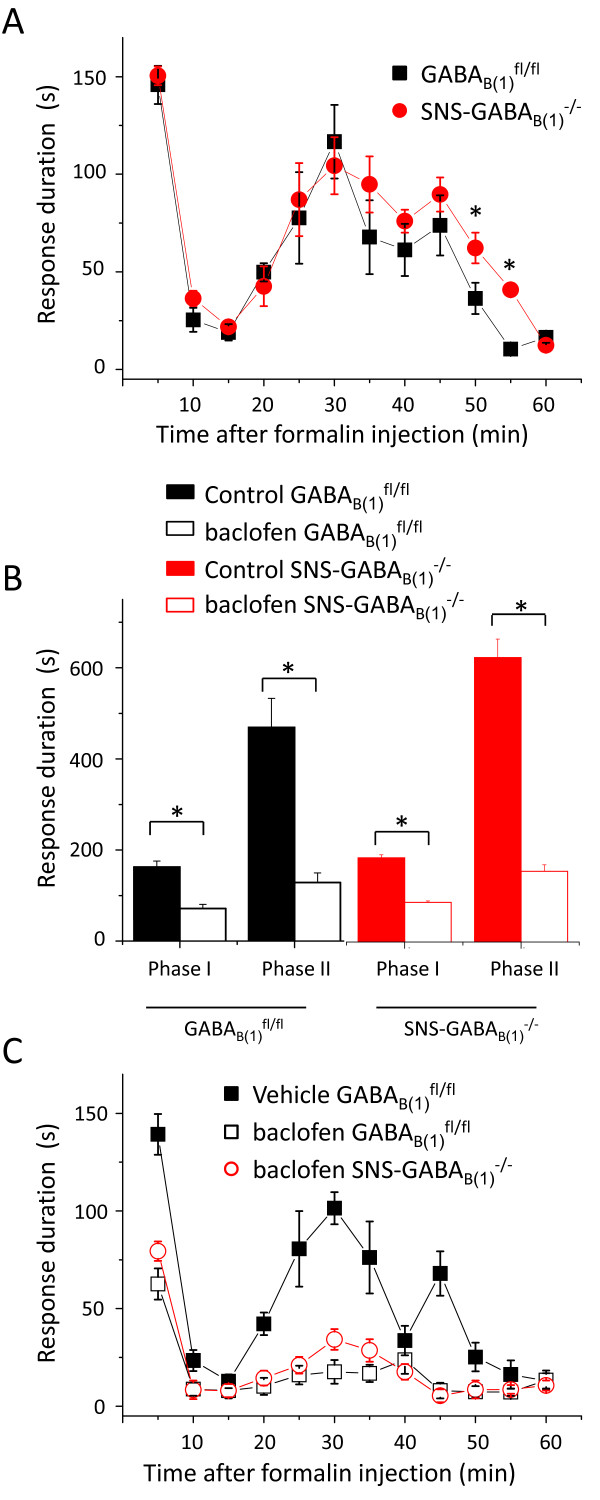
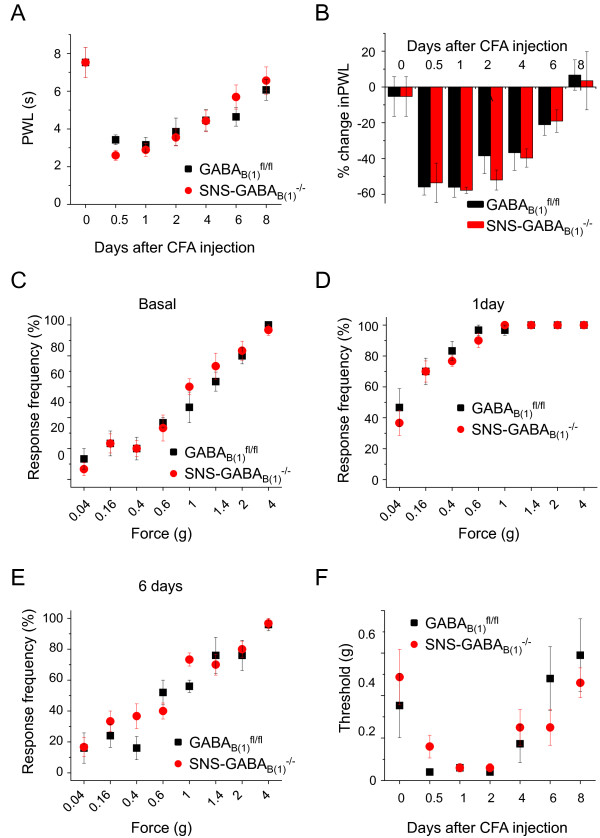
In order to elucidate the functional relevance of GABA(B) receptors expressed in peripheral nociceptive neurons in pain modulation we generated and analyzed conditional mouse mutants lacking functional GABA(B1) subunit specifically in nociceptors, preserving expression in the spinal cord and brain (SNS-GABA(B1)-/- mice). Lack of the GABA(B1) subunit precludes the assembly of functional GABA(B) receptor. We analyzed SNS-GABA(B1)-/- mice and their control littermates in several models of acute and neuropathic pain. Electrophysiological studies on peripheral afferents revealed higher firing frequencies in SNS-GABA(B1)-/- mice compared to corresponding control littermates. However no differences were seen in basal nociceptive sensitivity between these groups. The development of neuropathic and chronic inflammatory pain was similar across the two genotypes. The duration of nocifensive responses evoked by intraplantar formalin injection was prolonged in the SNS-GABAB(1)-/- animals as compared to their control littermates. Pharmacological experiments revealed that systemic baclofen-induced inhibition of formalin-induced nociceptive behaviors was not dependent upon GABA(B1) expression in nociceptors.
This study addressed contribution of GABA(B) receptors expressed on primary afferent nociceptive fibers to the modulation of pain. We observed that neither the development of acute and chronic pain nor the analgesic effects of a systematically-delivered GABA(B) agonist was significantly changed upon a specific deletion of GABA(B) receptors from peripheral nociceptive neurons in vivo. This lets us conclude that GABA(B) receptors in the peripheral nervous system play a less important role than those in the central nervous system in the regulation of pain.
γ-氨基丁酸(GABA)是一种重要的抑制性神经递质,主要通过离子型(GABA(A))和代谢型(GABA(B))受体来介导其对神经元的作用。GABA(B)受体广泛表达于中枢和外周神经系统。尽管有证据表明 GABA(B)受体在疼痛调节中具有关键功能,但外周表达的 GABA(B)受体与中枢表达的 GABA(B)受体的相对贡献尚不清楚。
为了阐明在外周伤害性神经元中表达的 GABA(B)受体在疼痛调节中的功能相关性,我们生成并分析了特异性缺失伤害感受器中功能性 GABA(B1)亚基的条件性小鼠突变体,保留了脊髓和大脑中的表达(SNS-GABA(B1)-/- 小鼠)。缺乏 GABA(B1)亚基会阻止功能性 GABA(B)受体的组装。我们分析了 SNS-GABA(B1)-/- 小鼠及其对照同窝仔鼠在几种急性和神经性疼痛模型中的表现。对周围传入神经的电生理研究显示,SNS-GABA(B1)-/- 小鼠的放电频率高于相应的对照同窝仔鼠。然而,这两组之间的基础痛觉敏感性没有差异。两种基因型的神经性和慢性炎症性疼痛的发展相似。足底福尔马林注射引起的伤害性反应持续时间在 SNS-GABAB(1)-/- 动物中比对照同窝仔鼠延长。药理学实验表明,全身性巴氯芬诱导的福尔马林诱导的伤害性行为抑制不依赖于伤害感受器中 GABA(B1)的表达。
本研究探讨了表达在外周伤害性传入纤维上的 GABA(B)受体对疼痛调节的贡献。我们观察到,在体内特异性缺失外周伤害性神经元中的 GABA(B)受体后,急性和慢性疼痛的发展以及系统性给予 GABA(B)激动剂的镇痛作用均无明显变化。这让我们得出结论,外周神经系统中的 GABA(B)受体在疼痛调节中的作用不如中枢神经系统中的 GABA(B)受体重要。