Department of Chemistry, Stanford University, Stanford, California 94305-5080, USA.
J Am Chem Soc. 2009 Dec 30;131(51):18343-57. doi: 10.1021/ja9053948.
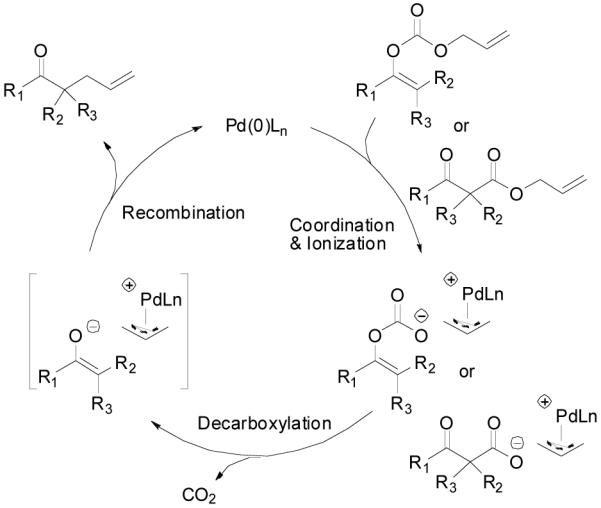
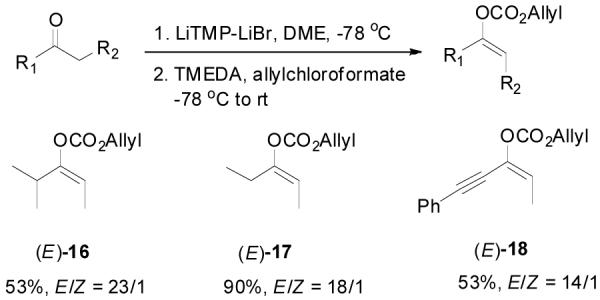
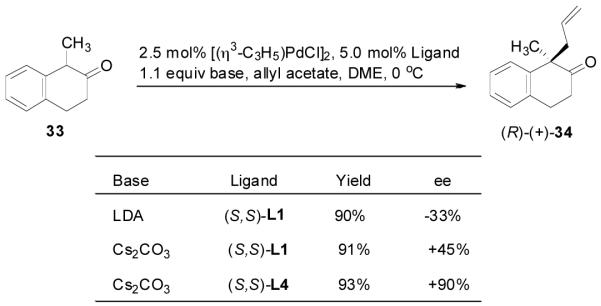
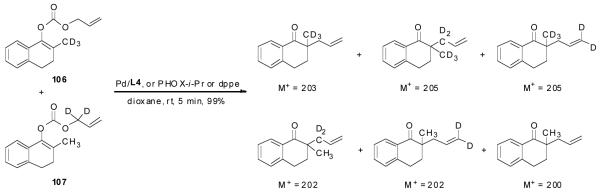
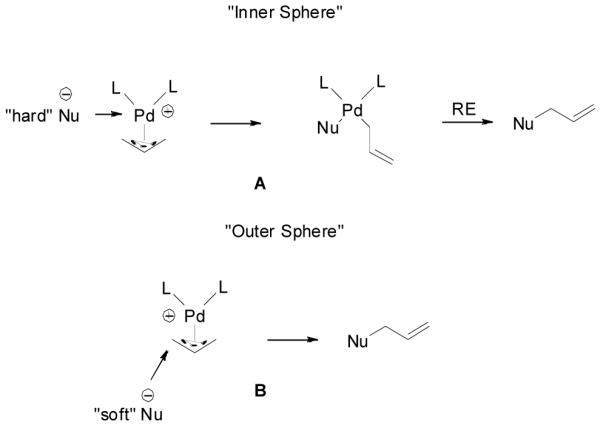
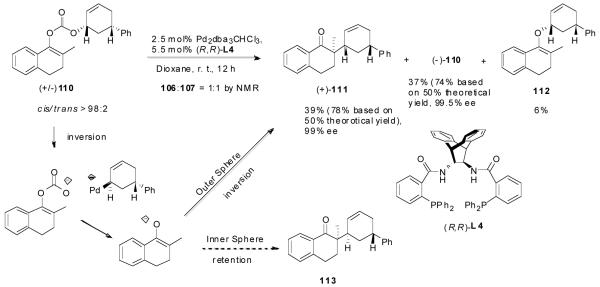
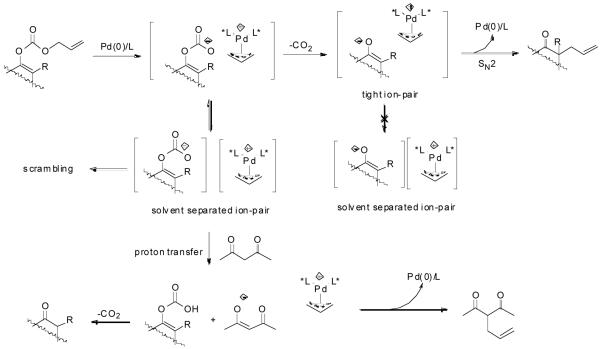
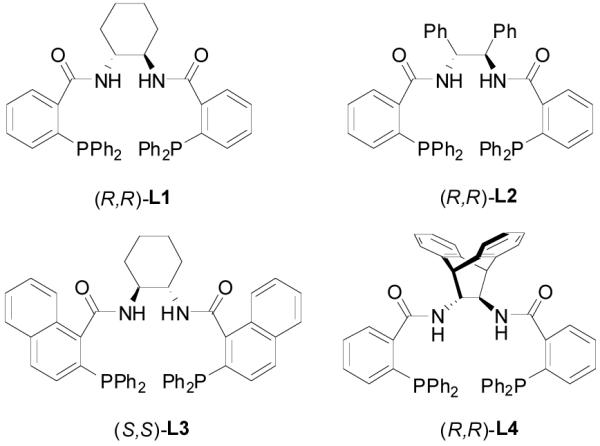
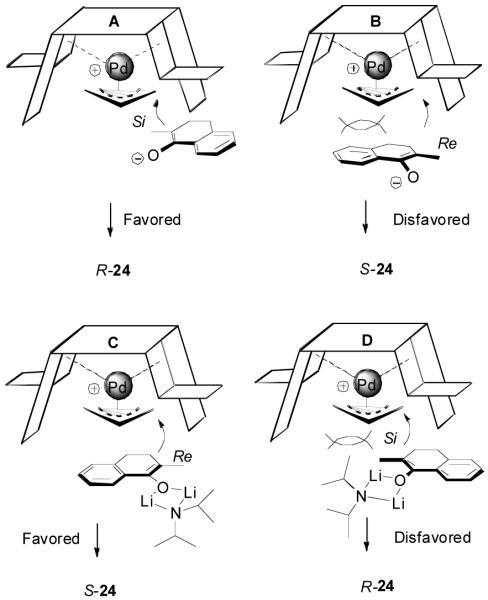
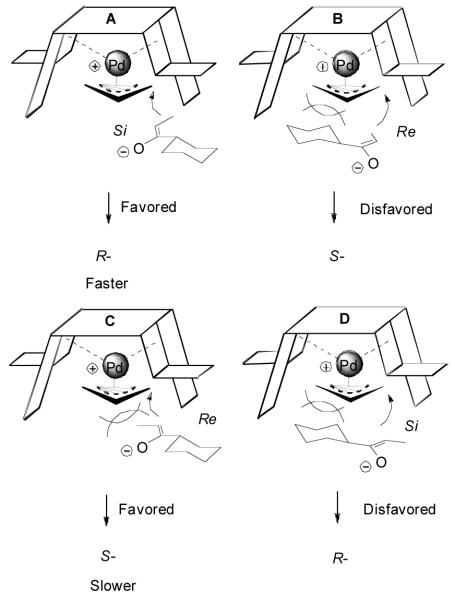
Palladium-catalyzed decarboxylative asymmetric allylic alkylation (DAAA) of allyl enol carbonates as a highly chemo-, regio-, and enantioselective process for the synthesis of ketones bearing either a quaternary or a tertiary alpha-stereogenic center has been investigated in detail. Chiral ligand L4 was found to be optimal in the DAAA of a broad scope of cyclic and acyclic ketones including simple aliphatic ketones with more than one enolizable proton. The allyl moiety of the carbonates has been extended to a variety of cyclic or acyclic disubstituted allyl groups. Our mechanistic studies reveal that, similar to the direct allylation of lithium enolates, the DAAA reaction proceeds through an "outer sphere" S(N)2 type of attack on the pi-allylpalladium complex by the enolate. An important difference between the DAAA reaction and the direct allylation of lithium enolates is that in the DAAA reaction, the nucleophile and the electrophile were generated simultaneously. Since the pi-allylpalladium cation must serve as the counterion for the enolate, the enolate probably exists as a tight-ion-pair. This largely prevents the common side reactions of enolates associated with the equilibrium between different enolates. The much milder reaction conditions as well as the much broader substrate scope also represent the advantages of the DAAA reaction over the direct allylation of preformed metal enolates.
钯催化的脱羧不对称烯丙基烷基化(DAAA)反应作为一种高化学选择性、区域选择性和对映选择性的方法,已经被广泛用于合成具有季碳或叔碳手性中心的酮。研究发现,手性配体 L4 是环状和非环状酮的 DAAA 反应的最佳配体,包括具有多个烯醇质子的简单脂肪酮。碳酸烯丙酯的烯丙基部分可以扩展到各种环状或非环状的二取代烯丙基基团。我们的机理研究表明,与锂烯醇化物的直接烷基化反应类似,DAAA 反应通过烯醇化物对 π-烯丙基钯配合物的“外球”S(N)2 型进攻进行。DAAA 反应与锂烯醇化物的直接烷基化反应的一个重要区别是,在 DAAA 反应中,亲核试剂和亲电试剂是同时生成的。由于 π-烯丙基钯阳离子必须作为烯醇化物的抗衡离子,因此烯醇化物可能以紧密的离子对形式存在。这在很大程度上防止了与不同烯醇化物之间的平衡有关的烯醇化物的常见副反应。DAAA 反应的反应条件要温和得多,底物范围也要广得多,这也代表了它优于预形成的金属烯醇化物的直接烷基化反应的优势。