Laboratory of Cancer Genetics, Cancer Research Institute of Slovak Academy of Sciences, Vlarska 7, 833 91 Bratislava, Slovak Republic.
BMC Cancer. 2009 Nov 20;9:405. doi: 10.1186/1471-2407-9-405.
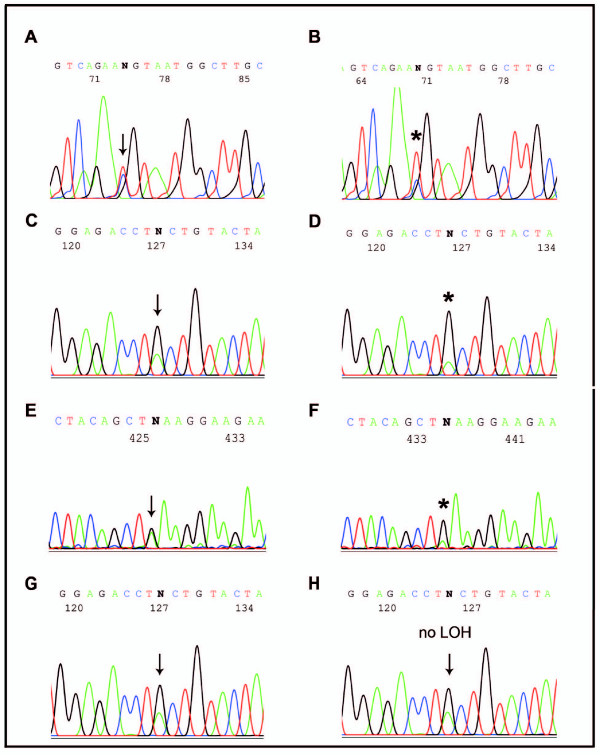
Depending on the population studied, large genomic rearrangements (LGRs) of the mismatch repair (MMR) genes constitute various proportions of the germline mutations that predispose to hereditary non-polyposis colorectal cancer (HNPCC). It has been reported that loss of heterozygosity (LOH) at the LGR region occurs through a gene conversion mechanism in tumors from MLH1/MSH2 deletion carriers; however, the converted tracts were delineated only by extragenic microsatellite markers. We sought to determine the frequency of LGRs in Slovak HNPCC patients and to study LOH in tumors from LGR carriers at the LGR region, as well as at other heterozygous markers within the gene to more precisely define conversion tracts.
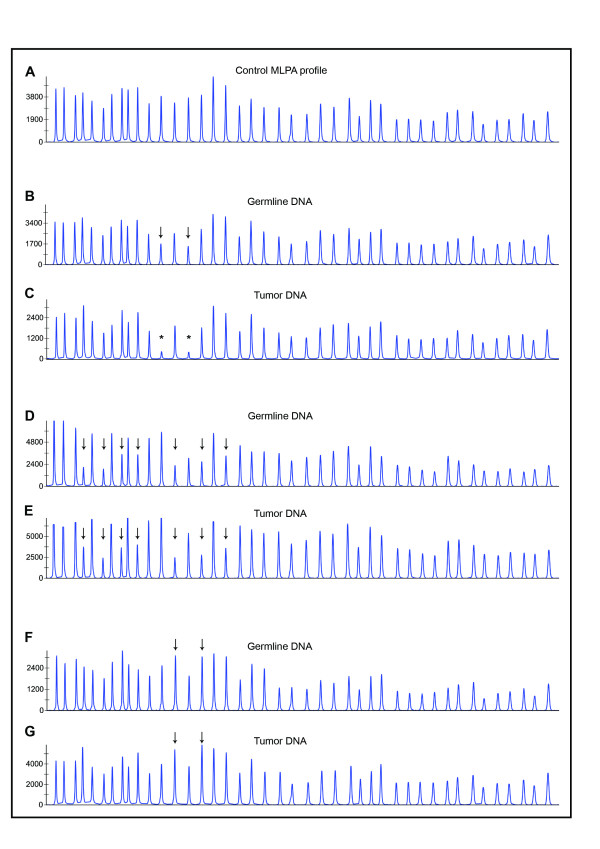
The main MMR genes responsible for HNPCC, MLH1, MSH2, MSH6, and PMS2, were analyzed by MLPA (multiplex ligation-dependent probe amplification) in a total of 37 unrelated HNPCC-suspected patients whose MLH1/MSH2 genes gave negative results in previous sequencing experiments. An LOH study was performed on six tumors from LGR carriers by combining MLPA to assess LOH at LGR regions and sequencing to examine LOH at 28 SNP markers from the MLH1 and MSH2 genes.
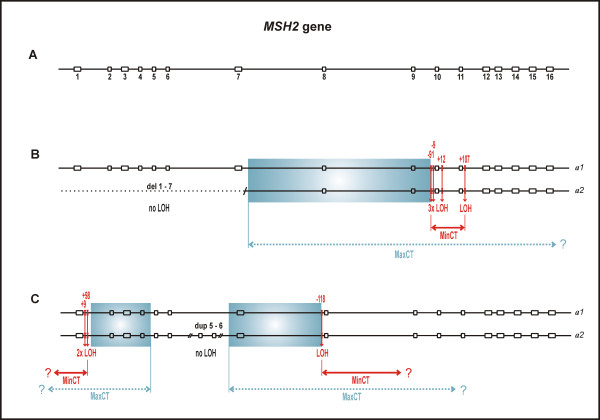
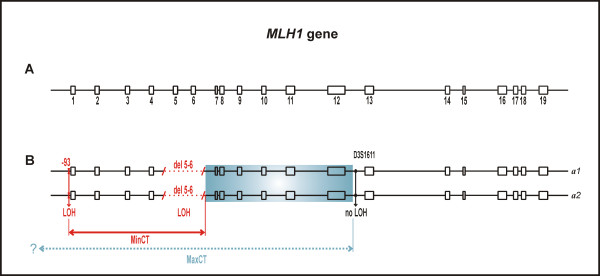
We found six rearrangements in the MSH2 gene (five deletions and dup5-6), and one aberration in the MLH1 gene (del5-6). The MSH2 deletions were of three types (del1, del1-3, del1-7). We detected LOH at the LGR region in the single MLH1 case, which was determined in a previous study to be LOH-negative in the intragenic D3S1611 marker. Three tumors displayed LOH of at least one SNP marker, including two cases that were LOH-negative at the LGR region.
LGRs accounted for 25% of germline MMR mutations identified in 28 Slovakian HNPCC families. A high frequency of LGRs among the MSH2 mutations provides a rationale for a MLPA screening of the Slovakian HNPCC families prior scanning by DNA sequencing. LOH at part of the informative loci confined to the MLH1 or MSH2 gene (heterozygous LGR region, SNP, or microsatellite) is a novel finding and can be regarded as a partial LOH. The conversion begins within the gene, and the details of conversion tracts are discussed for each case.
根据研究人群的不同,错配修复(MMR)基因的大片段基因重排(LGR)构成了易患遗传性非息肉病结直肠癌(HNPCC)的种系突变的各种比例。据报道,在 MLH1/MSH2 缺失携带者的肿瘤中,LGR 区域的杂合性丢失(LOH)通过基因转换机制发生;然而,转换片段仅通过基因外微卫星标记来描绘。我们试图确定斯洛伐克 HNPCC 患者中 LGR 的频率,并研究 LGR 携带者肿瘤中的 LOH 在 LGR 区域以及基因内其他杂合标记处,以更精确地定义转换片段。
通过多重连接依赖性探针扩增(MLPA)分析负责 HNPCC 的主要 MMR 基因 MLH1、MSH2、MSH6 和 PMS2,共分析了 37 名先前测序实验中 MLH1/MSH2 基因呈阴性结果的无关联 HNPCC 疑似患者。对 6 名 LGR 携带者的肿瘤进行 LOH 研究,结合 MLPA 评估 LGR 区域的 LOH,并对 MLH1 和 MSH2 基因的 28 个 SNP 标记进行测序以检测 LOH。
我们在 MSH2 基因中发现了 6 个重排(5 个缺失和 dup5-6),在 MLH1 基因中发现了 1 个异常(del5-6)。MSH2 缺失有三种类型(del1、del1-3、del1-7)。我们在单个 MLH1 病例中检测到 LGR 区域的 LOH,该病例在先前的研究中被确定为基因内 D3S1611 标记的 LOH 阴性。3 个肿瘤显示至少一个 SNP 标记的 LOH,包括两个 LGR 区域 LOH 阴性的病例。
LGRs 占 28 个斯洛伐克 HNPCC 家族中鉴定的种系 MMR 突变的 25%。MSH2 突变中 LGRs 的高频率为斯洛伐克 HNPCC 家族的 MLPA 筛查提供了依据,然后再进行 DNA 测序。部分信息性位点的 LOH 局限于 MLH1 或 MSH2 基因(杂合 LGR 区域、SNP 或微卫星)是一个新发现,可以视为部分 LOH。转换始于基因内,并针对每个病例讨论转换片段的细节。