Department of Molecular Physiology and Biophysics, Carver College of Medicine, University of Iowa, Iowa City, IA, USA.
Reprod Biol Endocrinol. 2009 Nov 23;7:131. doi: 10.1186/1477-7827-7-131.
One determinant of the total K+ myometrial smooth muscle cell (MSMC) current is the large conductance, calcium- and voltage-activated potassium channel (maxi-K channel). This channel provides a repolarizing current in response to excitatory stimuli, most notably in response to increases in the levels of intracellular Ca2+, and blocking the channel by pharmacological means induces the depolarization of MSMCs and also enhances contraction strength. In MSMCs, maxi-K channels can reside in the caveolae, where they associate with the scaffolding protein caveolin-1 (cav-1). The aim of this study was to investigate the consequences of this interaction - more specifically, how disruption of the association between the maxi-K channel and cav-1 may influence the current expression and excitability of myometrial cells - with the aim of better understanding the mechanisms that underlie the regulation of normal and aberrant uterine function.
Myometrial biopsies were collected from women undergoing elective C-sections. From these samples, myometrial cells were isolated, cultured, infected with a virus containing either caveolin-1 (cav-1) siRNA or scrambled cav-1 siRNA, and finally subjected to patch-clamp analysis. Mutant caveolin-binding site maxi-K channel constructs were generated and transfected into mouse Ltk- fibroblasts. Channel activity, expression, association, and localization were examined by patch-clamping, Western blot, immunoprecipitation, and immunofluorescence, respectively.
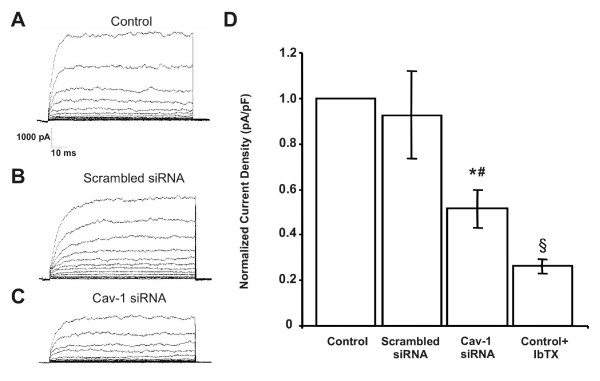
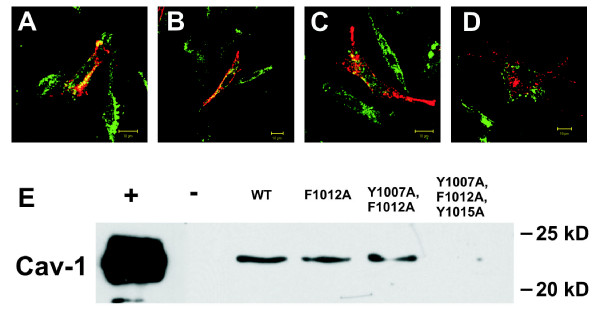
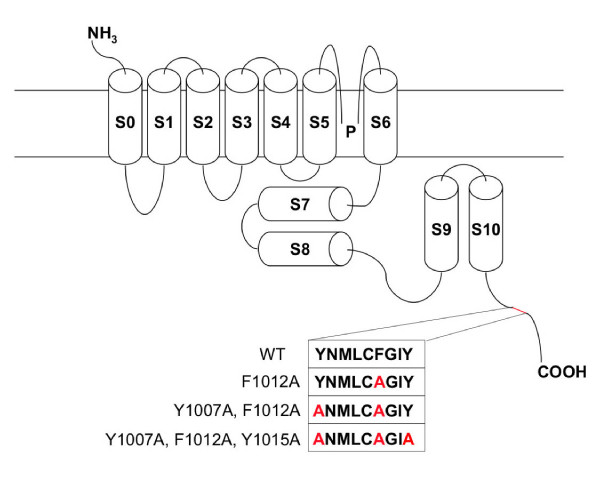
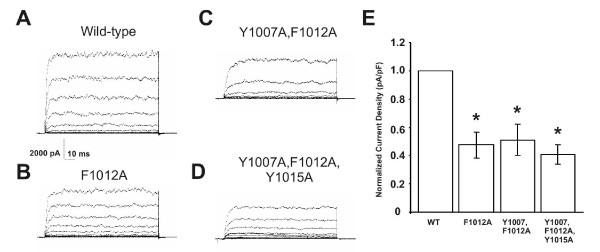
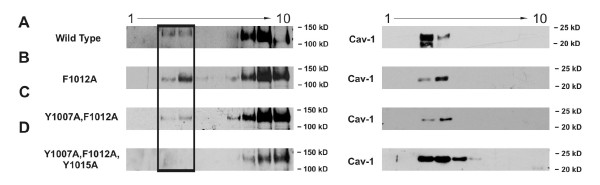
The caveolin-1 siRNA suppressed the total K+ current in human myometrial smooth muscle cells (hMSMC), as evident from comparison to the currents generated by both non-infected cells and cells infected with scrambled siRNA controls. The interaction between the maxi-K channel and caveolin depends on a region in the channel's C-terminal caveolin-binding site. Mutations of aromatic residues in this site (mutant F1012A, mutant Y1007A, F1012A and mutant Y1007A, F1012A, Y1015A) resulted in a decrease in K+ current compared to that produced by wild-type channels transfected into mouse Ltk- fibroblasts. However, mutation of all three aromatic amino acids (mutant Y1007A, F1012A, Y1015A) was necessary to disrupt the association between caveolin and the maxi-K channel, as visualized by immunofluorescence and immunoprecipitation.
Our results suggest that disruption of the caveolin-binding site interferes with the cav-1/maxi-K channel interaction, and that lack of the cav-1/maxi-K channel interaction in MSMCs attenuates the total K+ channel current of the cell.
总钾离子肌平滑肌细胞(MSMC)电流的一个决定因素是大电导、钙激活和电压激活钾通道(maxi-K 通道)。该通道在响应兴奋性刺激时提供去极化电流,特别是在细胞内 Ca2+水平增加时,通过药理学手段阻断通道会导致 MSMCs 去极化,并增强收缩强度。在 MSMCs 中,maxi-K 通道可以存在于 caveolae 中,在那里它们与支架蛋白 caveolin-1(cav-1)相关联。本研究的目的是研究这种相互作用的后果 - 更具体地说,如何破坏 maxi-K 通道和 cav-1 之间的关联可能会影响子宫细胞的电流表达和兴奋性 - 以便更好地理解正常和异常子宫功能调节的机制。
从接受选择性剖腹产的女性中收集子宫活检。从这些样本中分离培养了子宫细胞,并用含有 caveolin-1(cav-1)siRNA 或乱序 cav-1 siRNA 的病毒感染,最后进行了膜片钳分析。生成了突变的 caveolin 结合位点 maxi-K 通道构建体,并转染到小鼠 Ltk-成纤维细胞中。通过膜片钳、Western blot、免疫沉淀和免疫荧光分别检查通道活性、表达、关联和定位。
与非感染细胞和感染乱序 siRNA 对照的细胞产生的电流相比,cav-1 siRNA 抑制了人子宫平滑肌细胞(hMSMC)中的总钾电流。maxi-K 通道和 caveolin 之间的相互作用取决于通道 C 末端 caveolin 结合位点的一个区域。该位点的芳香族残基突变(突变 F1012A、突变 Y1007A、突变 F1012A 和突变 Y1007A、突变 F1012A、突变 Y1015A)导致与转染到小鼠 Ltk-成纤维细胞的野生型通道产生的钾电流相比减少。然而,只有突变所有三个芳香族氨基酸(突变 Y1007A、F1012A、Y1015A)才能破坏免疫荧光和免疫沉淀观察到的 caveolin 与 maxi-K 通道之间的关联。
我们的结果表明,破坏 caveolin 结合位点会干扰 cav-1/maxi-K 通道相互作用,而 MSMCs 中 cav-1/maxi-K 通道相互作用的缺失会减弱细胞的总钾通道电流。