The George and Jean Brumley, Jr, Neonatal-Perinatal Research Institute, Division of Neonatology/Department of Pediatrics, Duke University Medical Center, Box 2635, Durham, NC 27710, USA.
J Biomed Sci. 2009 Nov 23;16(1):104. doi: 10.1186/1423-0127-16-104.
Background K+ channels are the principal determinants of the resting membrane potential (RMP) in cardiac myocytes and thus, influence the magnitude and time course of the action potential (AP).
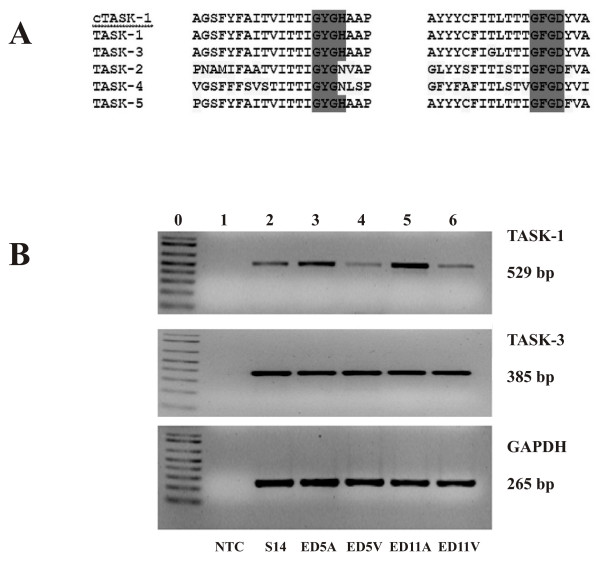
RT-PCR and in situ hybridization are used to study the distribution of TASK-1 and whole-cell patch clamp technique is employed to determine the functional expression of TASK-1 in embryonic chick heart.
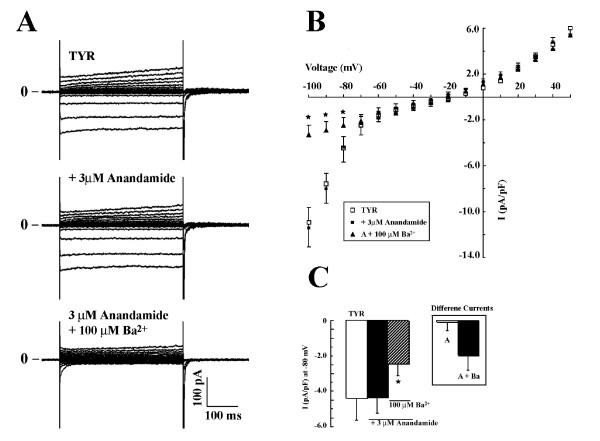
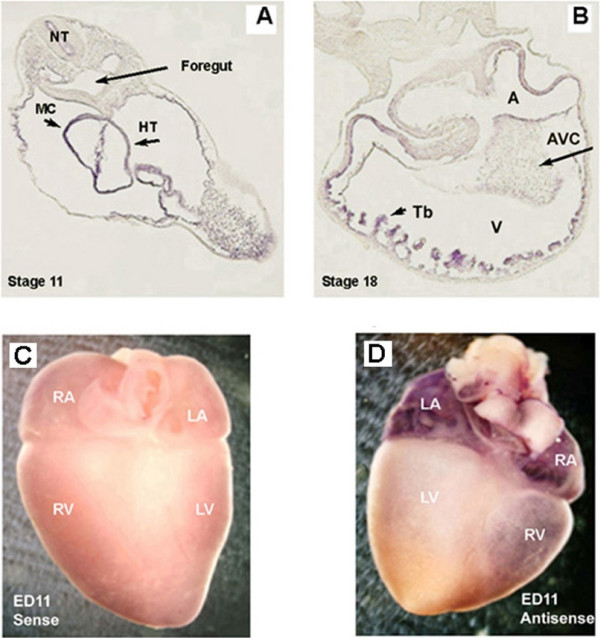
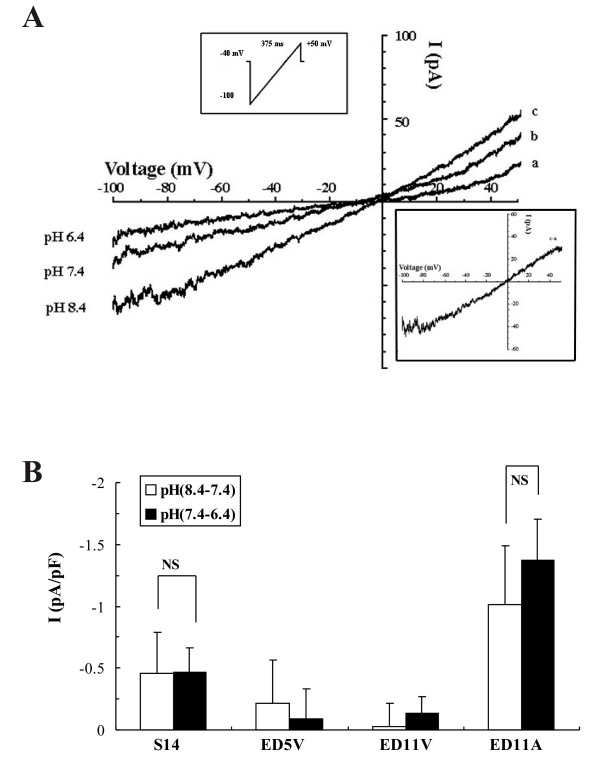
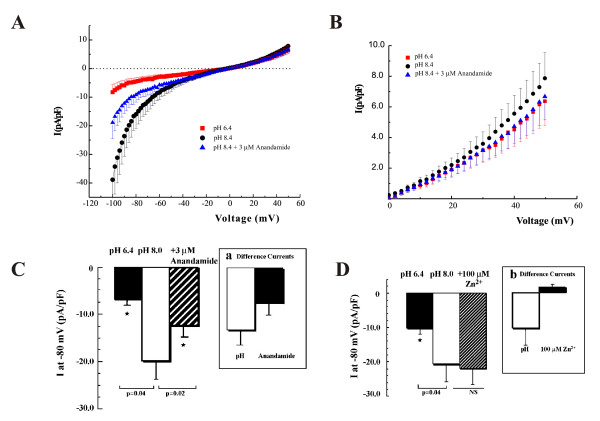
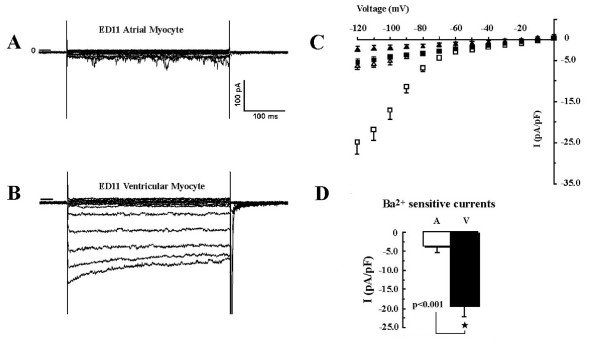
Chicken TASK-1 was expressed in the early tubular heart, then substantially decreased in the ventricles by embryonic day 5 (ED5), but remained relatively high in ED5 and ED11 atria. Unlike TASK-1, TASK-3 was uniformly expressed in heart at all developmental stages. In situ hybridization studies further revealed that TASK-1 was expressed throughout myocardium at Hamilton-Hamburger stages 11 and 18 (S11 & S18) heart. In ED11 heart, TASK-1 expression was more restricted to atria. Consistent with TASK-1 expression data, patch clamp studies indicated that there was little TASK-1 current, as measured by the difference currents between pH 8.4 and pH 7.4, in ED5 and ED11 ventricular myocytes. However, TASK-1 current was present in the early embryonic heart and ED11 atrial myocytes. TASK-1 currents were also identified as 3 microM anandamide-sensitive currents. 3 microM anandamide reduced TASK-1 currents by about 58% in ED11 atrial myocytes. Zn2+ (100 microM) which selectively inhibits TASK-3 channel at this concentration had no effect on TASK currents. In ED11 ventricle where TASK-1 expression was down-regulated, IK1 was about 5 times greater than in ED11 atrial myocytes.
Functional TASK-1 channels are differentially expressed in the developing chick heart and TASK-1 channels contribute to background K+ conductance in the early tubular embryonic heart and in atria. TASK-1 channels act as a contributor to background K+ current to modulate the cardiac excitability in the embryonic heart that expresses little IK1.
背景 K+ 通道是心肌细胞静息膜电位(RMP)的主要决定因素,因此,影响动作电位(AP)的幅度和时程。
使用 RT-PCR 和原位杂交技术研究 TASK-1 的分布,并用全细胞膜片钳技术确定 TASK-1 在鸡胚心脏中的功能表达。
鸡 TASK-1 在早期管状心脏中表达,然后在胚胎第 5 天(ED5)时在心室中大量减少,但在 ED5 和 ED11 心房中相对较高。与 TASK-1 不同,TASK-3 在所有发育阶段均均匀表达于心脏。原位杂交研究进一步表明,TASK-1 在 Hamilton-Hamburger 阶段 11 和 18(S11 和 S18)心脏的整个心肌中表达。在 ED11 心脏中,TASK-1 的表达更局限于心房。与 TASK-1 表达数据一致,膜片钳研究表明,在 ED5 和 ED11 心室肌细胞中,通过 pH 8.4 和 pH 7.4 之间的差异电流测量,TASK-1 电流很少。然而,TASK-1 电流存在于早期胚胎心脏和 ED11 心房肌细胞中。TASK-1 电流也被鉴定为 3 microM 大麻素敏感电流。3 microM 大麻素使 ED11 心房肌细胞中的 TASK-1 电流减少约 58%。在 ED11 心室中,TASK-1 表达下调,IK1 约为 ED11 心房肌细胞的 5 倍。
功能性 TASK-1 通道在发育中的鸡心中差异表达,TASK-1 通道有助于早期管状胚胎心脏和心房中的背景 K+ 电导。TASK-1 通道作为背景 K+ 电流的贡献者,调节表达少量 IK1 的胚胎心脏的心脏兴奋性。