Department of Molecular Genetics and Microbiology, School of Medicine, State University of New York, Stony Brook, New York, United States of America.
PLoS One. 2009 Nov 20;4(11):e7941. doi: 10.1371/journal.pone.0007941.
Plasmids of Borrelia species are dynamic structures that contain a large number of repetitive genes, gene fragments, and gene fusions. In addition, the transposable element IS605/200 family, as well as degenerate forms of this IS element, are prevalent. In Helicobacter pylori, flanking regions of the IS605 transposase gene contain sequences that fold into identical small stem loops. These function in transposition at the single-stranded DNA level.
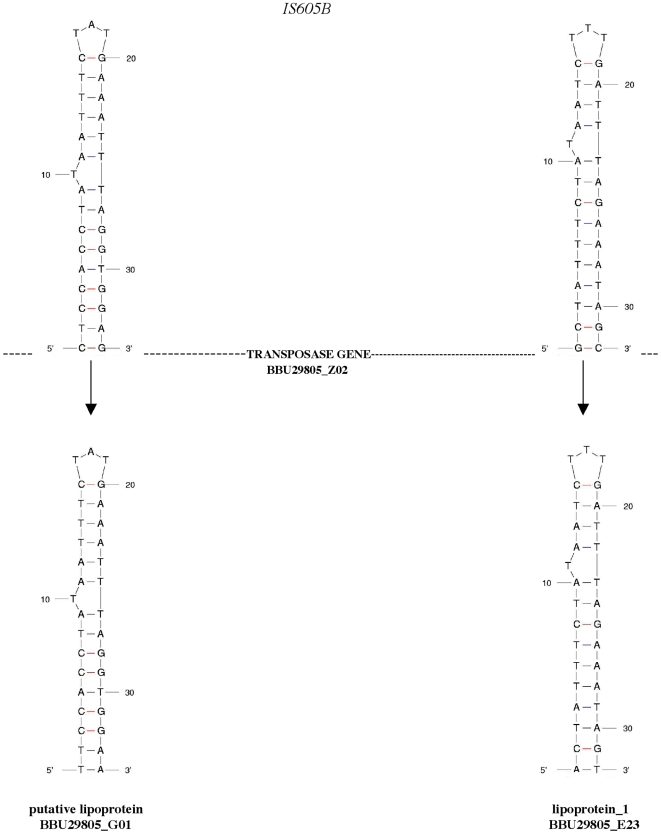
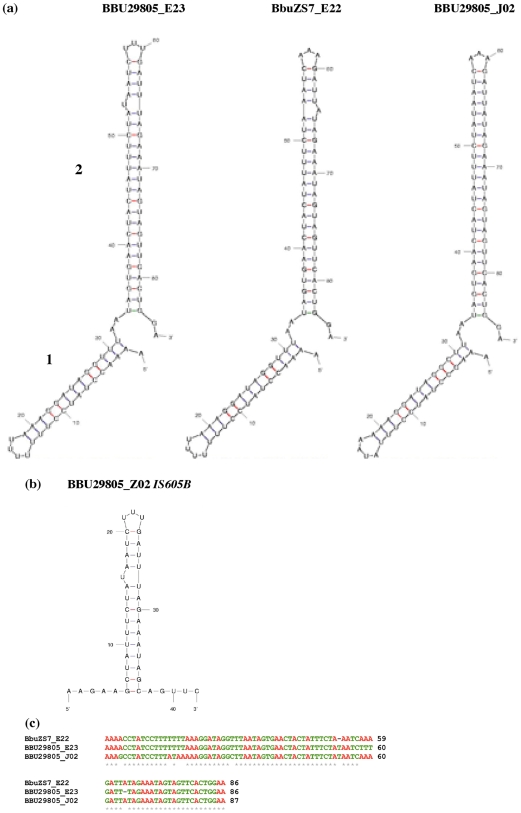
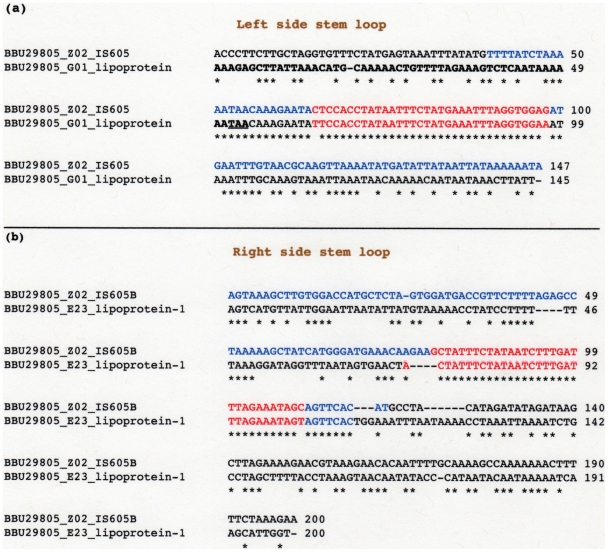
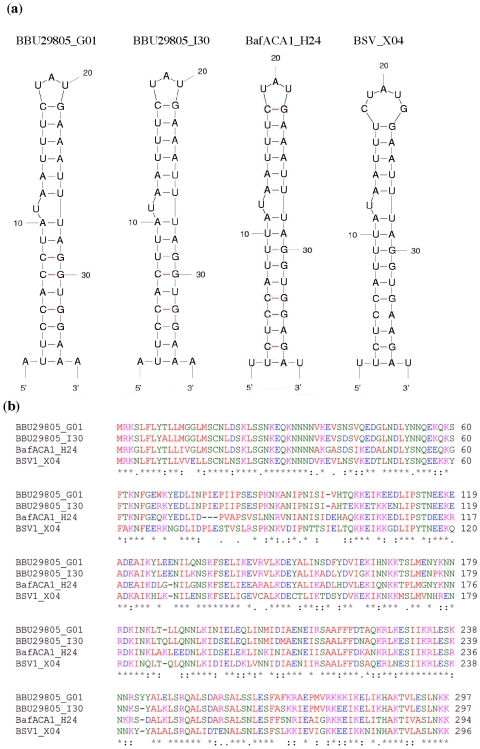
METHODOLOGY/PRINCIPAL FINDINGS: In work reported here, bioinformatics techniques were used to scan Borrelia plasmid genomes for IS605 transposable element specific stem loop sequences. Two variant stem loop motifs are found in the left and right flanking regions of the transposase gene. Both motifs appear to have dispersed in plasmid genomes and are found "free-standing" and phylogenetically conserved without the associated IS605 transposase gene or the adjacent flanking sequence. Importantly, IS605 specific stem loop sequences are also found at the 3' ends of lipoprotein genes (PFam12 and PFam60), however the left and right sequences appear to develop their own evolutionary patterns. The lipoprotein gene-linked left stem loop sequences maintain the IS605 stem loop motif in orthologs but only at the RNA level. These show mutations whereby variants fold into phylogenetically conserved RNA-type stem loops that contain the wobble non-Watson-Crick G-U base-pairing. The right flanking sequence is associated with the family lipoprotein-1 genes. A comparison of homologs shows that the IS605 stem loop motif rapidly dissipates, but a more elaborate secondary structure appears to develop in its place.
CONCLUSIONS/SIGNIFICANCE: Stem loop sequences specific to the transposable element IS605 are present in plasmid regions devoid of a transposase gene and significantly, are found linked to lipoprotein genes in Borrelia plasmids. These sequences are evolutionarily conserved and/or structurally developed in an RNA format. The findings show that IS605 stem loop sequences are multifaceted and are selectively conserved during evolution when the transposable element dissipates.
螺旋体的质粒是动态结构,包含大量重复基因、基因片段和基因融合。此外,转座元件 IS605/200 家族以及该 IS 元件的退化形式很常见。在幽门螺杆菌中,IS605 转座酶基因的侧翼区域含有能折叠成相同的小茎环的序列。这些序列在单链 DNA 水平上起转座作用。
方法/主要发现:在本报告的工作中,使用生物信息学技术扫描螺旋体质粒基因组中 IS605 转座元件的特定茎环序列。在转座酶基因的左右侧翼发现了两种变体茎环基序。这两个基序似乎在质粒基因组中分散存在,并且在没有相关的 IS605 转座酶基因或相邻侧翼序列的情况下,表现出“自由”和系统发育上的保守性。重要的是,IS605 特异性茎环序列也存在于脂蛋白基因(PFam12 和 PFam60)的 3'端,然而左右序列似乎发展出自己的进化模式。脂蛋白基因连接的左茎环序列在直系同源物中保留了 IS605 茎环基序,但仅在 RNA 水平上。这些显示出突变,使变体折叠成系统发育上保守的 RNA 型茎环,其中包含摆动非 Watson-Crick G-U 碱基对。右侧翼序列与家族脂蛋白-1 基因相关。同源物的比较表明,IS605 茎环基序迅速消散,但似乎在其位置上发展出更复杂的二级结构。
结论/意义:转座元件 IS605 特有的茎环序列存在于没有转座酶基因的质粒区域中,并且重要的是,在螺旋体质粒中的脂蛋白基因中发现了这些序列。这些序列在进化上保守和/或以 RNA 格式发展。研究结果表明,IS605 茎环序列是多方面的,并且在转座元件消散时在进化过程中被选择性地保守。