Gladstone Institute of Cardiovascular Disease, San Francisco, California, United States of America.
PLoS One. 2009 Nov 10;4(11):e7780. doi: 10.1371/journal.pone.0007780.
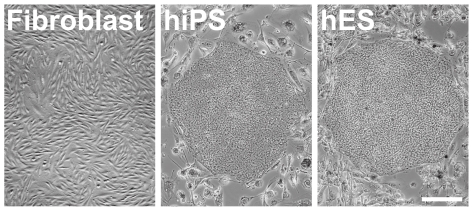
Reprogramming adult human somatic cells to create human induced pluripotent stem (hiPS) cell colonies involves a dramatic morphological and organizational transition. These colonies are morphologically indistinguishable from those of pluripotent human embryonic stem (hES) cells. G protein-coupled receptors (GPCRs) are required in diverse developmental processes, but their role in pluripotent colony morphology and organization is unknown. We tested the hypothesis that G(i)-coupled GPCR signaling contributes to the characteristic morphology and organization of human pluripotent colonies.
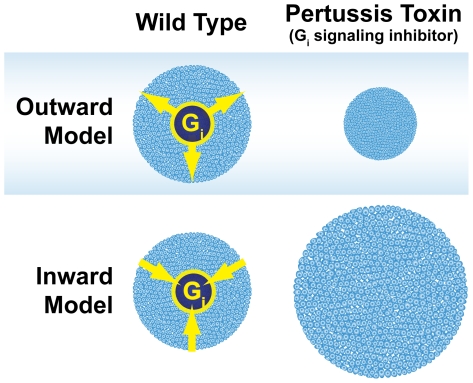
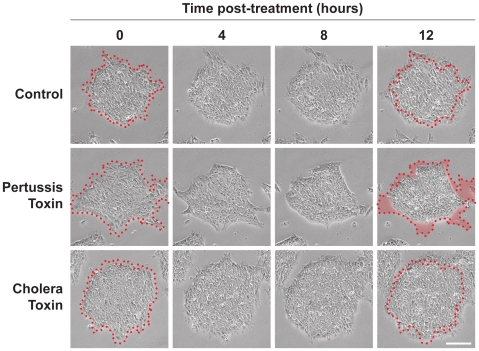
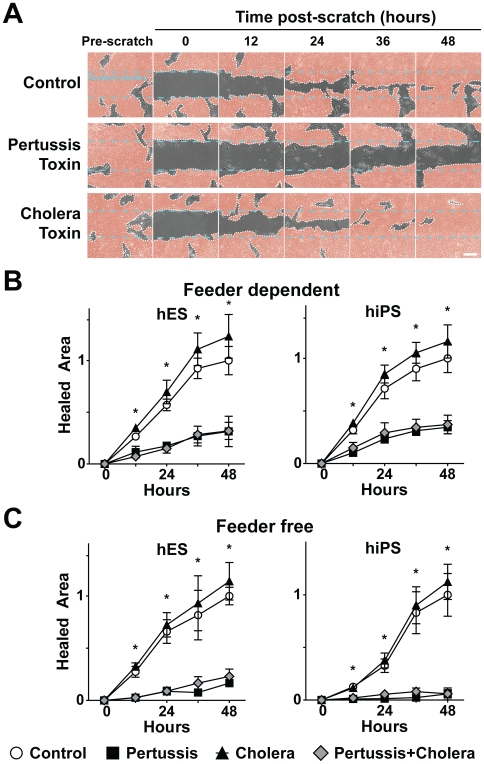
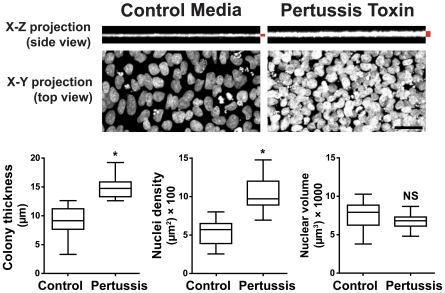
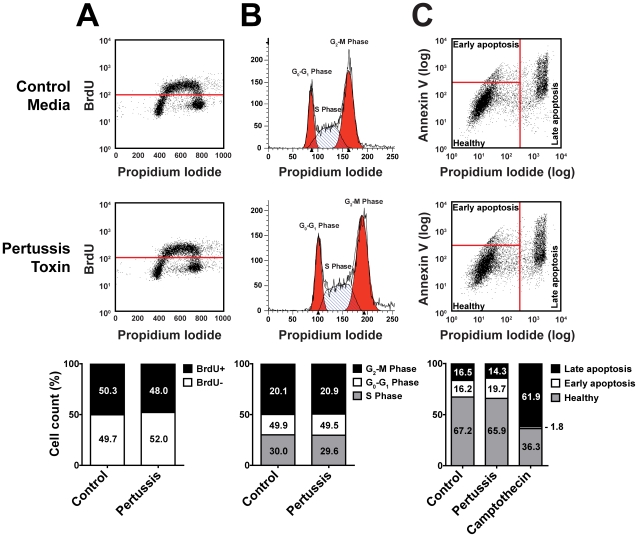
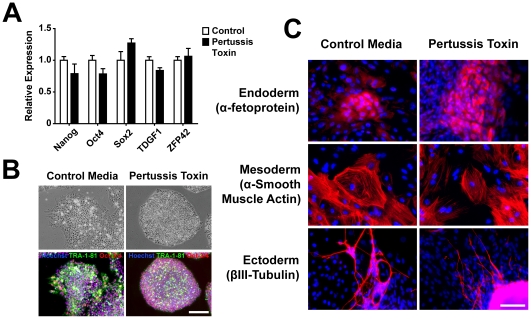
METHODOLOGY/PRINCIPAL FINDINGS: Specific and irreversible inhibition of G(i)-coupled GPCR signaling by pertussis toxin markedly altered pluripotent colony morphology. Wild-type hES and hiPS cells formed monolayer colonies, but colonies treated with pertussis toxin retracted inward, adopting a dense, multi-layered conformation. The treated colonies were unable to reform after a scratch wound insult, whereas control colonies healed completely within 48 h. In contrast, activation of an alternative GPCR pathway, G(s)-coupled signaling, with cholera toxin did not affect colony morphology or the healing response. Pertussis toxin did not alter the proliferation, apoptosis or pluripotency of pluripotent stem cells.
CONCLUSIONS/SIGNIFICANCE: Experiments with pertussis toxin suggest that G(i) signaling plays a critical role in the morphology and organization of pluripotent colonies. These results may be explained by a G(i)-mediated density-sensing mechanism that propels the cells radially outward. GPCRs are a promising target for modulating the formation and organization of hiPS and hES cell colonies and may be important for understanding somatic cell reprogramming and for engineering pluripotent stem cells for therapeutic applications.
将成人体细胞重编程为人类诱导多能干细胞(hiPS)细胞集落涉及到显著的形态和组织学转变。这些集落在形态上与多能人类胚胎干细胞(hES)细胞无法区分。G 蛋白偶联受体(GPCRs)在多种发育过程中是必需的,但它们在多能集落形态和组织中的作用尚不清楚。我们测试了 G(i)偶联 GPCR 信号转导是否有助于人类多能集落的特征形态和组织的假说。
方法/主要发现:百日咳毒素特异性和不可逆地抑制 G(i)偶联 GPCR 信号转导,显著改变了多能集落的形态。野生型 hES 和 hiPS 细胞形成单层集落,但用百日咳毒素处理的集落向内收缩,形成密集的多层构象。处理后的集落在划痕损伤后无法重新形成,而对照集落在 48 小时内完全愈合。相比之下,霍乱毒素激活替代的 GPCR 途径,G(s)偶联信号,不会影响集落形态或愈合反应。百日咳毒素不改变多能干细胞的增殖、凋亡或多能性。
结论/意义:百日咳毒素实验表明,G(i)信号转导在多能集落的形态和组织中起着关键作用。这些结果可以通过 G(i)介导的密度感应机制来解释,该机制推动细胞径向向外扩散。GPCR 是调节 hiPS 和 hES 细胞集落形成和组织的有前途的靶点,对于理解体细胞重编程和为治疗应用工程化多能干细胞可能很重要。