Brydøy Marianne, Oldenburg Jan, Klepp Olbjørn, Bremnes Roy M, Wist Erik A, Wentzel-Larsen Tore, Hauge Erik R, Dahl Olav, Fosså Sophie D
Department of Oncology, Haukeland University Hospital, N-5021 Bergen, Norway.
J Natl Cancer Inst. 2009 Dec 16;101(24):1682-95. doi: 10.1093/jnci/djp413.
Sensory neuropathy (paresthesias), tinnitus, hearing impairment, and Raynaud phenomena are side effects of cisplatin-based chemotherapy used to treat testicular cancer patients. We assessed the long-term occurrence of these side effects among testicular cancer survivors according to the treatment they received.
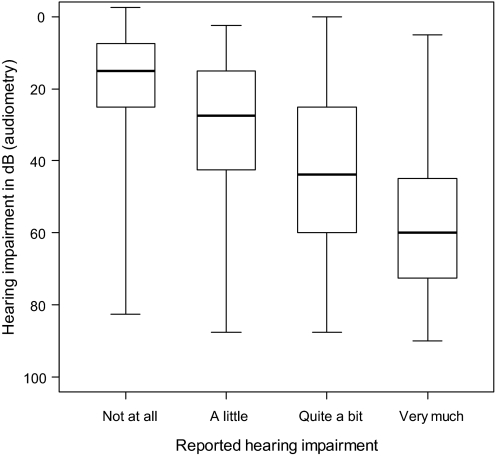
A total of 1814 men who were treated for unilateral testicular cancer in Norway during 1980-1994 were invited to participate in a national multicenter follow-up survey conducted during 1998-2002. The men were allocated to six groups according to the treatment they had received. Self-reported symptoms were assessed by a mailed questionnaire that included the Scale for Chemotherapy-Induced Neurotoxicity. A total of 1409 participants who responded to the questionnaire and/or underwent audiometry were assessable in this study. Respondents to the questionnaire (n = 1402) scored the relevant symptoms according to how troubled they were by each (not at all, a little, quite a bit, or very much). Hearing impairment was objectively assessed by audiometry at 4000 Hz in 755 men (seven of whom did not respond to the questionnaire). Group comparisons of symptom assessments were performed with chi2 or Kruskal-Wallis tests. Associations between relevant factors and self-reported symptoms or hearing impairment measured by audiometry were assessed using proportional odds ordinal logistic regression models and linear regression models, respectively. All statistical tests were two-sided.
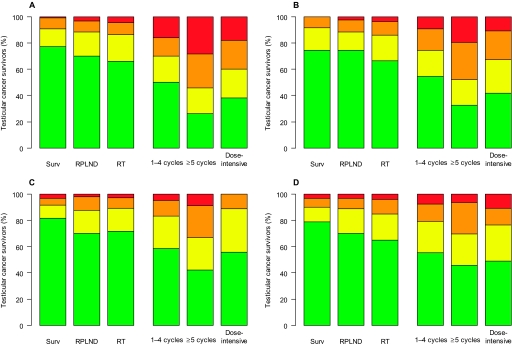
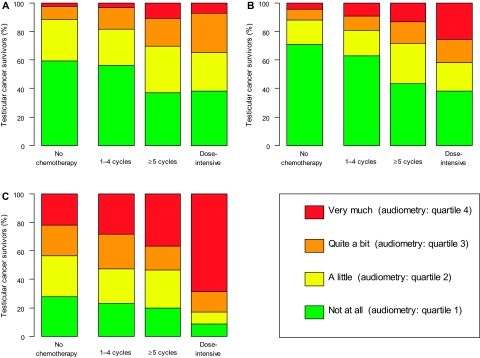
The median follow-up for the 1409 assessable men was 10.7 years (range = 4-21 years). All chemotherapy groups had statistically significantly higher odds for increasing severity of all assessed symptoms and inferior audiometric results compared with men who did not receive chemotherapy. Among chemotherapy-treated men, 39% (95% confidence interval [CI] = 35% to 43%) reported Raynaud-like phenomena (defined as white or cold hands or fingers [or feet or toes] on cold exposure), 29% (95% CI = 25% to 33%) reported paresthesias in the hands or feet, 21% (95% CI = 18% to 25%) reported hearing impairment, and 22% (95% CI = 19% to 26%) reported tinnitus as major symptoms troubling them quite a bit or very much. Hearing impairment (odds ratio [OR] = 5.3, 95% CI = 3.0 to 9.2) and tinnitus (OR = 7.1, 95% CI = 4.1 to 12.4) were particularly common in the dose-intensive chemotherapy group compared with the no chemotherapy group. Men who were treated with radiotherapy had higher odds of self-reported paresthesias in feet compared with those not treated with radiotherapy (OR = 1.5, 95% CI = 1.01 to 2.1, P = .04).
Long-term survivors of testicular cancer who were treated with cisplatin-based chemotherapy were more often troubled by dose-dependent neurological side effects and Raynaud-like phenomena compared with those who were not treated with chemotherapy.
感觉神经病变(感觉异常)、耳鸣、听力损害和雷诺现象是用于治疗睾丸癌患者的顺铂类化疗的副作用。我们根据所接受的治疗评估了这些副作用在睾丸癌幸存者中的长期发生率。
1980年至1994年期间在挪威接受单侧睾丸癌治疗的1814名男性被邀请参加1998年至2002年期间进行的一项全国多中心随访调查。这些男性根据所接受的治疗被分为六组。通过邮寄问卷评估自我报告的症状,问卷包括化疗诱导神经毒性量表。本研究共纳入1409名对问卷做出回应和/或接受听力测定的参与者。问卷回复者(n = 1402)根据每种症状给他们带来的困扰程度(完全没有、有点、相当多或非常多)对相关症状进行评分。755名男性(其中7人未回复问卷)在4000Hz频率下通过听力测定客观评估听力损害。症状评估的组间比较采用卡方检验或Kruskal-Wallis检验。分别使用比例优势有序逻辑回归模型和线性回归模型评估相关因素与自我报告症状或听力测定所测听力损害之间的关联。所有统计检验均为双侧检验。
1,409名可评估男性的中位随访时间为10.7年(范围 = 4至21年)。与未接受化疗的男性相比,所有化疗组在所有评估症状严重程度增加和听力测定结果较差方面的优势均具有统计学意义。在接受化疗的男性中,39%(95%置信区间[CI] = 35%至43%)报告有雷诺样现象(定义为寒冷暴露时手部或手指[或足部或脚趾]变白或发冷),29%(95%CI = 25%至33%)报告有手足感觉异常,21%(95%CI = 18%至25%)报告有听力损害,22%(95%CI = 19%至26%)报告耳鸣是给他们带来相当多或非常多困扰的主要症状。与未化疗组相比,剂量密集化疗组的听力损害(优势比[OR] = 5.3,95%CI = 3.0至9.2)和耳鸣(OR = 7.1,95%CI = 4.1至12.4)尤为常见。接受放疗的男性与未接受放疗的男性相比,自我报告足部感觉异常的几率更高(OR = 1.5,95%CI = 1.01至2.1,P = 0.04)。
与未接受化疗的睾丸癌长期幸存者相比,接受顺铂类化疗的幸存者更常受到剂量依赖性神经副作用和雷诺样现象的困扰。