Cancer Research Institute, Central South University, Hunan, the People's Republic of China.
Curr Genomics. 2009 Jun;10(4):216-22. doi: 10.2174/138920209788488481.
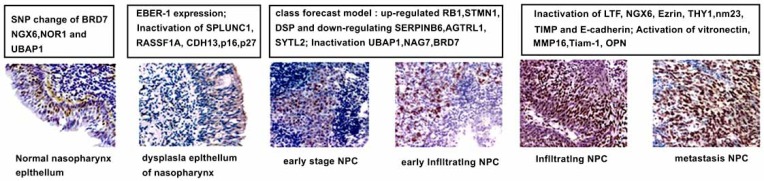
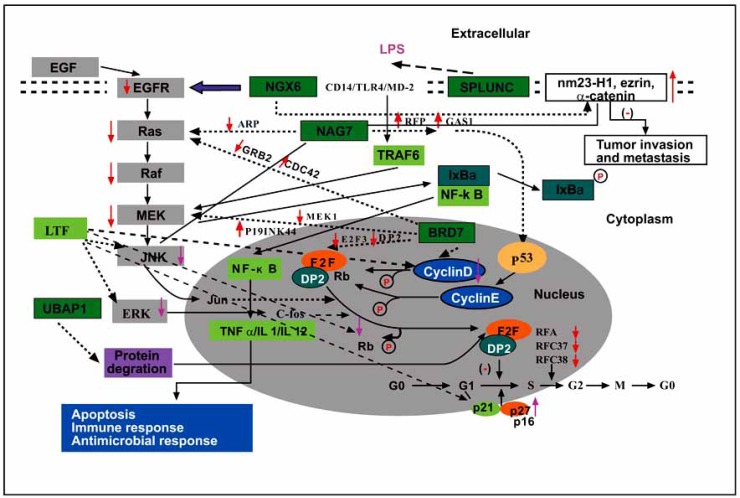
Nasopharyngeal carcinoma (NPC) is a polygenetic disease. SPLUNC1, UBAP1, BRD7, NAG7, NOR1, NGX6 and LTF genes were found to be tumor suppressor/susceptibility genes in different stages of NPC. SPLUNC1, an early warning molecular diagnosis marker, inhibits the bacteria clone formation, and is an innated immune molecule. SPLUNC1 can negatively regulate the ERK/MAPK signaling transduction pathway to inhibit NPC cell proliferation and induce apoptosis. BRD7, a transcript regulation factor, interacts with BRD2, and promotes apoptosis induced by BRD2. Its promoter is regulated by c-Myc and SP1. BRD7 inhibits NPC cell cycle progression, preventing passage through G0/G1 by suppressing ras/MEK/ERK, Rb/E2F and Wnt signaling pathways. Abnormal activation of BRD7 is crucial to cell cycle turbulence in NPC. NGX6, a metastasis-associated protein, can negative-regulate the EGF/Ras/MAPK signaling transduction pathway, and interacts with ezrin protein to inhibit NPC cell invasion and metastasis. LTF, also a metastasis-associated protein, can negatively regulate MAPK signal transduction pathways, such as JNK2 and ERK, to inhibit NPC cell proliferation and growth. Taken together, it was found that these tumor suppressor/susceptibility genes can regulate key molecules involved in cell signal pathways such as ras/MEK/ERK, Rb/E2F and EGFR ras/MEK/MAPK, and can regulate the expression of some adhesion molecules such as ezrin, nm23 and alpha-catenin. According to functional genomics and signaling transduction pathways, we have described a signaling cross-talk network between the tumor suppressor/susceptibility genes involved in NPC. These tumor suppressor/susceptibility genes may be potential treatment targets for NPC in the future.
鼻咽癌(NPC)是一种多基因疾病。在 NPC 的不同阶段,已发现 SPLUNC1、UBAP1、BRD7、NAG7、NOR1、NGX6 和 LTF 基因是肿瘤抑制/易感基因。SPLUNC1 是一种早期预警的分子诊断标志物,可抑制细菌克隆形成,是一种先天免疫分子。SPLUNC1 可负向调节 ERK/MAPK 信号转导通路,抑制 NPC 细胞增殖并诱导细胞凋亡。BRD7 是一种转录调控因子,与 BRD2 相互作用,促进 BRD2 诱导的细胞凋亡。其启动子受 c-Myc 和 SP1 调控。BRD7 抑制 NPC 细胞周期进程,通过抑制 ras/MEK/ERK、Rb/E2F 和 Wnt 信号通路,阻止细胞通过 G0/G1 期。BRD7 的异常激活对 NPC 细胞周期的不稳定性至关重要。NGX6 是一种转移相关蛋白,可负向调节 EGF/Ras/MAPK 信号转导通路,与 ezrin 蛋白相互作用,抑制 NPC 细胞侵袭和转移。LTF 也是一种转移相关蛋白,可负向调节 MAPK 信号转导通路,如 JNK2 和 ERK,抑制 NPC 细胞增殖和生长。综上所述,这些肿瘤抑制/易感基因可调节细胞信号通路中的关键分子,如 ras/MEK/ERK、Rb/E2F 和 EGFR ras/MEK/MAPK,并可调节 ezrin、nm23 和α-catenin 等一些黏附分子的表达。根据功能基因组学和信号转导通路,我们描述了 NPC 中涉及的肿瘤抑制/易感基因之间的信号交叉对话网络。这些肿瘤抑制/易感基因可能是未来 NPC 的潜在治疗靶点。