Department of Pathology and Host Defense, Faculty of Medicine, Kagawa University, Kagawa 761-0793, Japan.
Curr Neuropharmacol. 2009 Jun;7(2):142-9. doi: 10.2174/157015909788848901.
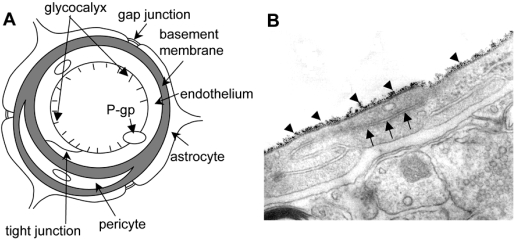
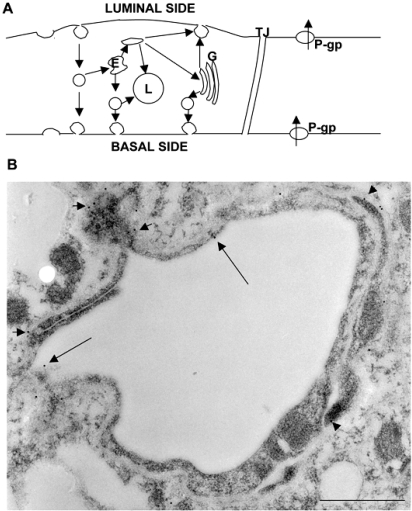
The blood-brain barrier (BBB) impedes the influx of intravascular compounds from the blood to the brain. Few blood-borne macromolecules are transferred into the brain because vesicular transcytosis in the endothelial cells is considerably limited and the tight junction is located between the endothelial cells. At the first line of the BBB, the endothelial glycocalyx which is a negatively charged, surface coat of proteoglycans, and adsorbed plasma proteins, contributes to the vasculoprotective effects of the vessels wall and are involved in maintaining vascular permeability. In the endothelial cytoplasm of cerebral capillaries, there is an asymmetrical array of metabolic enzymes such as alkaline phosphatase, acid phosphatase, 5'-nucleotidase, adenosine triphosphatase, and nucleoside diphosphatase and these enzymes contribute to inactivation of substrates. In addition, there are several types of influx or efflux transporters at the BBB, such as P-glycoprotein (P-gp), multidrug resistance associated protein, breast cancer resistance protein, organic anion transporters, organic cation transporters, organic cation transporter novel type transporters, and monocarboxylic acid transporters. P-gp, energy-dependent efflux transporter protein, is instrumental to the barrier function. Several findings recently reported indicate that endothelial P-gp contributes to efflux of undesirable substances such as beta-amyloid protein from the brain or periarterial interstitial fluid, while P-gp likely plays a crucial role in the genesis of multiple vascular abnormalities that accompany hypertension. In this review, influx and efflux mechanisms of drugs at the BBB are also reviewed and how medicines pass the BBB to reach the brain parenchyma is discussed.
血脑屏障(BBB)阻止血管内化合物从血液进入大脑。由于内皮细胞中的囊泡转胞吞作用受到极大限制,并且紧密连接位于内皮细胞之间,因此很少有血液来源的大分子进入大脑。在 BBB 的第一线,带负电荷的糖萼是内皮细胞表面覆盖的蛋白聚糖和吸附的血浆蛋白,有助于血管壁的血管保护作用,并参与维持血管通透性。在脑毛细血管的内皮细胞质中,存在碱性磷酸酶、酸性磷酸酶、5'-核苷酸酶、三磷酸腺苷酶和核苷二磷酸酶等代谢酶的不对称排列,这些酶有助于底物失活。此外,BBB 还有几种类型的流入或流出转运体,如 P-糖蛋白(P-gp)、多药耐药相关蛋白、乳腺癌耐药蛋白、有机阴离子转运体、有机阳离子转运体、有机阳离子转运体新型转运体和单羧酸转运体。P-gp 是一种能量依赖性外排转运蛋白,对屏障功能至关重要。最近的一些发现表明,内皮 P-gp 有助于将β-淀粉样蛋白等有害物质从大脑或动脉周围间质液中排出,而 P-gp 可能在伴随高血压的多种血管异常的发生中发挥关键作用。在这篇综述中,还回顾了药物在 BBB 中的流入和流出机制,并讨论了药物如何通过 BBB 到达脑实质。