Division of Cardiology, Department of Internal Medicine, College of Medicine, Dongguk University, Gyeongju, Korea.
Korean Circ J. 2009 Oct;39(10):393-8. doi: 10.4070/kcj.2009.39.10.393. Epub 2009 Oct 28.
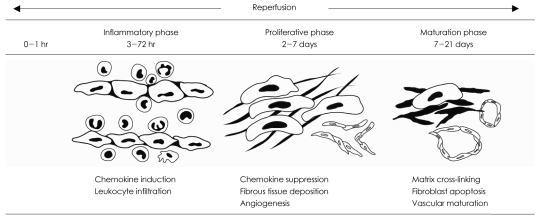
One of the most important therapeutic targets of current cardiology practice is to determine optimal strategies for the minimization of myocardial necrosis and optimization of cardiac repair following an acute myocardial infarction. Myocardial necrosis after acute myocardial infarction induces complement activation and free radical generation, triggering a cytokine cascade initiated by tumor necrosis factor-alpha (TNF-alpha) release. When reperfusion of the infarcted area is initiated, intense inflammation follows. Chemokines, cytokines and the complement system play an important role in recruiting neutrophils in the ischemic and reperfused myocardium. Cytokines promote adhesive interactions between leukocytes and endothelial cells, resulting in transmigration of inflammatory cells into the site of injury. The recruited neutrophils have potent cytotoxic effects through the release of proteolytic enzymes, and they interact with adhesion molecules on cardiomyocytes. In spite of the potential injury, reperfusion enhances cardiac repair; this may be related to the inflammatory response. Monocyte chemoattractant protein (MCP)-1 is upregulated in reperfused myocardium and can induce monocyte recruitment in the infarcted area. Monocyte subsets play a role in phagocytosis of dead cardiomyocytes and in granulation tissue formation. In addition, the transforming growth factor (TGF)-beta plays a crucial role in cardiac repair by suppressing inflammation. Resolution of inflammatory infiltration, containment of inflammation and the reparative response affecting the infarcted area are essential for optimal infarct healing. Here, we review the current literature on the inflammatory response and cardiac repair after myocardial infarction.
目前心脏病学实践的最重要治疗靶点之一是确定在急性心肌梗死后最小化心肌坏死和优化心脏修复的最佳策略。急性心肌梗死后的心肌坏死会诱导补体激活和自由基生成,触发由肿瘤坏死因子-α(TNF-α)释放引发的细胞因子级联反应。当梗死区域再灌注开始时,会出现强烈的炎症反应。趋化因子、细胞因子和补体系统在招募缺血和再灌注心肌中的中性粒细胞方面发挥着重要作用。细胞因子促进白细胞和内皮细胞之间的黏附相互作用,导致炎症细胞向损伤部位迁移。募集的中性粒细胞通过释放蛋白水解酶产生强大的细胞毒性作用,并与心肌细胞上的黏附分子相互作用。尽管存在潜在的损伤,但再灌注增强了心脏修复;这可能与炎症反应有关。单核细胞趋化蛋白(MCP)-1在再灌注的心肌中上调,并可诱导单核细胞在梗死区域募集。单核细胞亚群在吞噬坏死的心肌细胞和形成肉芽组织方面发挥作用。此外,转化生长因子(TGF)-β通过抑制炎症在心脏修复中起着至关重要的作用。炎症浸润的消退、炎症的控制和影响梗死区域的修复反应对于最佳梗死愈合至关重要。在这里,我们回顾了心肌梗死后炎症反应和心脏修复的最新文献。