Crowley Emily, McDevitt Christopher A, Callaghan Richard
Nuffield Department of Clinical Laboratory Sciences, John Radcliffe Hospital, University of Oxford, Oxford, UK.
Methods Mol Biol. 2010;596:405-32. doi: 10.1007/978-1-60761-416-6_18.
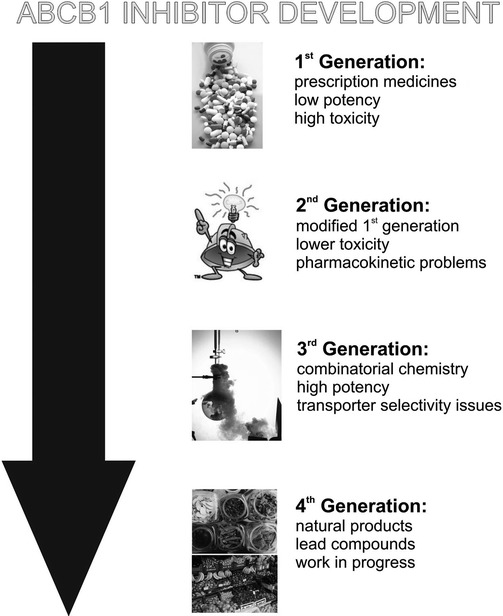
The prominent role for the drug efflux pump ABCB1 (P-glycoprotein) in mediating resistance to chemotherapy was first suggested in 1976 and sparked an incredible drive to restore the efficacy of anticancer drugs. Achieving this goal seemed inevitable in 1982 when a series of calcium channel blockers were demonstrated to restore the efficacy of chemotherapy agents. A large number of other compounds have since been demonstrated to restore chemotherapeutic sensitivity in cancer cells or tissues. Where do we stand almost three decades since the first reports of ABCB1 inhibition? Unfortunately, in the aftermath of extensive fundamental and clinical research efforts the situation remains gloomy. Only a small handful of compounds have reached late stage clinical trials and none are in routine clinical usage to circumvent chemoresistance. Why has the translation process been so ineffective? One factor is the multifactorial nature of drug resistance inherent to cancer tissues; ABCB1 is not the sole factor. However, expression of ABCB1 remains a significant negative prognostic indicator and is closely associated with poor response to chemotherapy in many cancer types. The main difficulties with restoration of sensitivity to chemotherapy reside with poor properties of the ABCB1 inhibitors: (1) low selectivity to ABCB1, (2) poor potency to inhibit ABCB1, (3) inherent toxicity and/or (4) adverse pharmacokinetic interactions with anticancer drugs. Despite these difficulties, there is a clear requirement for effective inhibitors and to date the strategies for generating such compounds have involved serendipity or simple chemical syntheses. This chapter outlines more sophisticated approaches making use of bioinformatics, combinatorial chemistry and structure informed drug design. Generating a new arsenal of potent and selective ABCB1 inhibitors offers the promise of restoring the efficacy of a key weapon in cancer treatment--chemotherapy.
药物外排泵ABCB1(P-糖蛋白)在介导化疗耐药性方面的突出作用最早于1976年被提出,这引发了人们为恢复抗癌药物疗效而进行的巨大努力。1982年,当一系列钙通道阻滞剂被证明可恢复化疗药物的疗效时,实现这一目标似乎指日可待。从那以后,大量其他化合物已被证明可恢复癌细胞或组织中的化疗敏感性。自首次报道ABCB1抑制作用近三十年来,我们处于什么境地呢?不幸的是,经过广泛的基础和临床研究努力,情况仍然不容乐观。只有少数几种化合物进入了后期临床试验,且没有一种用于常规临床以规避化疗耐药性。为什么转化过程如此无效呢?一个因素是癌症组织中耐药性的多因素性质;ABCB1不是唯一因素。然而,ABCB1的表达仍然是一个重要的负面预后指标,并且在许多癌症类型中与化疗反应不佳密切相关。恢复化疗敏感性的主要困难在于ABCB1抑制剂的性质不佳:(1)对ABCB1的选择性低,(2)抑制ABCB1的效力差,(3)固有毒性和/或(4)与抗癌药物的不良药代动力学相互作用。尽管存在这些困难,但显然需要有效的抑制剂,迄今为止,生成此类化合物的策略涉及偶然发现或简单的化学合成。本章概述了利用生物信息学、组合化学和基于结构的药物设计的更复杂方法。生成一系列新的强效和选择性ABCB1抑制剂有望恢复癌症治疗中的关键武器——化疗的疗效。