Department of Surgery, Duke University Medical Center, 401 MSRB, Research Drive, Durham, NC 27710, USA.
Br J Cancer. 2010 Jan 5;102(1):124-33. doi: 10.1038/sj.bjc.6605364. Epub 2009 Dec 1.
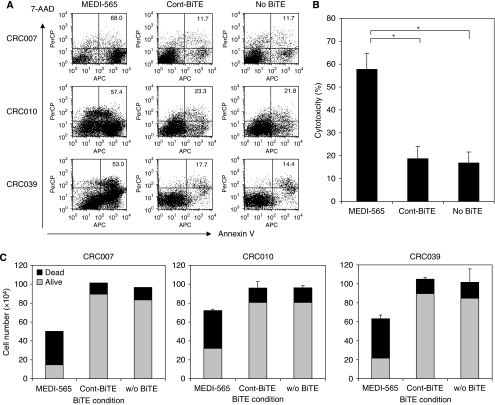
Novel technologies to redirect T-cell killing against cancer cells are emerging. We hypothesised that metastatic human colorectal cancer (CRC) previously treated with conventional chemotherapy would be sensitive to T-cell killing mediated by carcinoembryonic antigen (CEA)/CD3-bispecific T-cell-engaging BiTE antibody (MEDI-565).
We analysed proliferation and lysis of CEA-positive (CEA+) CRC specimens that had survived previous systemic chemotherapy and biologic therapy to determine whether they could be killed by patient T cells engaged by MEDI-565 in vitro.
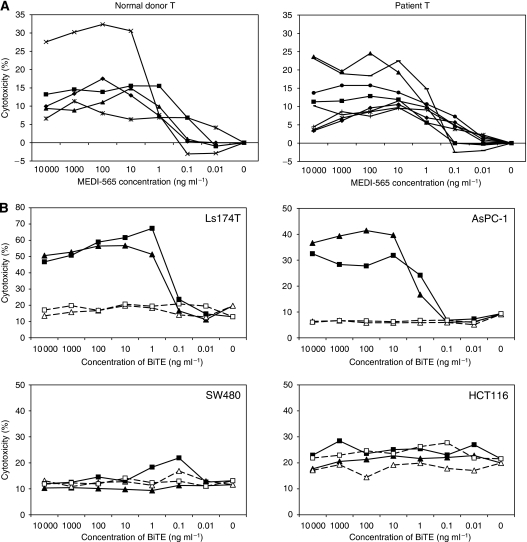
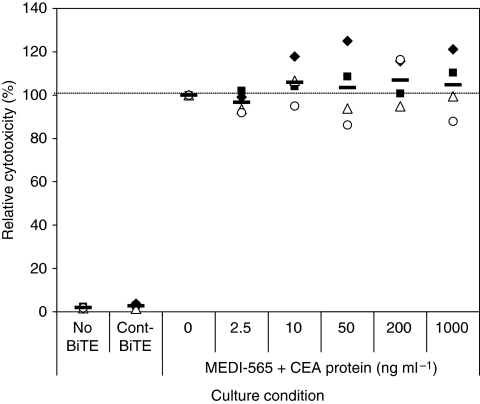
At low concentrations (0.1-1 ng ml(-1)), MEDI-565+ T cells caused reduced proliferation and enhanced apoptosis of CEA+ human CRC specimens. High levels of soluble CEA did not impair killing by redirected T cells and there was no increase in resistance to T-cell killing despite multiple rounds of exposure.
This study shows for the first time that metastatic CRC specimens derived from patients previously treated with conventional chemotherapy can be lysed by patient T cells. Clinical testing of cancer immunotherapies, such as MEDI-565 that result in exposure of tumours to large numbers of T cells, is warranted.
新兴的技术可以将 T 细胞的杀伤作用重新导向癌细胞。我们假设,经过传统化疗治疗的转移性人结直肠癌(CRC)将对靶向癌胚抗原(CEA)/CD3 的双特异性 T 细胞衔接 Bispecific T-cell-engaging BiTE 抗体(MEDI-565)的 T 细胞杀伤敏感。
我们分析了先前接受过全身化疗和生物治疗的 CEA 阳性(CEA+)CRC 标本的增殖和裂解情况,以确定它们是否可以被 MEDI-565 体外结合的患者 T 细胞杀死。
在低浓度(0.1-1ng/ml)时,MEDI-565+T 细胞导致 CEA+人 CRC 标本增殖减少和凋亡增强。高水平的可溶性 CEA 并不影响重定向 T 细胞的杀伤作用,尽管反复暴露,也没有增加对 T 细胞杀伤的抵抗力。
这项研究首次表明,先前接受过传统化疗治疗的转移性 CRC 标本可以被患者 T 细胞裂解。值得对 MEDI-565 等导致肿瘤暴露于大量 T 细胞的癌症免疫疗法进行临床测试。