Instituto de Investigación Médica M. y M. Ferreyra (INIMEC - CONICET), Córdoba, C.P 5000, Argentina.
Physiol Behav. 2010 Mar 3;99(3):348-54. doi: 10.1016/j.physbeh.2009.11.012. Epub 2009 Nov 30.
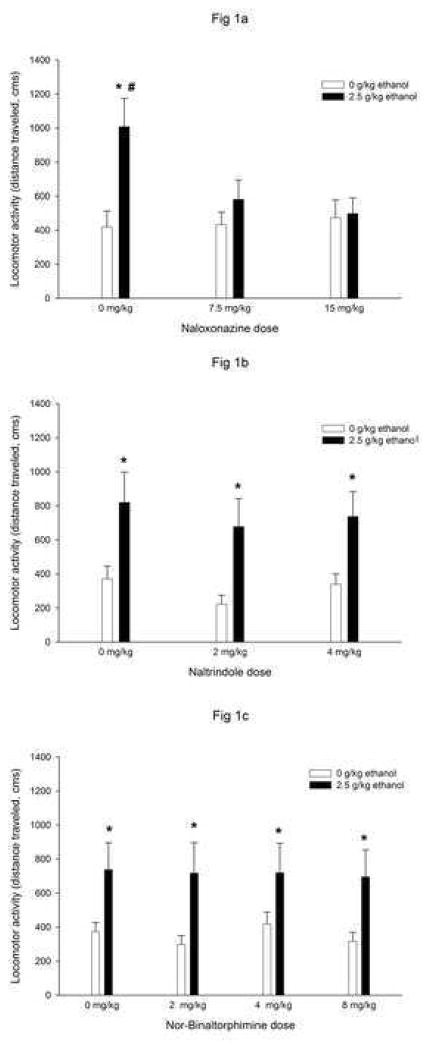
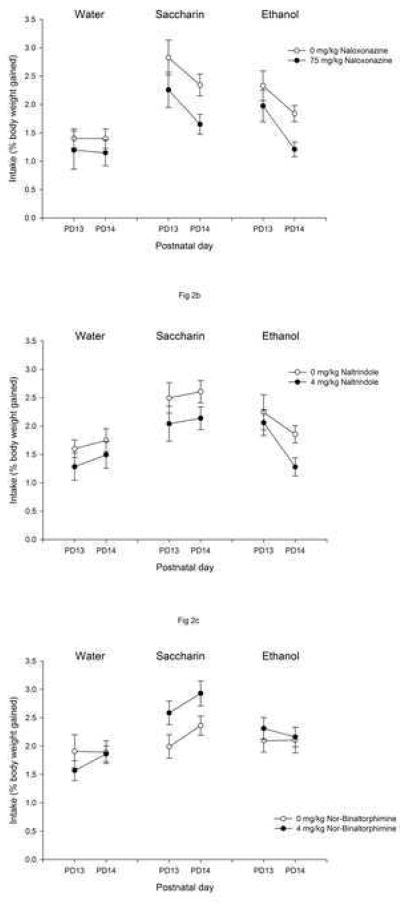
The opioid system modulates ethanol intake and reinforcement in adult and preweanling rodents. While adult heterogeneous rats normally do not show ethanol-mediated locomotor stimulation, preweanling rats show it quite clearly. We recently observed that naloxone, a non-specific opioid antagonist, attenuated ethanol-induced locomotor activation in preweanling rats. In the present study we tested the role of specific opioid receptors (mu, delta and kappa) in ethanol-mediated locomotor stimulation and ethanol intake. In Experiment 1 13-day-old rats received naloxonazine (mu antagonist: 0, 7.5 or 15 mg/kg), naltrindole (delta antagonist: 0, 2 or 4 mg/kg) or nor-binaltorphimine (kappa antagonist: 0, 2, 4 or 8 mg/kg) before an intragastric administration of ethanol (0 or 2.5 g/kg), and subsequent locomotor activity assessment. In Experiment 2, the same opioid antagonists were administered on postnatal days 13 and 14 before consumption of ethanol (6%), saccharin (0.05%) or distilled water. In Experiment 1 only naloxonazine reduced ethanol-mediated locomotor stimulation. None of the opioid antagonists affected locomotor activity in water controls. In Experiment 2 naloxonazine and naltrindole suppressed ingestion of all the solutions tested. Similar to what has been reported in adult rodents, mu-opioid receptors seem to modulate ethanol-activating effects during early ontogeny. Hence, there seems to be a partial overlap of neurochemical mechanisms involved in the rewarding and stimulating effects of ethanol in preweanling rats. Mu-receptor antagonists reduced both ethanol-induced activity and ethanol intake, but it is unclear whether the latter effect is specific to ethanol or only a reflection of an effect on consummatory behavior generally, since mu and delta receptor antagonists also suppressed ingestion of water and saccharin.
阿片样物质系统调节成年和未成年动物的乙醇摄入和强化。虽然成年异质大鼠通常不会表现出乙醇介导的运动刺激,但未成年大鼠则非常明显。我们最近观察到,纳洛酮,一种非特异性阿片拮抗剂,可减弱未成年大鼠乙醇诱导的运动激活。在本研究中,我们测试了特定阿片受体(μ、δ 和 κ)在乙醇介导的运动刺激和乙醇摄入中的作用。在实验 1 中,13 天大的大鼠在接受乙醇(0 或 2.5 g/kg)灌胃之前,接受纳洛酮嗪(μ 拮抗剂:0、7.5 或 15 mg/kg)、纳曲吲哚(δ 拮抗剂:0、2 或 4 mg/kg)或诺布纳曲酮(κ 拮抗剂:0、2、4 或 8 mg/kg)的处理,并随后进行运动活性评估。在实验 2 中,在出生后第 13 天和第 14 天给予相同的阿片拮抗剂,然后让其摄入乙醇(6%)、蔗糖素(0.05%)或蒸馏水。在实验 1 中,只有纳洛酮嗪降低了乙醇介导的运动刺激。在水对照中,没有一种阿片拮抗剂影响运动活性。在实验 2 中,纳洛酮嗪和纳曲吲哚抑制了所有测试溶液的摄入。类似于成年啮齿动物的报道,μ-阿片受体似乎在早期发育过程中调节乙醇的激活作用。因此,在未成年大鼠中,涉及乙醇奖赏和刺激作用的神经化学机制似乎存在部分重叠。μ-受体拮抗剂减少了乙醇诱导的活性和乙醇摄入,但尚不清楚后者的作用是否仅针对乙醇,还是仅反映了对一般摄食行为的影响,因为 μ 和 δ 受体拮抗剂也抑制了水和蔗糖素的摄入。