Department of Molecular Biology, Simon Fraser University, Burnaby, British Columbia, Canada.
PLoS One. 2009 Dec 1;4(12):e8094. doi: 10.1371/journal.pone.0008094.
It has been noted that many bacterial virulence factor genes are located within genomic islands (GIs; clusters of genes in a prokaryotic genome of probable horizontal origin). However, such studies have been limited to single genera or isolated observations. We have performed the first large-scale analysis of multiple diverse pathogens to examine this association. We additionally identified genes found predominantly in pathogens, but not non-pathogens, across multiple genera using 631 complete bacterial genomes, and we identified common trends in virulence for genes in GIs. Furthermore, we examined the relationship between GIs and clustered regularly interspaced palindromic repeats (CRISPRs) proposed to confer resistance to phage.
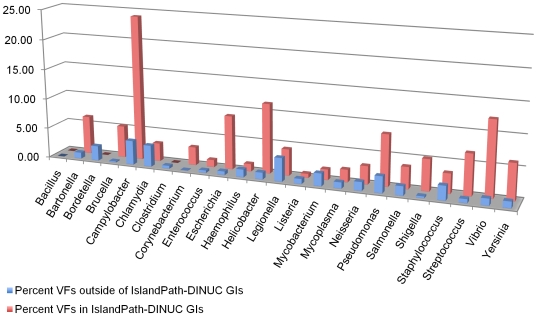
METHODOLOGY/PRINCIPAL FINDINGS: We show quantitatively that GIs disproportionately contain more virulence factors than the rest of a given genome (p<1E-40 using three GI datasets) and that CRISPRs are also over-represented in GIs. Virulence factors in GIs and pathogen-associated virulence factors are enriched for proteins having more "offensive" functions, e.g. active invasion of the host, and are disproportionately components of type III/IV secretion systems or toxins. Numerous hypothetical pathogen-associated genes were identified, meriting further study.
CONCLUSIONS/SIGNIFICANCE: This is the first systematic analysis across diverse genera indicating that virulence factors are disproportionately associated with GIs. "Offensive" virulence factors, as opposed to host-interaction factors, may more often be a recently acquired trait (on an evolutionary time scale detected by GI analysis). Newly identified pathogen-associated genes warrant further study. We discuss the implications of these results, which cement the significant role of GIs in the evolution of many pathogens.
已经注意到许多细菌毒力因子基因位于基因组岛(GI;原核基因组中可能具有水平起源的基因簇)内。然而,此类研究仅限于单一属或孤立的观察。我们首次对多个不同病原体进行了大规模分析,以检验这种关联。我们还使用 631 个完整的细菌基因组,鉴定了在多个属中主要存在于病原体而非非病原体中的基因,并确定了 GI 中基因的共同毒力趋势。此外,我们还研究了 GI 与推测赋予噬菌体抗性的成簇规律间隔短回文重复序列(CRISPR)之间的关系。
方法/主要发现:我们定量地表明,GI 中包含的毒力因子比例明显高于给定基因组的其余部分(使用三个 GI 数据集,p<1E-40),并且 CRISPR 也在 GI 中过度表达。GI 中的毒力因子和与病原体相关的毒力因子富含具有更多“进攻性”功能的蛋白质,例如主动入侵宿主,并且不成比例地是 III/IV 型分泌系统或毒素的组成部分。鉴定出许多假定的与病原体相关的基因,值得进一步研究。
结论/意义:这是首次在多个属中进行的系统分析,表明毒力因子与 GI 不成比例地相关。与宿主相互作用因子相比,“进攻性”毒力因子可能更经常是最近获得的特征(在 GI 分析检测到的进化时间尺度上)。新鉴定的与病原体相关的基因值得进一步研究。我们讨论了这些结果的意义,这些结果巩固了 GI 在许多病原体进化中的重要作用。