Department of Health, Haikou, Hainan Province, China.
PLoS One. 2009 Nov 30;4(11):e8085. doi: 10.1371/journal.pone.0008085.
Tuberculin skin tests (TSTs) are long-established screening methods for tuberculosis (TB). We aimed to compare agreement between the intradermal Mantoux and multipuncture percutaneous Tine methods and to quantify risk factors for a positive test result.
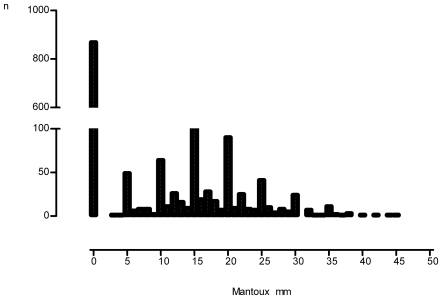
METHODOLOGY/PRINCIPAL FINDINGS: 1512 South African children younger than 5 years of age who were investigated for tuberculosis (TB) during a Bacille Calmette Guerin (BCG) trial were included in this analysis. Children underwent both Mantoux and Tine tests. A positive test was defined as Mantoux >or=15 mm or Tine >or= Grade 3 for the binary comparison. Agreement was evaluated using kappa (binary) and weighted kappa (hierarchical). Multivariate regression models identified independent risk factors for TST positivity. The Mantoux test was positive in 430 children (28.4%) and the Tine test in 496 children (32.8%, p<0.0001), with observed binary agreement 87.3% (kappa 0.70) and hierarchical agreement 85.0% (weighted kappa 0.66). Among 173 children culture-positive for Mycobacterium tuberculosis, Mantoux was positive in 49.1% and Tine in 54.9%, p<0.0001 (kappa 0.70). Evidence of digit preference was noted for Mantoux readings at 5 mm threshold intervals. After adjustment for confounders, a positive culture, suggestive chest radiograph, and proximity of TB contact were risk factors for a positive test using both TST methods. There were no independent associations between ethnicity, gender, age, or over-crowding, and TST result.
CONCLUSIONS/SIGNIFICANCE: The Tine test demonstrated a higher positive test rate than the Mantoux, with substantial agreement between TST methods among young BCG-vaccinated children. TB disease and exposure factors, but not demographic variables, were independent risk factors for a positive result using either test method. These findings suggest that the Tine might be a useful screening tool for childhood TB in resource-limited countries.
结核菌素皮肤试验(TST)是一种长期以来用于筛查结核病(TB)的方法。本研究旨在比较皮内曼妥昔和多针经皮 Tine 方法之间的一致性,并量化阳性检测结果的相关风险因素。
方法/主要发现:本研究共纳入了 1512 名南非 5 岁以下疑似结核病(TB)患儿,他们参加了卡介苗(BCG)试验。所有患儿均接受了曼妥昔和 Tine 两种测试。将曼妥昔测试结果>15mm 或 Tine 测试结果≥3 级定义为阳性。采用 Kappa(二分类)和加权 Kappa(等级)对一致性进行评估。多变量回归模型确定了 TST 阳性的独立风险因素。430 名患儿(28.4%)曼妥昔测试阳性,496 名患儿(32.8%)Tine 测试阳性(p<0.0001),观察到的二分类一致性为 87.3%(Kappa 0.70),等级一致性为 85.0%(加权 Kappa 0.66)。在 173 名结核分枝杆菌培养阳性的患儿中,曼妥昔测试阳性率为 49.1%,Tine 测试阳性率为 54.9%(p<0.0001)(Kappa 0.70)。在 5mm 阈值间隔的曼妥昔测试读数中观察到数字偏好证据。在调整混杂因素后,培养阳性、提示性胸片和结核接触的临近程度是两种 TST 方法阳性检测的危险因素。种族、性别、年龄或过度拥挤与 TST 结果之间没有独立关联。
结论/意义:Tine 测试的阳性检出率高于曼妥昔,两种 TST 方法在年轻 BCG 接种儿童中具有高度一致性。TB 疾病和暴露因素是两种测试方法阳性结果的独立风险因素,而不是人口统计学变量。这些发现表明,Tine 可能是资源有限国家儿童结核病筛查的有用工具。