Department of Biological Sciences, Purdue University, West Lafayette, Indiana, United States of America.
PLoS Pathog. 2009 Nov;5(11):e1000672. doi: 10.1371/journal.ppat.1000672. Epub 2009 Nov 26.
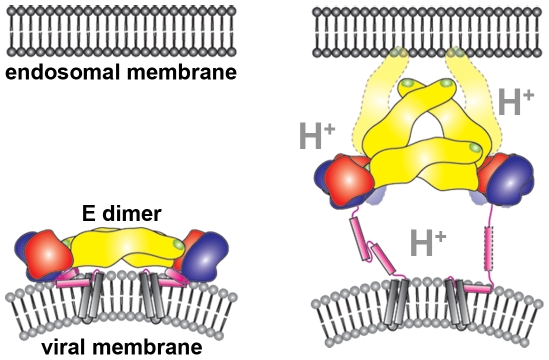
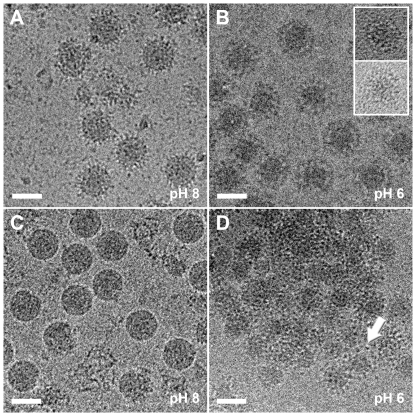
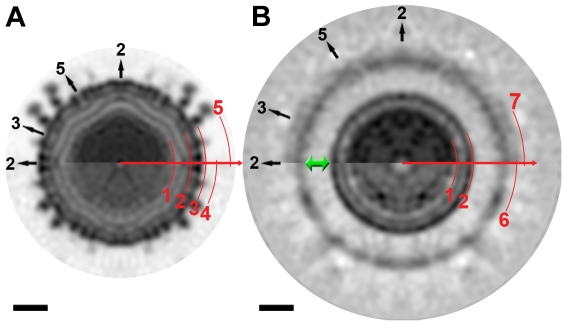
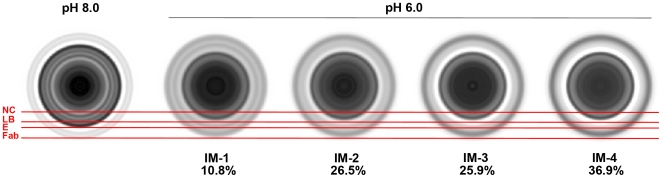
During cell entry of flaviviruses, low endosomal pH triggers the rearrangement of the viral surface glycoproteins to a fusion-active state that allows the release of the infectious RNA into the cytoplasm. In this work, West Nile virus was complexed with Fab fragments of the neutralizing mAb E16 and was subsequently exposed to low pH, trapping the virions in a pre-fusion intermediate state. The structure of the complex was studied by cryo-electron microscopy and provides the first structural glimpse of a flavivirus fusion intermediate near physiological conditions. A radial expansion of the outer protein layer of the virion was observed compared to the structure at pH 8. The resulting approximately 60 A-wide shell of low density between lipid bilayer and outer protein layer is likely traversed by the stem region of the E glycoprotein. By using antibody fragments, we have captured a structural intermediate of a virus that likely occurs during cell entry. The trapping of structural transition states by antibody fragments will be applicable for other processes in the flavivirus life cycle and delineating other cellular events that involve conformational rearrangements.
在黄病毒进入细胞的过程中,低内涵体 pH 值会引发病毒表面糖蛋白的重排,使其进入融合激活状态,从而将感染性 RNA 释放到细胞质中。在这项工作中,西尼罗河病毒与中和单抗 E16 的 Fab 片段结合,随后暴露于低 pH 值环境下,将病毒困在融合前的中间状态。通过冷冻电镜研究了该复合物的结构,为在生理条件下观察黄病毒融合中间态提供了第一个结构视角。与 pH 值为 8 时的结构相比,观察到病毒的外层蛋白发生了径向扩张。在脂双层和外层蛋白层之间形成的低密度约 60Å 宽的壳可能是由 E 糖蛋白的茎区穿过的。通过使用抗体片段,我们捕获了可能发生在细胞进入过程中的病毒结构中间态。通过抗体片段捕获结构转换状态将适用于黄病毒生命周期中的其他过程,并阐明涉及构象重排的其他细胞事件。