Men R H, Bray M, Lai C J
Molecular Viral Biology Section, National Institute of Allergy and Infectious Diseases, Bethesda, Maryland 20892.
J Virol. 1991 Mar;65(3):1400-7. doi: 10.1128/JVI.65.3.1400-1407.1991.
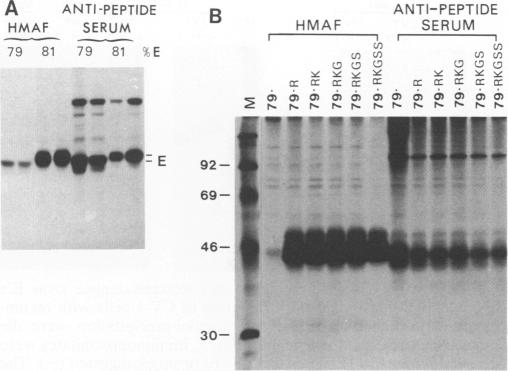
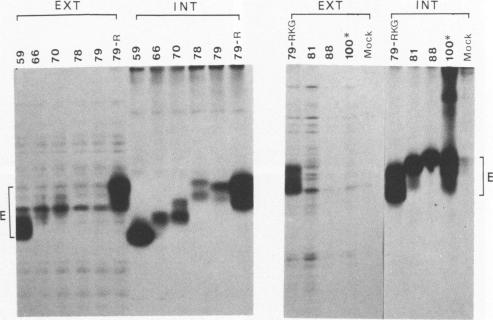
Recombinant vaccinia viruses expressing C-terminally truncated E's that ranged in length from 9 to 99% of the N-terminal sequence were constructed. The overall antigenicity of the E products was analyzed by radioimmunoprecipitation, using dengue virus hyperimmune mouse ascitic fluid (HMAF) or an anti-E peptide serum. Truncated E that was 79% or less in length did not bind HMAF efficiently, whereas E constructs greater than 79% were able to bind HMAF with high efficiency. The first 392 amino acids of the dengue type 4 virus E sequence, including the Arg-392 following the 79% E C terminus, appeared to be critical for proper antigenic structure required for efficient binding by HMAF. Truncated E's ranging from 59 to 81% in length were secreted extracellularly, whereas smaller or larger E's were retained intracellularly. Secreted E's contained carbohydrate side chains that were resistant to endoglycosidase H digestion, suggesting that the transport of E occurs via a pathway from the rough endoplasmic reticulum through the Golgi complex. 79% E-RKG (which possessed the three additional amino acids immediately downstream of 79% E) was expressed at a high concentration on the surface of recombinant virus-infected cells presumably being inserted into the plasma membrane by a hydrophobic C-terminal membrane anchor. Evaluation in mice of the protective efficacy of the various vaccinia virus E recombinants indicated that only truncated E's that were recognized efficiently by HMAF induced a high level of resistance to dengue virus encephalitis. 79% E-RKG which is expressed at a high concentration on the surface of infected cells was highly immunogenic when tested for induction of an E antibody response. This suggests that cell surface expression of 79% E-RKG was responsible for its enhanced immunogenicity. Finally, passive immunization studies indicated that serum antibodies to E played a major role in the complete or nearly complete resistance to dengue virus challenge induced by certain vaccinia virus-truncated E recombinants.
构建了表达C末端截短的E蛋白的重组痘苗病毒,其长度范围为N末端序列的9%至99%。使用登革病毒超免疫小鼠腹水(HMAF)或抗E肽血清,通过放射免疫沉淀分析E产物的总体抗原性。长度为79%或更短的截短E不能有效地结合HMAF,而长度大于79%的E构建体能够高效地结合HMAF。登革4型病毒E序列的前392个氨基酸,包括79%E C末端后的Arg-392,似乎对HMAF有效结合所需的正确抗原结构至关重要。长度在59%至81%之间的截短E分泌到细胞外,而更小或更大的E则保留在细胞内。分泌的E含有对内切糖苷酶H消化有抗性的碳水化合物侧链,这表明E的转运通过从粗面内质网经高尔基体复合体的途径进行。79%E-RKG(在79%E的紧邻下游具有另外三个氨基酸)以高浓度表达在重组病毒感染细胞的表面,推测是通过疏水的C末端膜锚定插入到质膜中。对各种痘苗病毒E重组体的保护效力在小鼠中的评估表明,只有被HMAF有效识别的截短E诱导了对登革病毒脑炎的高水平抗性。在测试诱导E抗体反应时,在感染细胞表面以高浓度表达的79%E-RKG具有高度免疫原性。这表明79%E-RKG的细胞表面表达是其增强免疫原性的原因。最后,被动免疫研究表明,针对E的血清抗体在某些痘苗病毒截短E重组体诱导产生的对登革病毒攻击的完全或几乎完全抗性中起主要作用。