Bray M, Zhao B T, Markoff L, Eckels K H, Chanock R M, Lai C J
Laboratory of Infectious Diseases, National Institute of Allergy and Infectious Diseases, Bethesda, Maryland 20892.
J Virol. 1989 Jun;63(6):2853-6. doi: 10.1128/JVI.63.6.2853-2856.1989.
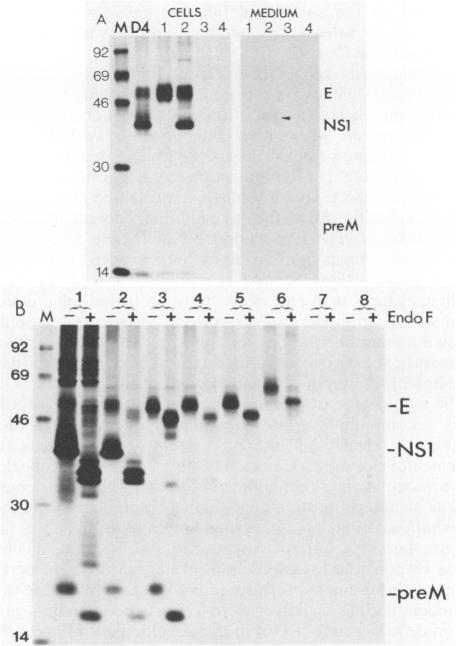
We have constructed vaccinia virus recombinants expressing dengue virus proteins from cloned DNA for use in experimental immunoprophylaxis. A recombinant virus containing a 4.0-kilobase DNA sequence that codes for three structural proteins, capsid (C), premembrane (pre-M), and envelope (E), and for nonstructural proteins NS1 and NS2a produced authentic pre-M, E, and NS1 in infected CV-1 cells. Mice immunized with this recombinant were protected against an intracerebral injection of 100 50% lethal doses of dengue 4 virus. A recombinant containing only genes C, pre-M, and E also induced solid resistance to challenge. Deletion of the putative C-terminal hydrophobic anchor of the E glycoprotein did not result in secretion of E from recombinant-virus-infected cells. Recombinants expressing only the E protein preceded by its own predicted N-terminal hydrophobic signal or by the signal of influenza A virus hemagglutinin or by the N-terminal 71 amino acids of the G glycoprotein of respiratory syncytial virus produced glycosylated E protein products of expected molecular sizes. These vaccinia virus recombinants also protected mice.
我们构建了痘苗病毒重组体,其表达来自克隆DNA的登革病毒蛋白,用于实验性免疫预防。一种重组病毒含有一段4.0千碱基的DNA序列,该序列编码三种结构蛋白,即衣壳蛋白(C)、前膜蛋白(pre-M)和包膜蛋白(E),以及非结构蛋白NS1和NS2a,在感染的CV-1细胞中产生了真实的pre-M、E和NS1。用这种重组体免疫的小鼠可抵抗脑内注射100个50%致死剂量的登革4型病毒。仅含有基因C、pre-M和E的重组体也诱导了对攻击的稳固抗性。E糖蛋白假定的C末端疏水锚的缺失并未导致E从重组病毒感染的细胞中分泌。表达仅由其自身预测的N末端疏水信号或甲型流感病毒血凝素信号或呼吸道合胞病毒G糖蛋白的N末端71个氨基酸引导的E蛋白的重组体产生了预期分子大小的糖基化E蛋白产物。这些痘苗病毒重组体也保护了小鼠。