Centre de Recherche des Cordeliers, INSERM, UMR-S 872, Paris, France.
Diabetes. 2010 Mar;59(3):600-10. doi: 10.2337/db09-0897. Epub 2009 Dec 3.
Ceramide is now recognized as a negative regulator of insulin signaling by impairing protein kinase B (PKB)/Akt activation. In different cells, two distinct mechanisms have been proposed to mediate ceramide inhibition of PKB/Akt: one involving atypical protein kinase C zeta (PKCzeta) and the other the protein phosphatase-2 (PP2A). We hypothesized that ceramide action through PKCzeta or PP2A might depend on plasma membrane (PM) structural organization and especially on caveolin-enriched domain (CEM) abundance.
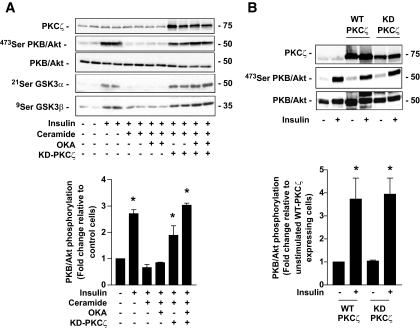
We have used different PKCzeta mutant constructs or the PP2A inhibitor, okadaic acid (OKA), to selectively inhibit PKCzeta- and PP2A-dependent pathways in cells expressing different caveolin-1 levels and evaluated the impact of insulin and ceramide on PKB/Akt activity in different PM subdomains.
Although the PKCzeta-mediated negative effect of ceramide on insulin-stimulated PKB/Akt was dominant in adipocytes, a ceramide action through PP2A outside CEMs, prevented by OKA, was also unraveled. To test the importance of CEM to direct ceramide action through the PKCzeta pathway, we treated 3T3-L1 preadipocytes devoid of CEMs with ceramide and we saw a shift of the lipid-negative action on PKB/Akt to a PP2A-mediated mechanism. In fibroblasts with low CEM abundance, the ceramide-activated PP2A pathway dominated, but could be shifted to a ceramide-activated PKCzeta pathway after caveolin-1 overexpression.
Our results show that ceramide can switch from a PKCzeta-dependent mechanism to a PP2A pathway, acting negatively on PKB/Akt, and hence revealing a critical role of CEMs of the PM in this process.
神经酰胺通过损害蛋白激酶 B(PKB)/Akt 的激活,被认为是胰岛素信号的负调节剂。在不同的细胞中,已经提出了两种不同的机制来介导神经酰胺对 PKB/Akt 的抑制:一种涉及非典型蛋白激酶 C zeta(PKCzeta),另一种涉及蛋白磷酸酶-2(PP2A)。我们假设神经酰胺通过 PKCzeta 或 PP2A 的作用可能取决于质膜(PM)的结构组织,特别是富含窖蛋白的域(CEM)的丰度。
我们使用不同的 PKCzeta 突变体构建物或 PP2A 抑制剂,冈田酸(OKA),选择性地抑制表达不同窖蛋白-1 水平的细胞中的 PKCzeta 和 PP2A 依赖性途径,并评估胰岛素和神经酰胺对不同 PM 亚域中 PKB/Akt 活性的影响。
尽管神经酰胺通过 PKCzeta 对胰岛素刺激的 PKB/Akt 的负性作用在脂肪细胞中占主导地位,但也揭示了一种通过 PP2A 在 CEM 之外的神经酰胺作用,该作用被 OKA 阻止。为了测试 CEM 对通过 PKCzeta 途径直接作用于神经酰胺的重要性,我们用神经酰胺处理缺乏 CEM 的 3T3-L1 前脂肪细胞,我们看到脂质对 PKB/Akt 的负性作用转移到 PP2A 介导的机制。在窖蛋白-1 丰度低的成纤维细胞中,神经酰胺激活的 PP2A 途径占主导地位,但在窖蛋白-1 过表达后,可转移到神经酰胺激活的 PKCzeta 途径。
我们的结果表明,神经酰胺可以从依赖于 PKCzeta 的机制切换到 PP2A 途径,从而对 PKB/Akt 产生负性作用,因此揭示了 PM 的 CEM 在这个过程中的关键作用。