Institute for Brain Disorders and Neural Regeneration, Albert Einstein College of Medicine, Bronx, New York, United States of America.
PLoS One. 2009 Dec 7;4(12):e7936. doi: 10.1371/journal.pone.0007936.
The repressor element-1 silencing transcription factor/neuron-restrictive silencer factor (REST/NRSF) is a master regulator of neuronal gene expression. REST functions as a modular scaffold for dynamic recruitment of epigenetic regulatory factors including its primary cofactor, the corepressor for element-1-silencing transcription factor (CoREST), to genomic loci that contain the repressor element-1 (RE1) binding motif. While REST was initially believed to silence RE1 containing neuronal genes in neural stem cells (NSCs) and non-neuronal cells, emerging evidence shows an increasingly complex cell type- and developmental stage-specific repertoire of REST target genes and functions that include regulation of neuronal lineage maturation and plasticity.
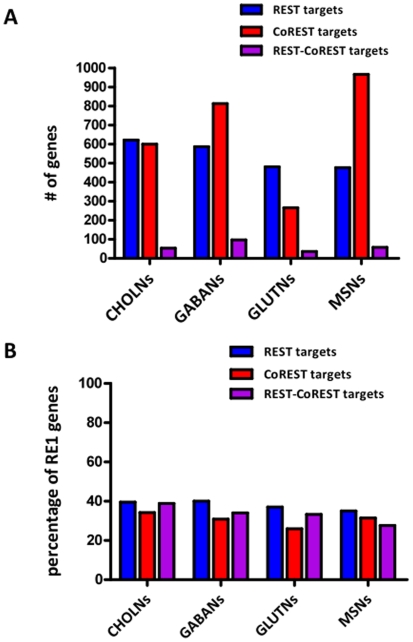
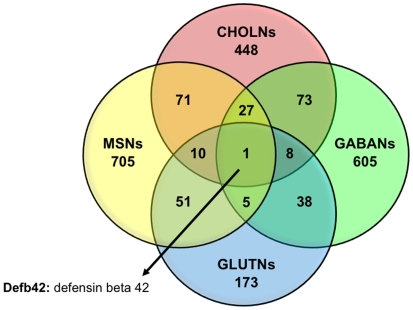
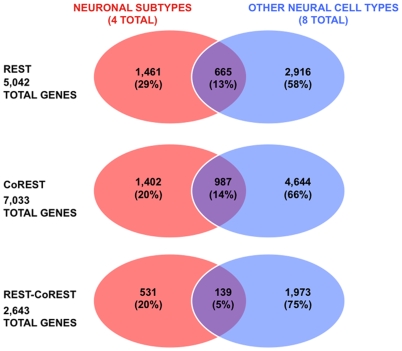
METHODOLOGY/PRINCIPAL FINDINGS: In this study, we utilized chromatin immunoprecipitation on chip (ChIP-chip) analysis to examine REST and CoREST functions during NSC-mediated specification of cholinergic neurons (CHOLNs), GABAergic neurons (GABANs), glutamatergic neurons (GLUTNs), and medium spiny projection neurons (MSNs). We identified largely distinct but overlapping profiles of REST and CoREST target genes during neuronal subtype specification including a disproportionately high percentage that are exclusive to each neuronal subtype.
CONCLUSIONS/SIGNIFICANCE: Our findings demonstrate that the differential deployment of REST and CoREST is an important regulatory mechanism that mediates neuronal subtype specification by modulating specific gene networks responsible for inducing and maintaining neuronal subtype identity. Our observations also implicate a broad array of factors in the generation of neuronal diversity including but not limited to those that mediate homeostasis, cell cycle dynamics, cell viability, stress responses and epigenetic regulation.
阻遏元件-1 沉默转录因子/神经元抑制因子(REST/NRSF)是神经元基因表达的主要调节因子。REST 作为一种模块化支架,可动态募集表观遗传调节因子,包括其主要辅助因子元件-1 沉默转录因子(CoREST)的核心抑制因子,以基因组位点包含阻遏元件-1(RE1)结合基序。虽然最初认为 REST 在神经干细胞(NSCs)和非神经元细胞中沉默含有 RE1 的神经元基因,但新出现的证据显示,REST 靶基因和功能具有越来越复杂的细胞类型和发育阶段特异性,包括调节神经元谱系成熟和可塑性。
方法/主要发现:在这项研究中,我们利用染色质免疫沉淀芯片(ChIP-chip)分析,研究了 REST 和 CoREST 在 NSC 介导的胆碱能神经元(CHOLNs)、GABA 能神经元(GABANs)、谷氨酸能神经元(GLUTNs)和中等棘突投射神经元(MSNs)分化过程中的功能。我们在神经元亚型特化过程中鉴定了 REST 和 CoREST 的靶基因,它们具有很大的不同但又有重叠的特征,包括很大比例的基因是每个神经元亚型所特有的。
结论/意义:我们的发现表明,REST 和 CoREST 的差异表达是一种重要的调节机制,通过调节负责诱导和维持神经元亚型特征的特定基因网络,介导神经元亚型特化。我们的观察结果还暗示了广泛的因素参与了神经元多样性的产生,包括但不限于那些介导内稳态、细胞周期动态、细胞活力、应激反应和表观遗传调节的因素。