Division of Pharmacoepidemiology and Pharmacotherapy, Utrecht Institute for pharmaceutical Sciences, Utrecht University, PO Box 80082, 3508 TB Utrecht, The Netherlands.
Orphanet J Rare Dis. 2009 Dec 14;4:27. doi: 10.1186/1750-1172-4-27.
Regulators and payers have to strike a balance between the needs of the patient and the optimal allocation of resources. Drugs indicated for rare diseases (orphan medicines) are a special group in this context because of their often high per unit costs. Our objective in this pilot study was to determine, for drugs used in an outpatient setting, how utilisation of centrally authorised drugs varies between countries across a selection of EU member states.
We randomly selected five orphan medicines and nine other drugs that were centrally authorised in the European Union between January 2000 and November 2006. We compared utilisation of these drugs in six European Union member states: Austria, Denmark, Finland, Portugal, The Netherlands, and Sweden. Utilisation data were expressed as Defined Daily Doses per 1000 persons per year. Variability in use across countries was determined by calculating the relative standard deviation for the utilisation rates of individual drugs across countries.
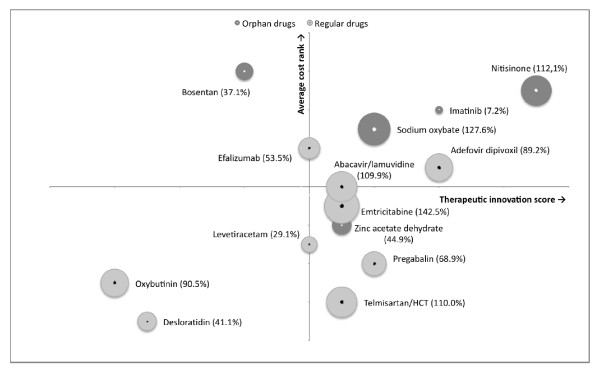
No association between orphan medicine status and variability in use across countries was found (P = 0.52). Drugs with an orphan medicine status were more expensive and had a higher innovation score than drugs without an orphan medicine status.
The results show that the variability in use of orphan medicines in the different health care systems of the European Union appears to be comparable to the other newly authorised drugs that were included in the analysis. This means that, although strong heterogeneity in access may exist, this heterogeneity is not specific for drugs with an orphan status.
监管机构和支付方必须在患者需求和资源的最佳配置之间取得平衡。在这种情况下,用于治疗罕见病(孤儿药)的药物是一个特殊群体,因为它们的单位成本往往很高。我们在这项试点研究中的目的是,确定在门诊环境中使用的药物,在一系列欧盟成员国中,各国对中央授权药物的使用情况如何存在差异。
我们随机选择了五种孤儿药和九种其他在 2000 年 1 月至 2006 年 11 月期间在欧盟获得中央授权的药物。我们比较了这六种欧盟成员国(奥地利、丹麦、芬兰、葡萄牙、荷兰和瑞典)使用这些药物的情况。利用数据表示为每 1000 人每年的限定日剂量。通过计算各国个别药物利用率的相对标准偏差来确定各国之间使用的变异性。
我们未发现孤儿药地位与各国之间使用的变异性之间存在关联(P=0.52)。具有孤儿药地位的药物比没有孤儿药地位的药物更昂贵,创新评分更高。
结果表明,欧盟不同医疗保健系统中孤儿药的使用变异性似乎与纳入分析的其他新授权药物相当。这意味着,尽管在获得药物方面可能存在强烈的异质性,但这种异质性并不是孤儿药特有的。