Sprinzak Einat, Cokus Shawn J, Yeates Todd O, Eisenberg David, Pellegrini Matteo
UCLA-DOE Institute for Genomics and Proteomics, University of California Los Angeles, Los Angeles, CA, USA.
BMC Syst Biol. 2009 Dec 14;3:115. doi: 10.1186/1752-0509-3-115.
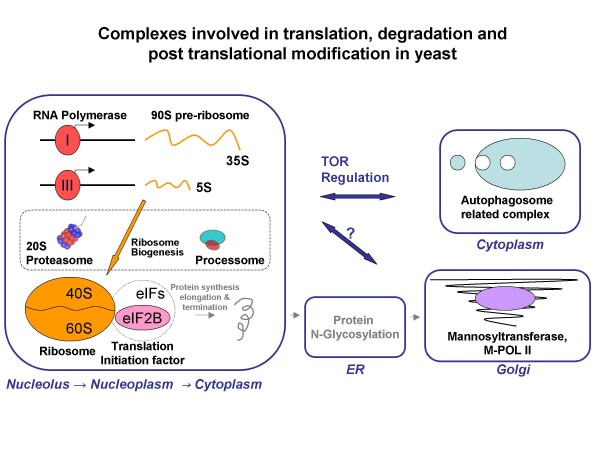
Many of the functional units in cells are multi-protein complexes such as RNA polymerase, the ribosome, and the proteasome. For such units to work together, one might expect a high level of regulation to enable co-appearance or repression of sets of complexes at the required time. However, this type of coordinated regulation between whole complexes is difficult to detect by existing methods for analyzing mRNA co-expression. We propose a new methodology that is able to detect such higher order relationships.
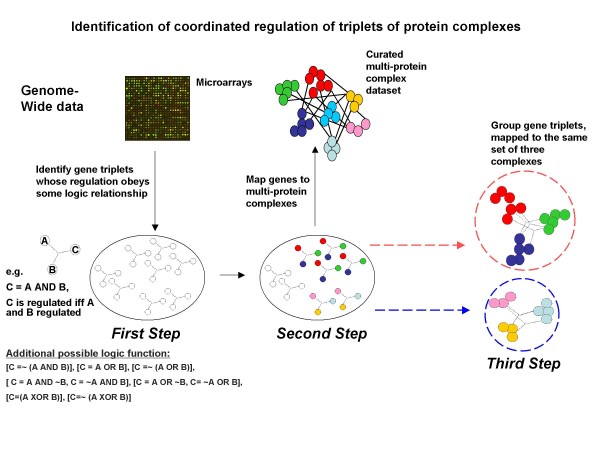
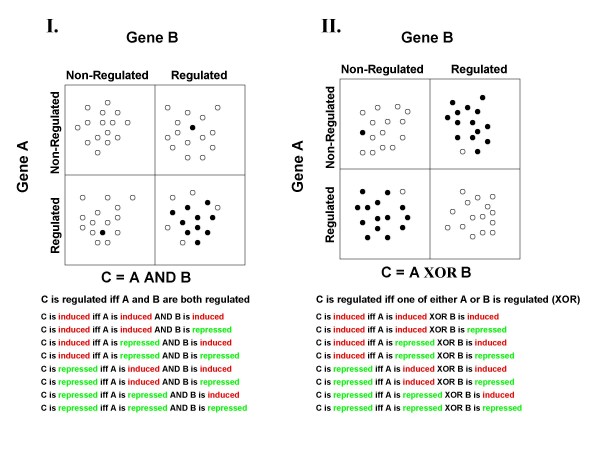
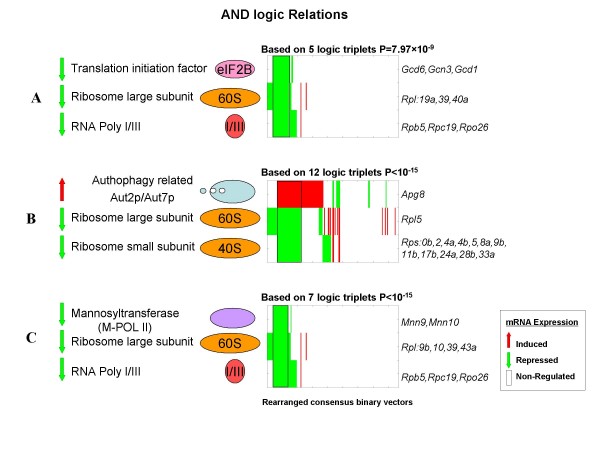
We detect coordinated regulation of multiple protein complexes using logic analysis of gene expression data. Specifically, we identify gene triplets composed of genes whose expression profiles are found to be related by various types of logic functions. In order to focus on complexes, we associate the members of a gene triplet with the distinct protein complexes to which they belong. In this way, we identify complexes related by specific kinds of regulatory relationships. For example, we may find that the transcription of complex C is increased only if the transcription of both complex A AND complex B is repressed. We identify hundreds of examples of coordinated regulation among complexes under various stress conditions. Many of these examples involve the ribosome. Some of our examples have been previously identified in the literature, while others are novel. One notable example is the relationship between the transcription of the ribosome, RNA polymerase and mannosyltransferase II, which is involved in N-linked glycan processing in the Golgi.
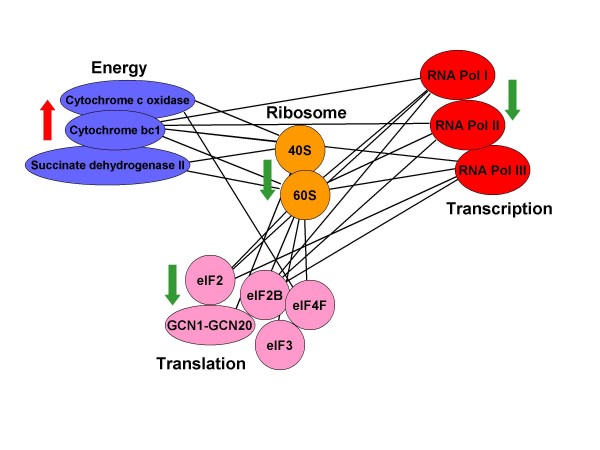
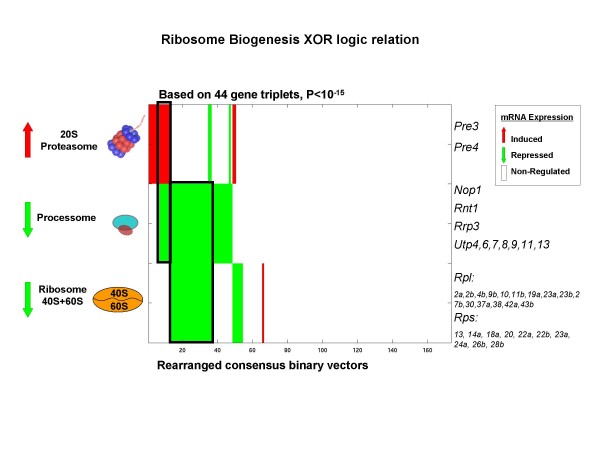
The analysis proposed here focuses on relationships among triplets of genes that are not evident when genes are examined in a pairwise fashion as in typical clustering methods. By grouping gene triplets, we are able to decipher coordinated regulation among sets of three complexes. Moreover, using all triplets that involve coordinated regulation with the ribosome, we derive a large network involving this essential cellular complex. In this network we find that all multi-protein complexes that belong to the same functional class are regulated in the same direction as a group (either induced or repressed).
细胞中的许多功能单元都是多蛋白复合体,如RNA聚合酶、核糖体和蛋白酶体。为了使这些单元协同工作,人们可能期望有高水平的调控,以便在需要时使复合体集合共同出现或受到抑制。然而,现有的分析mRNA共表达的方法很难检测到整个复合体之间的这种协同调控。我们提出了一种能够检测这种高阶关系的新方法。
我们使用基因表达数据的逻辑分析来检测多种蛋白复合体的协同调控。具体来说,我们识别由基因组成的基因三联体,这些基因的表达谱通过各种逻辑功能相互关联。为了聚焦于复合体,我们将基因三联体的成员与其所属的不同蛋白复合体联系起来。通过这种方式,我们识别出通过特定类型调控关系相关联的复合体。例如,我们可能发现只有当复合体A和复合体B的转录都受到抑制时,复合体C的转录才会增加。我们在各种应激条件下识别出数百个复合体之间协同调控的例子。其中许多例子都涉及核糖体。我们的一些例子先前已在文献中被识别,而其他的则是新发现的。一个值得注意的例子是核糖体、RNA聚合酶和参与高尔基体中N - 连接聚糖加工的甘露糖基转移酶II转录之间的关系。
本文提出的分析方法聚焦于基因三联体之间的关系,而这些关系在像典型聚类方法那样以成对方式检查基因时并不明显。通过对基因三联体进行分组,我们能够解读三个复合体集合之间的协同调控。此外,利用所有与核糖体存在协同调控的三联体,我们构建了一个涉及这个重要细胞复合体的大型网络。在这个网络中,我们发现属于同一功能类别的所有多蛋白复合体作为一个组受到相同方向的调控(要么被诱导,要么被抑制)。