Centro de Estudos do Genoma Humano, Instituto de Biociências, Universidade de São Paulo, São Paulo, SP, Brazil.
BMC Med Genet. 2009 Dec 14;10:136. doi: 10.1186/1471-2350-10-136.
Treacher Collins syndrome (TCS) is an autosomal dominant craniofacial disorder caused by frameshift deletions or duplications in the TCOF1 gene. These mutations cause premature termination codons, which are predicted to lead to mRNA degradation by nonsense mediated mRNA decay (NMD). Haploinsufficiency of the gene product (treacle) during embryonic development is the proposed molecular mechanism underlying TCS. However, it is still unknown if TCOF1 expression levels are decreased in post-embryonic human cells.
We have estimated TCOF1 transcript levels through real time PCR in mRNA obtained from leucocytes and mesenchymal cells of TCS patients (n = 23) and controls (n = 18). Mutational screening and analysis of NMD were performed by direct sequencing of gDNA and cDNA, respectively.
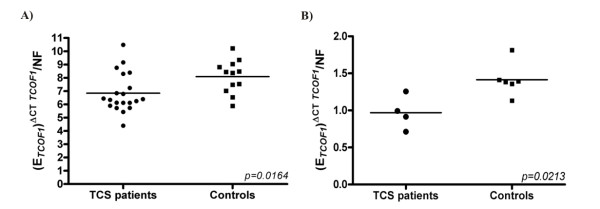
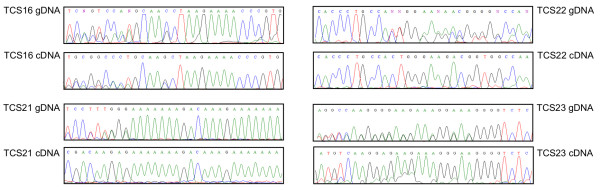
All the 23 patients had typical clinical features of the syndrome and pathogenic mutations were detected in 19 of them. We demonstrated that the expression level of TCOF1 is 18-31% lower in patients than in controls (p < 0.05), even if we exclude the patients in whom we did not detect the pathogenic mutation. We also observed that the mutant allele is usually less abundant than the wild type one in mesenchymal cells.
This is the first study to report decreased expression levels of TCOF1 in TCS adult human cells, but it is still unknown if this finding is associated to any phenotype in adulthood. In addition, as we demonstrated that alleles harboring the pathogenic mutations have lower expression, we herein corroborate the current hypothesis of NMD of the mutant transcript as the explanation for diminished levels of TCOF1 expression. Further, considering that TCOF1 deficiency in adult cells could be associated to pathologic clinical findings, it will be important to verify if TCS patients have an impairment in adult stem cell properties, as this can reduce the efficiency of plastic surgery results during rehabilitation of these patients.
Treacher Collins 综合征(TCS)是一种常染色体显性颅面发育障碍,由 TCOF1 基因的移码缺失或重复引起。这些突变导致提前出现终止密码子,据预测这会导致无意义介导的 mRNA 降解(NMD)导致 mRNA 降解。胚胎发育过程中基因产物(treacle)的单倍不足被认为是 TCS 的分子机制。然而,尚不清楚 TCOF1 在胚胎后人类细胞中的表达水平是否降低。
我们通过实时 PCR 从 TCS 患者(n=23)和对照者(n=18)的白细胞和间充质细胞获得的 mRNA 中估计 TCOF1 转录本水平。通过直接对 gDNA 和 cDNA 进行测序分别进行 NMD 的突变筛选和分析。
所有 23 例患者均具有该综合征的典型临床特征,其中 19 例检测到致病性突变。我们证明,与对照者相比,患者的 TCOF1 表达水平低 18-31%(p<0.05),即使我们排除了未检测到致病性突变的患者。我们还观察到,在间充质细胞中,突变等位基因通常比野生型等位基因含量少。
这是第一项报道 TCS 成年人类细胞中 TCOF1 表达水平降低的研究,但尚不清楚这一发现是否与成年后的任何表型有关。此外,由于我们证明携带致病性突变的等位基因表达水平较低,我们在此证实了突变转录本 NMD 的假说,解释了 TCOF1 表达水平降低的原因。此外,由于成年细胞中的 TCOF1 缺乏可能与病理性临床发现有关,因此验证 TCS 患者是否存在成年干细胞特性受损将非常重要,因为这可能会降低这些患者康复过程中整形手术结果的效率。