INRA, UR 346, F-63122 Saint-Genès-Champanelle, France-Unité AGIRs, CIRAD, France.
Vet Res. 2010 May-Jun;41(3):28. doi: 10.1051/vetres/2009076. Epub 2009 Dec 16.
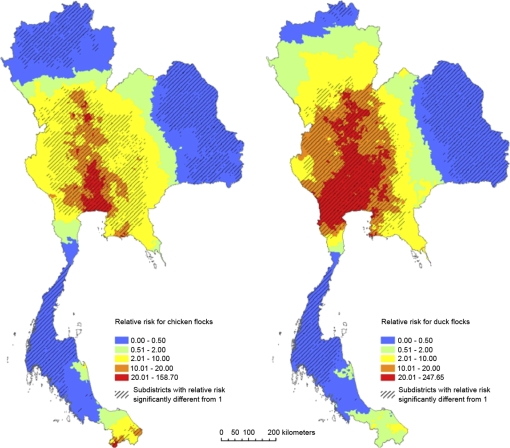
Beginning in 2003, highly pathogenic avian influenza (HPAI) H5N1 virus spread across Southeast Asia, causing unprecedented epidemics. Thailand was massively infected in 2004 and 2005 and continues today to experience sporadic outbreaks. While research findings suggest that the spread of HPAI H5N1 is influenced primarily by trade patterns, identifying the anthropogenic risk factors involved remains a challenge. In this study, we investigated which anthropogenic factors played a role in the risk of HPAI in Thailand using outbreak data from the "second wave" of the epidemic (3 July 2004 to 5 May 2005) in the country. We first performed a spatial analysis of the relative risk of HPAI H5N1 at the subdistrict level based on a hierarchical Bayesian model. We observed a strong spatial heterogeneity of the relative risk. We then tested a set of potential risk factors in a multivariable linear model. The results confirmed the role of free-grazing ducks and rice-cropping intensity but showed a weak association with fighting cock density. The results also revealed a set of anthropogenic factors significantly linked with the risk of HPAI. High risk was associated strongly with densely populated areas, short distances to a highway junction, and short distances to large cities. These findings highlight a new explanatory pattern for the risk of HPAI and indicate that, in addition to agro-environmental factors, anthropogenic factors play an important role in the spread of H5N1. To limit the spread of future outbreaks, efforts to control the movement of poultry products must be sustained.
自 2003 年以来,高致病性禽流感(HPAI)H5N1 病毒在东南亚地区传播,造成了前所未有的疫情。泰国在 2004 年和 2005 年受到了大规模感染,至今仍不时爆发疫情。虽然研究结果表明,HPAI H5N1 的传播主要受贸易模式影响,但确定其中涉及的人为风险因素仍然是一个挑战。在这项研究中,我们利用该国“第二波”(2004 年 7 月 3 日至 2005 年 5 月 5 日)疫情的暴发数据,调查了哪些人为因素在泰国的 HPAI 风险中发挥了作用。我们首先使用分层贝叶斯模型对 HPAI H5N1 的相对风险进行了分区级别上的空间分析。我们观察到相对风险存在很强的空间异质性。然后,我们在多变量线性模型中测试了一组潜在的风险因素。结果证实了自由放养鸭子和水稻种植强度的作用,但与斗鸡密度的关联较弱。结果还揭示了一组与 HPAI 风险显著相关的人为因素。高风险与人口密集地区、与高速公路交叉口的短距离以及与大城市的短距离密切相关。这些发现强调了 HPAI 风险的一种新的解释模式,并表明除了农业环境因素外,人为因素在 H5N1 的传播中也发挥了重要作用。为了限制未来疫情的传播,必须持续努力控制家禽产品的流动。