Faculty of Science, Center of Excellence for Vectors and Vector Borne Diseases, Mahidol University at Salaya, 999 Phutthamonthon 4, Nakhon Pathom 73170, Thailand.
Int J Health Geogr. 2010 Jan 27;9:3. doi: 10.1186/1476-072X-9-3.
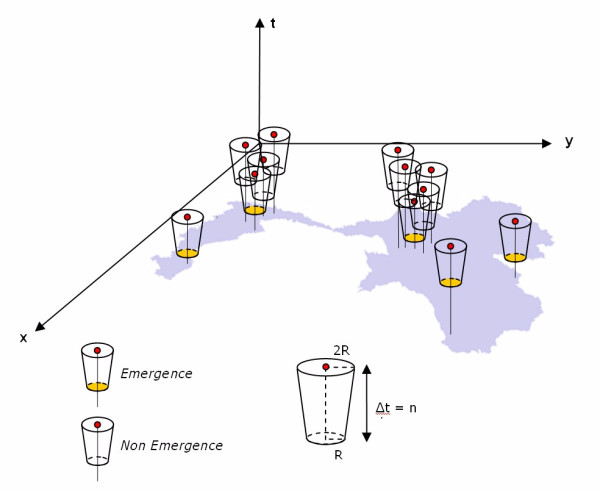
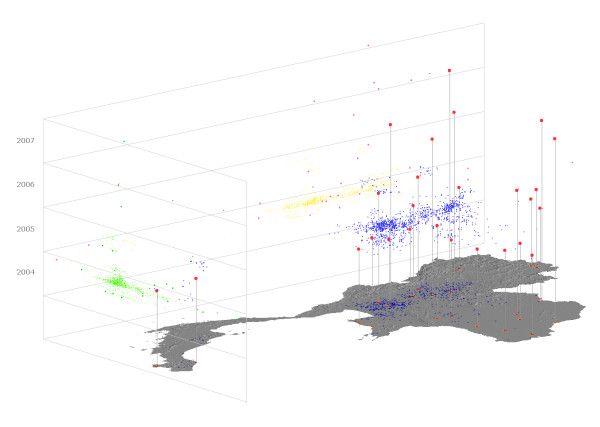
The highly pathogenic avian influenza (HPAI) H5N1 virus remains a worldwide threat to human and animal health, while the mechanisms explaining its epizootic emergence and re-emergence in poultry are largely unknown. Data from Thailand, a country that experienced significant epidemics in poultry and has recorded suspicious cases of HPAI on a daily basis since 2004, are used here to study the process of emergence. A spatial approach is employed to describe all HPAI H5N1 virus epizootics from 2004 to 2008 and to characterize the pattern of emergence: multiple independent introductions of the virus followed by moderate local spread vs. very rare emergencies followed by strong local spread and rare long range diffusion jumps. Sites where epizootics originate (by foreign introduction, local persistence, or long range jump) were selected from those to which the disease subsequently spreads using a filter based on relative date and position. The spatial distribution of these selected foci was statistically analyzed, and to differentiate environmental factors from long range diffusion, we investigate the relationship of these foci with environmental exposure factors and with rearing characteristics.
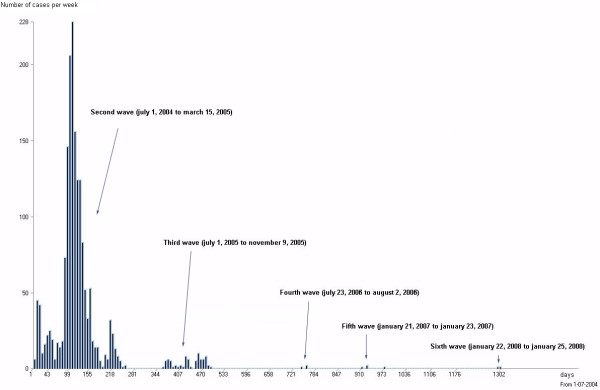
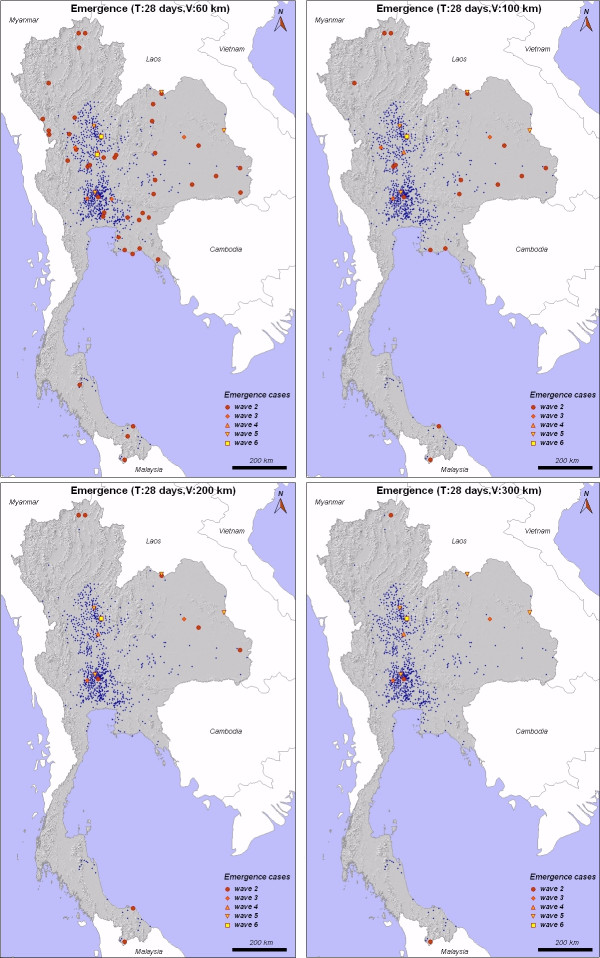
During each wave of epizootics, the temporal occurrence of cases did not show a temporal interruption of more than a week. All foci were globally clustered; i.e., more than 90% of cases had a previous case within a 10 km range and a 21 day period of time, showing a strong local spread. We were able to estimate 60 km as the maximum distance for the local farm to farm dissemination process. The remaining "emergent" cases have occurred randomly over Thailand and did not show specific location, clusters, or trends. We found that these foci are not statistically related to specific environmental conditions or land cover characteristics, and most of them may be interpreted as long range diffusion jumps due to commercial practices.
We conclude that only a few foci appear to have been at the origin of each HPAI epidemic wave, leading to the practical action that surveillance and control must focus on farm to farm transmission rather than on emergence or wild fauna.
高致病性禽流感(HPAI)H5N1 病毒仍然对人类和动物健康构成全球威胁,而解释其在禽类中爆发和再次出现的机制在很大程度上尚不清楚。本文使用来自泰国的数据进行研究,泰国在禽类中经历了重大疫情,并自 2004 年以来每天都有可疑的 HPAI 病例记录。采用空间方法描述 2004 年至 2008 年所有 HPAI H5N1 病毒的爆发,并描述爆发模式:病毒的多次独立传入,随后是中度局部传播,与非常罕见的紧急情况,随后是强烈的局部传播和罕见的远距离扩散跳跃。从疾病随后传播的地点中选择那些爆发起源地(通过外国传入、本地持续存在或远距离跳跃),使用基于相对日期和位置的过滤器进行选择。对这些选定焦点的空间分布进行了统计分析,并为了将环境因素与远距离扩散区分开来,我们研究了这些焦点与环境暴露因素和饲养特征的关系。
在每次疫情爆发期间,病例的时间发生没有超过一周的时间中断。所有焦点都呈全球聚集;即,超过 90%的病例在 10 公里范围内和 21 天的时间内有前一个病例,表现出强烈的局部传播。我们能够估计 60 公里是本地农场到农场传播过程的最大距离。剩下的“突发”病例在泰国各地随机发生,没有特定的位置、聚类或趋势。我们发现这些焦点与特定的环境条件或土地覆盖特征没有统计学上的关系,并且大多数可能被解释为由于商业实践而导致的远距离扩散跳跃。
我们得出的结论是,只有少数焦点似乎是每次 HPAI 疫情爆发的源头,这使得监测和控制必须侧重于农场到农场的传播,而不是出现或野生动物。