Johannes Kepler University Linz, Institute of Polymer Science, Altenberger Strasse 69, Linz, Austria.
J Exp Bot. 2010;61(2):587-95. doi: 10.1093/jxb/erp325. Epub 2009 Dec 9.
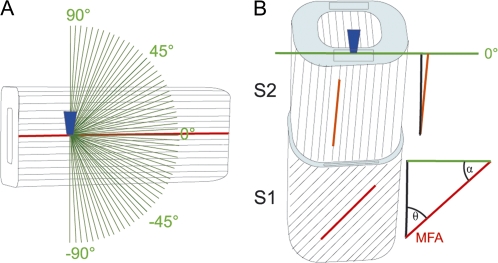
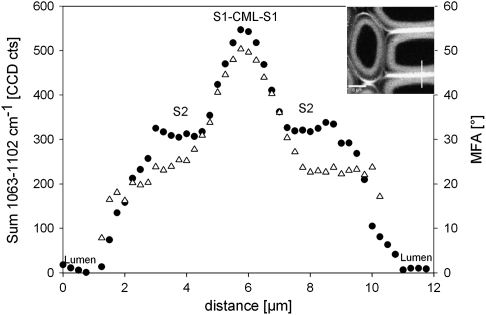
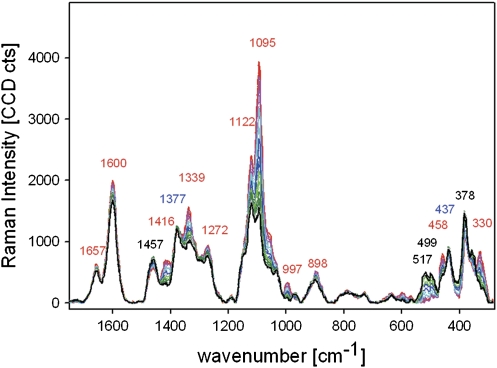
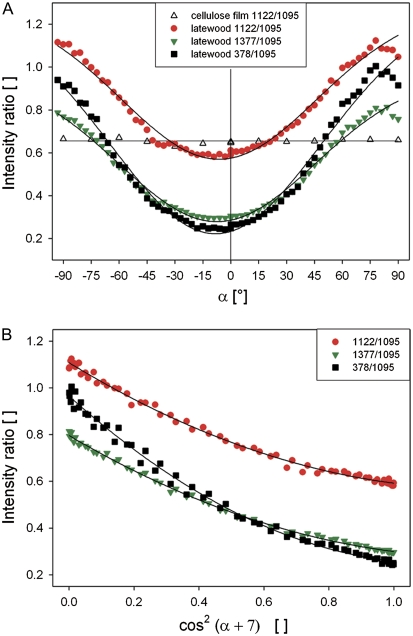
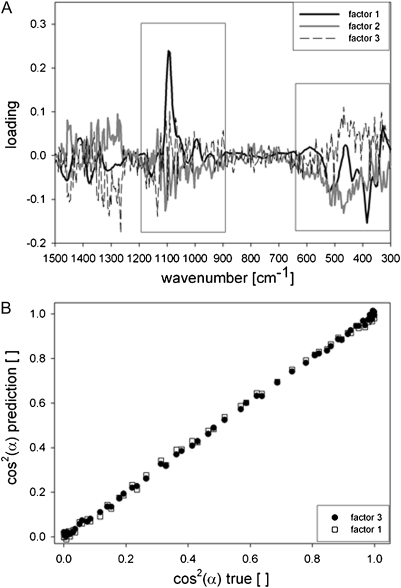
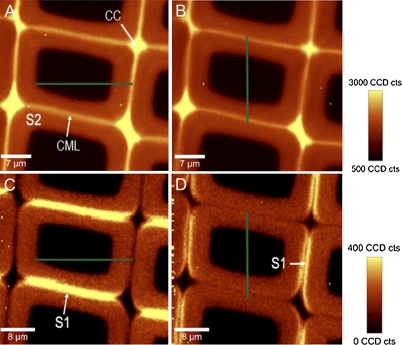
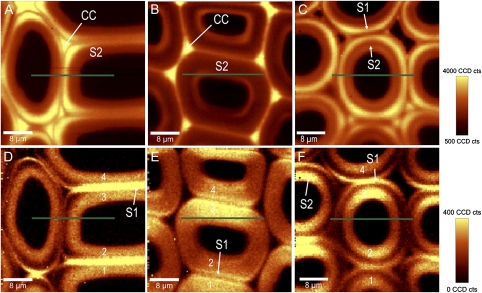
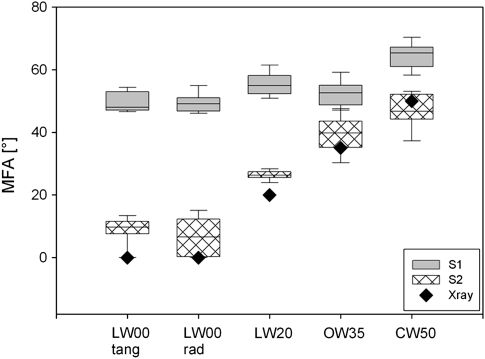
The functional characteristics of plant cell walls depend on the composition of the cell wall polymers, as well as on their highly ordered architecture at scales from a few nanometres to several microns. Raman spectra of wood acquired with linear polarized laser light include information about polymer composition as well as the alignment of cellulose microfibrils with respect to the fibre axis (microfibril angle). By changing the laser polarization direction in 3 degrees steps, the dependency between cellulose and laser orientation direction was investigated. Orientation-dependent changes of band height ratios and spectra were described by quadratic linear regression and partial least square regressions, respectively. Using the models and regressions with high coefficients of determination (R(2) > 0.99) microfibril orientation was predicted in the S1 and S2 layers distinguished by the Raman imaging approach in cross-sections of spruce normal, opposite, and compression wood. The determined microfibril angle (MFA) in the different S2 layers ranged from 0 degrees to 49.9 degrees and was in coincidence with X-ray diffraction determination. With the prerequisite of geometric sample and laser alignment, exact MFA prediction can complete the picture of the chemical cell wall design gained by the Raman imaging approach at the micron level in all plant tissues.
植物细胞壁的功能特性取决于细胞壁聚合物的组成,以及它们在从几个纳米到几个微米的尺度上的高度有序结构。用线偏振激光光获得的木材拉曼光谱包括关于聚合物组成以及纤维素微纤维相对于纤维轴(微纤维角)排列的信息。通过以 3 度的步长改变激光偏振方向,研究了纤维素和激光取向方向之间的依赖性。通过二次线性回归和偏最小二乘回归分别描述了带高比和光谱的取向依赖性变化。使用具有高决定系数(R(2) > 0.99)的模型和回归,通过在云杉正常、相反和压缩木材的横截面中使用 Raman 成像方法区分的 S1 和 S2 层,预测微纤维取向。在不同的 S2 层中确定的微纤维角(MFA)范围从 0 度到 49.9 度,与 X 射线衍射测定结果一致。在几何样品和激光对准的前提下,准确的 MFA 预测可以完成在所有植物组织中通过 Raman 成像方法在微米级水平上获得的细胞壁化学设计的图像。