Department of Psychology, New York University, New York, New York, United States of America.
PLoS One. 2009 Dec 9;4(12):e8228. doi: 10.1371/journal.pone.0008228.
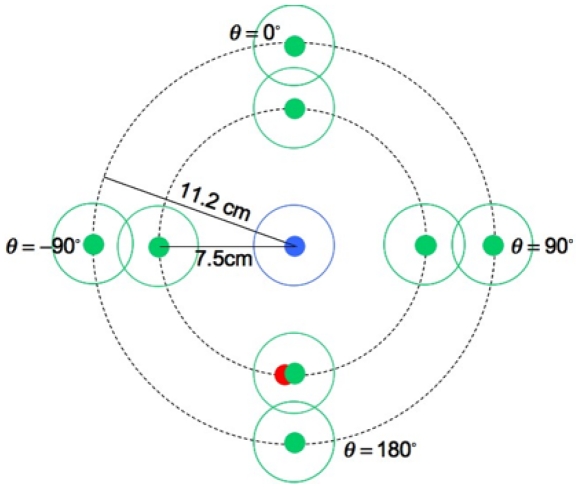
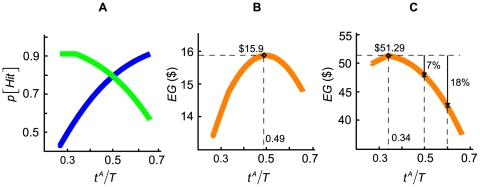
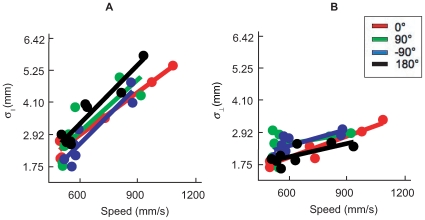
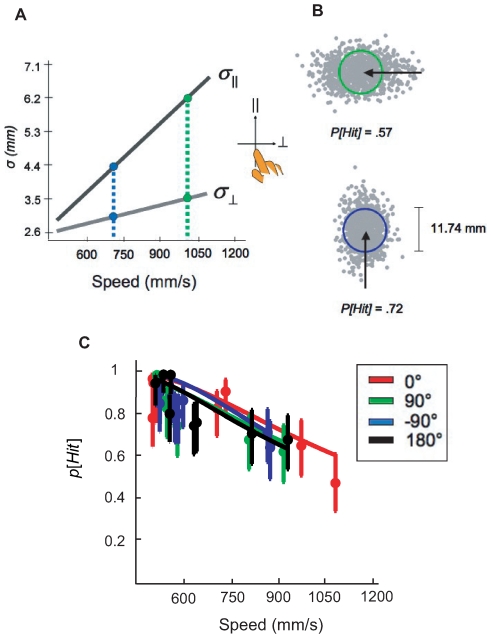
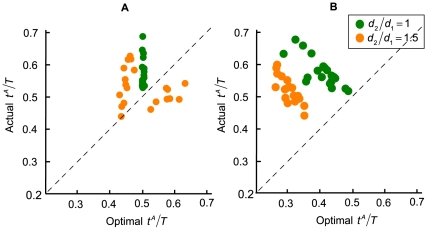
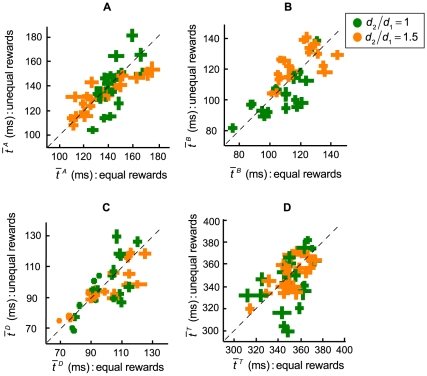
The allocation of limited resources such as time or energy is a core problem that organisms face when planning complex actions. Most previous research concerning planning of movement has focused on the planning of single, isolated movements. Here we investigated the allocation of time in a pointing task where human subjects attempted to touch two targets in a specified order to earn monetary rewards. Subjects were required to complete both movements within a limited time but could freely allocate the available time between the movements. The time constraint presents an allocation problem to the subjects: the more time spent on one movement, the less time is available for the other. In different conditions we assigned different rewards to the two tokens. How the subject allocated time between movements affected their expected gain on each trial. We also varied the angle between the first and second movements and the length of the second movement. Based on our results, we developed and tested a model of speed-accuracy tradeoff for sequential movements. Using this model we could predict the time allocation that would maximize the expected gain of each subject in each experimental condition. We compared human performance with predicted optimal performance. We found that all subjects allocated time sub-optimally, spending more time than they should on the first movement even when the reward of the second target was five times larger than the first. We conclude that the movement planning system fails to maximize expected reward in planning sequences of as few as two movements and discuss possible interpretations drawn from economic theory.
资源(如时间或能量)的分配是生物体在规划复杂行为时面临的核心问题。大多数关于运动规划的研究都集中在单个、孤立的运动规划上。在这里,我们研究了在指向任务中时间的分配,人类受试者试图按照特定的顺序触摸两个目标以赚取货币奖励。受试者需要在有限的时间内完成两个运动,但可以在运动之间自由分配可用的时间。时间限制给受试者带来了一个分配问题:一个运动花费的时间越多,另一个运动可用的时间就越少。在不同的条件下,我们为两个代币分配了不同的奖励。受试者在运动之间分配时间的方式影响了他们在每次试验中的预期收益。我们还改变了第一和第二运动之间的角度以及第二运动的长度。基于我们的结果,我们为顺序运动开发并测试了一个速度-准确性权衡模型。使用这个模型,我们可以预测每个受试者在每个实验条件下的最佳时间分配,以最大化每个受试者的预期收益。我们将人类表现与预测的最佳表现进行了比较。我们发现所有受试者的时间分配都不理想,即使第二个目标的奖励是第一个目标的五倍,他们也会在第一个运动上花费比他们应该花费的更多的时间。我们得出结论,运动规划系统在规划两个或更少的运动序列时未能最大化预期奖励,并从经济理论中讨论了可能的解释。