Yao Li, Zhong Wenjun, Zhang Zhumin, Maenner Matthew J, Engelman Corinne D
Department of Human Development and Family Studies, University of Wisconsin-Madison, 1300 Linden Drive, Madison, Wisconsin 53706, USA.
BMC Proc. 2009 Dec 15;3 Suppl 7(Suppl 7):S83. doi: 10.1186/1753-6561-3-s7-s83.
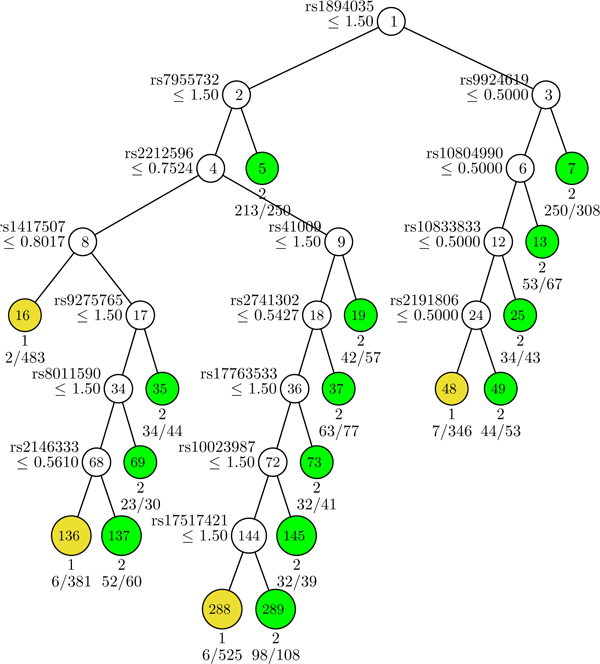
The aim of this study was to detect the effect of interactions between single-nucleotide polymorphisms (SNPs) on incidence of heart diseases. For this purpose, 2912 subjects with 350,160 SNPs from the Framingham Heart Study (FHS) were analyzed. PLINK was used to control quality and to select the 10,000 most significant SNPs. A classification tree algorithm, Generalized, Unbiased, Interaction Detection and Estimation (GUIDE), was employed to build a classification tree to detect SNP-by-SNP interactions for the selected 10 k SNPs. The classes generated by GUIDE were reexamined by a generalized estimating equations (GEE) model with the empirical variance after accounting for potential familial correlation. Overall, 17 classes were generated based on the splitting criteria in GUIDE. The prevalence of coronary heart disease (CHD) in class 16 (determined by SNPs rs1894035, rs7955732, rs2212596, and rs1417507) was the lowest (0.23%). Compared to class 16, all other classes except for class 288 (prevalence of 1.2%) had a significantly greater risk when analyzed using GEE model. This suggests the interactions of SNPs on these node paths are significant.
本研究的目的是检测单核苷酸多态性(SNP)之间的相互作用对心脏病发病率的影响。为此,对来自弗雷明汉心脏研究(FHS)的2912名受试者的350,160个SNP进行了分析。使用PLINK来控制质量并选择10,000个最显著的SNP。采用一种分类树算法——广义、无偏、相互作用检测与估计(GUIDE),构建分类树以检测所选10,000个SNP的逐个SNP相互作用。在考虑潜在家族相关性后,通过具有经验方差的广义估计方程(GEE)模型对GUIDE生成的类别进行重新检验。总体而言,基于GUIDE中的分裂标准生成了17个类别。第16类(由SNP rs1894035、rs7955732、rs2212596和rs1417507确定)的冠心病(CHD)患病率最低(0.23%)。与第16类相比,使用GEE模型分析时,除第288类(患病率为1.2%)外,所有其他类别患心脏病的风险均显著更高。这表明这些节点路径上的SNP相互作用具有显著性。