Duarte João M N, Morgenthaler Florence D, Lei Hongxia, Poitry-Yamate Carol, Gruetter Rolf
Center for Biomedical Imaging, Ecole Polytechnique Fédérale de Lausanne Lausanne, Switzerland.
Front Neuroenergetics. 2009 Oct 12;1:6. doi: 10.3389/neuro.14.006.2009. eCollection 2009.
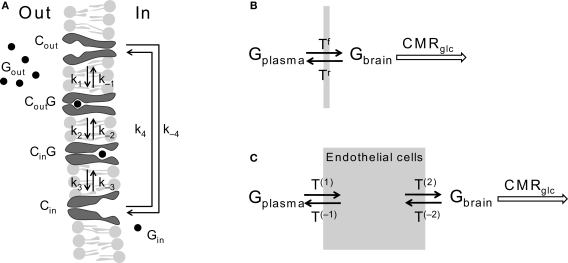
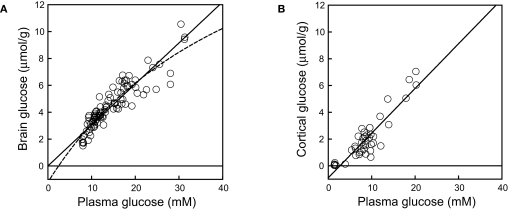
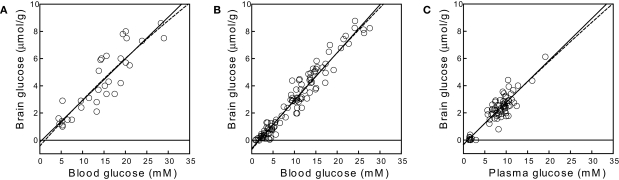
Glucose supply from blood to brain occurs through facilitative transporter proteins. A near linear relation between brain and plasma glucose has been experimentally determined and described by a reversible model of enzyme kinetics. A conformational four-state exchange model accounting for trans-acceleration and asymmetry of the carrier was included in a recently developed multi-compartmental model of glucose transport. Based on this model, we demonstrate that brain glucose (G(brain)) as function of plasma glucose (G(plasma)) can be described by a single analytical equation namely comprising three kinetic compartments: blood, endothelial cells and brain. Transport was described by four parameters: apparent half saturation constant K(t), apparent maximum rate constant T(max), glucose consumption rate CMR(glc), and the iso-inhibition constant K(ii) that suggests G(brain) as inhibitor of the isomerisation of the unloaded carrier. Previous published data, where G(brain) was quantified as a function of plasma glucose by either biochemical methods or NMR spectroscopy, were used to determine the aforementioned kinetic parameters. Glucose transport was characterized by K(t) ranging from 1.5 to 3.5 mM, T(max)/CMR(glc) from 4.6 to 5.6, and K(ii) from 51 to 149 mM. It was noteworthy that K(t) was on the order of a few mM, as previously determined from the reversible model. The conformational four-state exchange model of glucose transport into the brain includes both efflux and transport inhibition by G(brain), predicting that G(brain) eventually approaches a maximum concentration. However, since K(ii) largely exceeds G(plasma), iso-inhibition is unlikely to be of substantial importance for plasma glucose below 25 mM. As a consequence, the reversible model can account for most experimental observations under euglycaemia and moderate cases of hypo- and hyperglycaemia.
血液中的葡萄糖通过易化转运蛋白供应给大脑。大脑与血浆葡萄糖之间存在近似线性关系,这已通过酶动力学的可逆模型进行了实验测定和描述。最近开发的葡萄糖转运多室模型纳入了一个构象四态交换模型,该模型解释了载体的转位加速和不对称性。基于此模型,我们证明大脑葡萄糖(G(brain))作为血浆葡萄糖(G(plasma))的函数可以用一个单一的解析方程来描述,该方程包含三个动力学室:血液、内皮细胞和大脑。转运由四个参数描述:表观半饱和常数K(t)、表观最大速率常数T(max)、葡萄糖消耗率CMR(glc)以及等抑制常数K(ii),K(ii)表明G(brain)作为未负载载体异构化的抑制剂。先前发表的数据,其中通过生化方法或核磁共振波谱法将G(brain)定量为血浆葡萄糖的函数,用于确定上述动力学参数。葡萄糖转运的特征在于K(t)范围为1.5至3.5 mM,T(max)/CMR(glc)为4.6至5.6,K(ii)为51至149 mM。值得注意的是,K(t)约为几毫摩尔,如先前从可逆模型中所确定的。葡萄糖转运至大脑的构象四态交换模型包括G(brain)的流出和转运抑制,预测G(brain)最终会接近最大浓度。然而,由于K(ii)大大超过G(plasma),对于血浆葡萄糖低于25 mM的情况,等抑制不太可能具有实质性重要性。因此,可逆模型可以解释正常血糖以及轻度低血糖和高血糖情况下的大多数实验观察结果。