Institute of Dentistry, Barts & The London School of Medicine and Dentistry, Queen Mary University of London, London, UK.
PLoS One. 2009 Dec 21;4(12):e8358. doi: 10.1371/journal.pone.0008358.
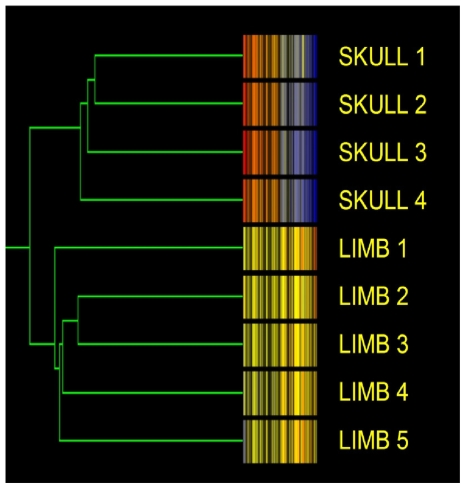
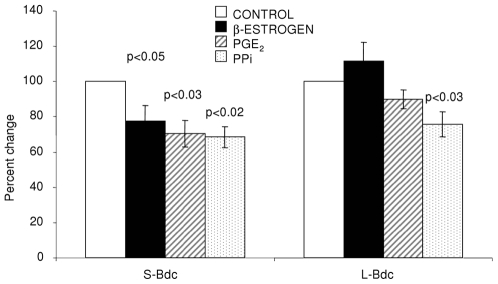
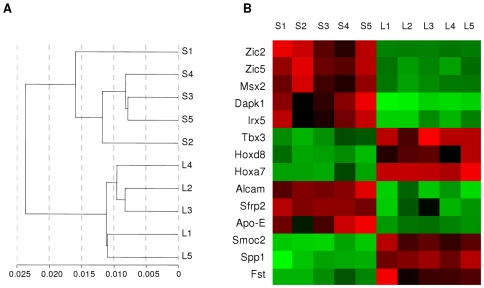
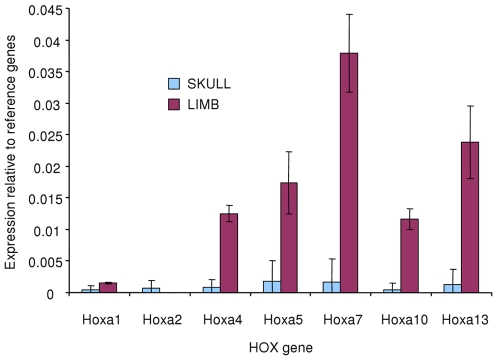
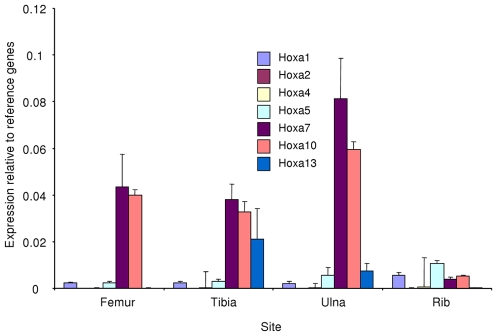
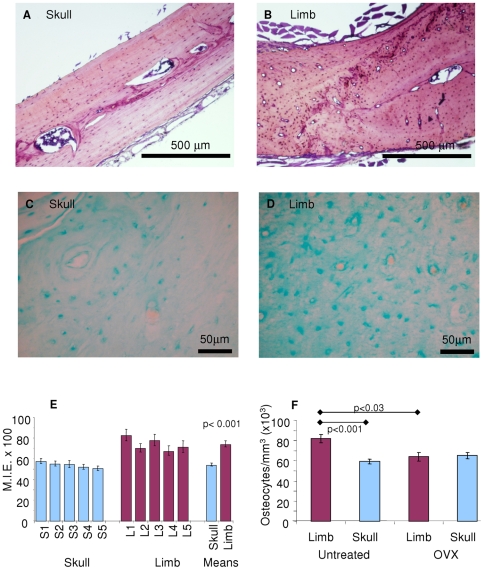
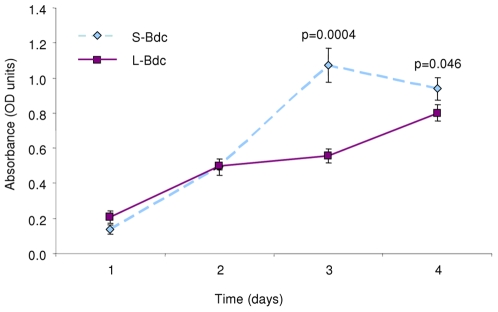
The incidence of limb bone fracture and subsequent morbidity and mortality due to excessive bone loss is increasing in the progressively ageing populations of both men and women. In contrast to bone loss in the weight-bearing limb, bone mass in the protective skull vault is maintained. One explanation for this could be anatomically diverse bone matrix characteristics generated by heterogeneous osteoblast populations. We have tested the hypothesis that adult bones demonstrate site-specific characteristics, and report differences at the organ, cell and transcriptome levels. Limb bones contain greater amounts of polysulphated glycosaminoglycan stained with Alcian Blue and have significantly higher osteocyte densities than skull bone. Site-specific patterns persist in cultured adult bone-derived cells both phenotypically (proliferation rate, response to estrogen and cell volumes), and at the level of specific gene expression (collagen triple helix repeat containing 1, reelin and ras-like and estrogen-regulated growth inhibitor). Based on genome-wide mRNA expression and cluster analysis, we demonstrate that bones and cultured adult bone-derived cells segregate according to site of derivation. We also find the differential expression of genes associated with embryological development (Skull: Zic, Dlx, Irx, Twist1 and Cart1; Limb: Hox, Shox2, and Tbx genes) in both adult bones and isolated adult bone-derived cells. Together, these site-specific differences support the view that, analogous to different muscle types (cardiac, smooth and skeletal), skull and limb bones represent separate classes of bone. We assign these differences, not to mode of primary ossification, but to the embryological cell lineage; the basis and implications of this division are discussed.
在男性和女性的人口老龄化进程中,四肢骨骨折的发病率以及由此导致的过度骨质流失相关发病率和死亡率都在不断上升。与承重肢体的骨丢失相反,保护性颅骨穹窿的骨量得以维持。造成这种现象的一个解释可能是由异质成骨细胞群体产生的具有解剖学多样性的骨基质特征。我们已经验证了一个假设,即成人骨骼具有特定部位的特征,并报告了器官、细胞和转录组水平的差异。肢体骨骼中含有更多用阿尔辛蓝染色的多硫酸化糖胺聚糖,并且骨细胞密度明显高于颅骨。在培养的成人骨源性细胞中,这种部位特异性模式既表型上(增殖率、对雌激素的反应和细胞体积),也在特定基因表达水平上(胶原蛋白三螺旋重复序列 1、reelin 和 ras 样和雌激素调节生长抑制剂)都保持不变。基于全基因组 mRNA 表达和聚类分析,我们证明了骨骼和培养的成人骨源性细胞根据其来源部位进行分类。我们还发现了与胚胎发育相关的基因(颅骨:Zic、Dlx、Irx、Twist1 和 Cart1;四肢:Hox、Shox2 和 Tbx 基因)在成人骨骼和分离的成人骨源性细胞中都有差异表达。总之,这些部位特异性差异支持这样一种观点,即类似于不同的肌肉类型(心脏、平滑和骨骼),颅骨和四肢骨代表不同类型的骨骼。我们将这些差异归因于胚胎细胞谱系,而不是初次骨化的方式;讨论了这种划分的基础和意义。