Division of Rheumatology, The Children's Hospital, 13123 E 16th Ave, Aurora, CO 80045, USA.
Pediatr Rheumatol Online J. 2009 Dec 22;7:21. doi: 10.1186/1546-0096-7-21.
We investigated the etiology of acute hepatitis in three children with systemic Juvenile Idiopathic Arthritis (sJIA) taking Interleukin-1 receptor antagonist (IL1RA).
Laboratory and clinical data for three children with sJIA diagnosed at ages 13 months to 8 years who developed acute hepatitis during treatment with IL1RA were reviewed for evidence of sJIA flare, infection, macrophage activation syndrome (MAS), malignancy, and drug reaction.
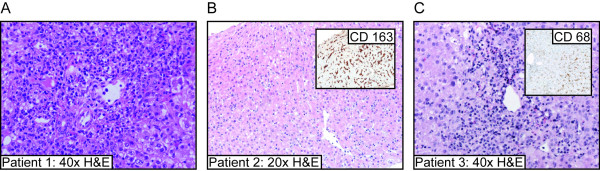
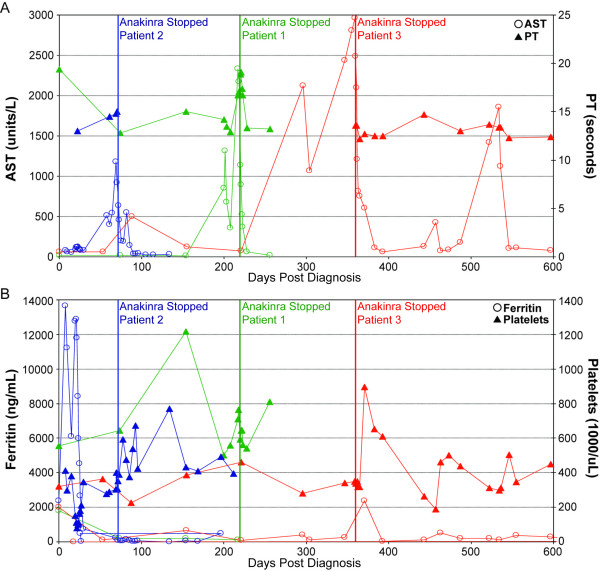
In all patients, hepatitis persisted despite cessation of known hepatotoxic drugs and in absence of known infectious triggers, until discontinuation of IL1RA. Liver biopsies had mixed inflammatory infiltrates with associated hepatocellular injury suggestive of an exogenous trigger. At the time of hepatitis, laboratory data and liver biopsies were not characteristic of MAS. In two patients, transaminitis resolved within one week of discontinuing IL1RA, the third improved dramatically in one month.
Although sJIA symptoms improved significantly on IL1RA, it appeared that IL1RA contributed to the development of acute hepatitis. Hepatitis possibly occurred as a result of an altered immune response to a typical childhood infection while on IL1RA. Alternatively, hepatitis could have represented an atypical presentation of MAS in patients with sJIA taking IL1RA. Further investigation is warranted to determine how anti-IL1 therapies alter immune responsiveness to exogenous triggers in patients with immune dysfunction such as sJIA. Our patients suggest that close monitoring for hepatic and other toxicities is indicated when treating with IL1RA.
我们研究了在接受白细胞介素-1 受体拮抗剂 (IL1RA) 治疗的 3 例全身幼年特发性关节炎 (sJIA) 儿童中,急性肝炎的病因。
对 3 例年龄在 13 个月至 8 岁之间的 sJIA 患儿的实验室和临床数据进行了回顾性分析,这些患儿在接受 IL1RA 治疗期间出现了急性肝炎,以寻找 sJIA 发作、感染、巨噬细胞活化综合征 (MAS)、恶性肿瘤和药物反应的证据。
在所有患者中,尽管停用了已知的肝毒性药物,且无明确的感染触发因素,但在停用 IL1RA 之前,肝炎仍持续存在。肝活检显示混合性炎症浸润,伴有肝实质损伤,提示有外源性触发因素。在肝炎发生时,实验室数据和肝活检均不具有 MAS 的特征。在 2 例患者中,停用 IL1RA 后 1 周内肝功能异常得到改善,第 3 例患者在 1 个月内显著改善。
尽管 IL1RA 使 sJIA 症状显著改善,但 IL1RA 似乎导致了急性肝炎的发生。肝炎可能是由于在使用 IL1RA 时,对外源性感染的免疫反应发生改变而引起的。或者,肝炎可能代表了接受 IL1RA 治疗的 sJIA 患者中 MAS 的非典型表现。进一步的研究需要确定抗 IL1 治疗如何改变免疫功能障碍(如 sJIA)患者对外源性触发因素的免疫反应。我们的患者提示,在使用 IL1RA 治疗时,需要密切监测肝脏和其他毒性。