Department of Genetics and Pathology, The Rudbeck Laboratory, Uppsala University, Uppsala, Sweden.
Mol Syst Biol. 2009;5:337. doi: 10.1038/msb.2009.93. Epub 2009 Dec 22.
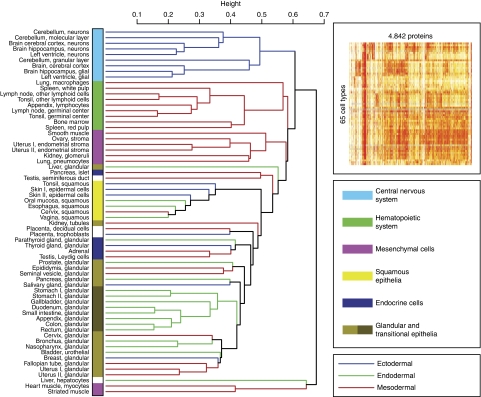
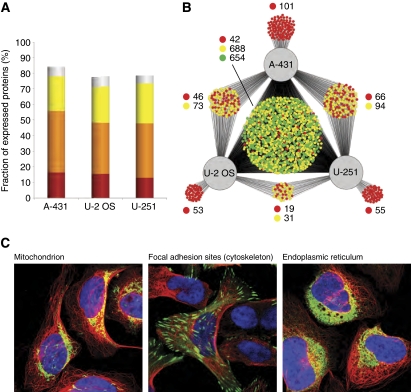
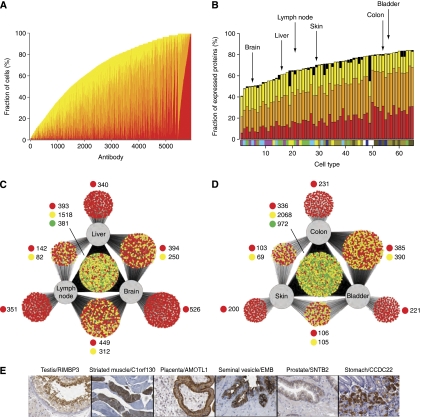
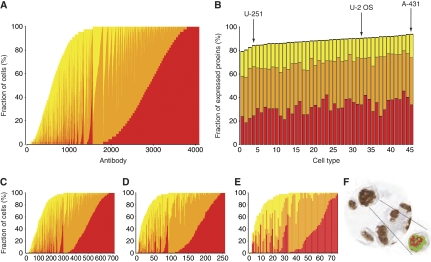
Defining the protein profiles of tissues and organs is critical to understanding the unique characteristics of the various cell types in the human body. In this study, we report on an anatomically comprehensive analysis of 4842 protein profiles in 48 human tissues and 45 human cell lines. A detailed analysis of over 2 million manually annotated, high-resolution, immunohistochemistry-based images showed a high fraction (>65%) of expressed proteins in most cells and tissues, with very few proteins (<2%) detected in any single cell type. Similarly, confocal microscopy in three human cell lines detected expression of more than 70% of the analyzed proteins. Despite this ubiquitous expression, hierarchical clustering analysis, based on global protein expression patterns, shows that the analyzed cells can be still subdivided into groups according to the current concepts of histology and cellular differentiation. This study suggests that tissue specificity is achieved by precise regulation of protein levels in space and time, and that different tissues in the body acquire their unique characteristics by controlling not which proteins are expressed but how much of each is produced.
定义组织和器官的蛋白质图谱对于了解人体各种细胞类型的独特特征至关重要。在这项研究中,我们报告了对 48 个人体组织和 45 个人体细胞系的 4842 种蛋白质图谱的解剖学全面分析。对超过 200 万个手动注释、高分辨率、基于免疫组织化学的图像的详细分析表明,大多数细胞和组织中表达的蛋白质比例很高(>65%),很少有蛋白质(<2%)在任何单个细胞类型中检测到。同样,在三种人源细胞系中的共聚焦显微镜检测到分析的蛋白质中有超过 70%的表达。尽管存在这种普遍表达,但基于全局蛋白质表达模式的层次聚类分析表明,根据当前的组织学和细胞分化概念,所分析的细胞仍然可以根据组织特异性进一步细分为组。这项研究表明,组织特异性是通过在空间和时间上精确调节蛋白质水平来实现的,并且身体不同的组织通过控制每种蛋白质的产生量而不是表达哪些蛋白质来获得其独特的特征。