Berman-Gund Laboratory for the Study of Retinal Degenerations, Harvard Medical School, Massachusetts Eye & Ear Infirmary, Boston, Massachusetts, United States of America.
PLoS One. 2009 Dec 24;4(12):e8438. doi: 10.1371/journal.pone.0008438.
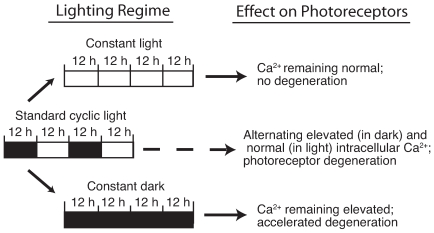
In one group of gene mutations that cause photoreceptor degeneration in human patients, guanylyl cyclase is overactive in the dark. The ensuing excess opening of cGMP-gated cation channels causes intracellular calcium to rise to toxic levels. The Y99C mutation in guanylate cyclase-activating protein 1 (GCAP1) has been shown to act this way. We determined whether prolonged light exposure, which lowers cGMP levels through activation of phototransduction, might protect photoreceptors in a line of transgenic mice carrying the GCAP1-Y99C.
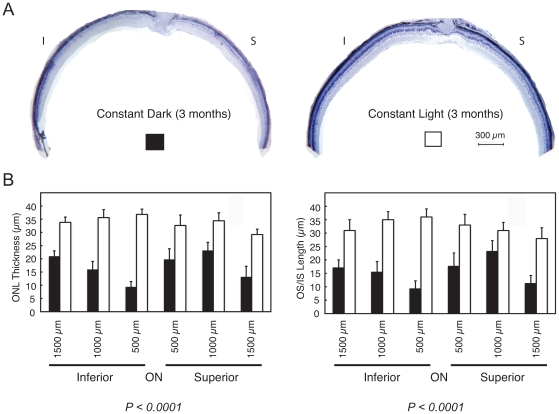
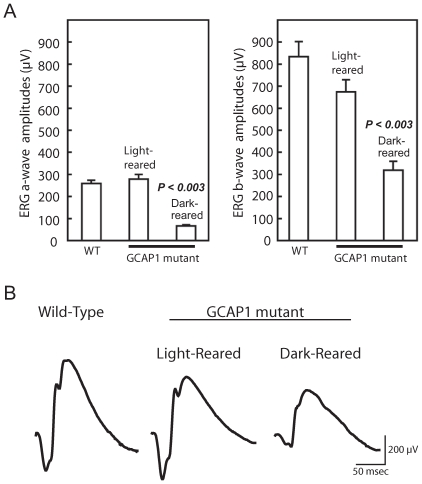
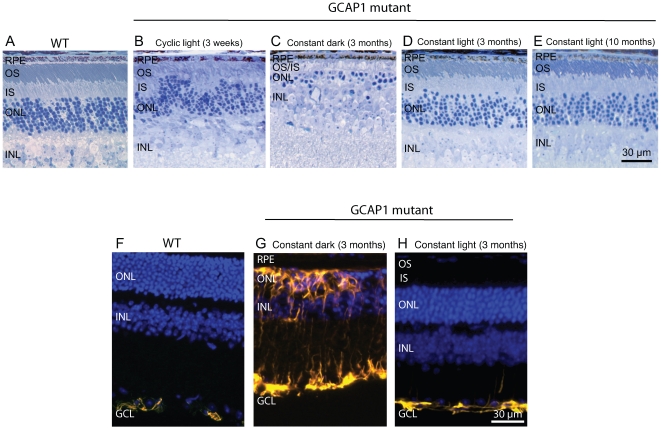
METHODOLOGY/PRINCIPAL FINDINGS: We reared cohorts of GCAP1-Y99C transgenic mice under standard cyclic, constant dark and constant light conditions. Mouse eyes were analyzed by histology and by immunofluorescence for GFAP upregulation, a non-specific marker for photoreceptor degeneration. Full-field electroretinograms (ERGs) were recorded to assess retinal function. Consistent with our hypothesis, constant darkness accelerated disease, while continuous lighting arrested photoreceptor degeneration.
CONCLUSIONS/SIGNIFICANCE: In contrast to most forms of retinal degeneration, which are exacerbated by increased exposure to ambient light, a subset with mutations that cause overly active guanylyl cyclase and high intracellular calcium benefitted from prolonged light exposure. These findings may have therapeutic implications for patients with these types of genetic defects.
在导致人类患者光感受器变性的一组基因突变中,鸟苷酸环化酶在黑暗中过度活跃。随之而来的 cGMP 门控阳离子通道过度开放导致细胞内钙上升到毒性水平。已经表明,鸟苷酸环化酶激活蛋白 1(GCAP1)中的 Y99C 突变就是这样起作用的。我们确定了延长光照时间是否可以通过激活光转导来降低 cGMP 水平,从而保护携带 GCAP1-Y99C 的转基因小鼠系中的光感受器。
方法/主要发现:我们在标准循环、持续黑暗和持续光照条件下饲养了一批 GCAP1-Y99C 转基因小鼠。通过组织学和 GFAP 上调的免疫荧光分析来分析小鼠眼睛,GFAP 上调是光感受器变性的非特异性标志物。记录全视野视网膜电图(ERG)以评估视网膜功能。与我们的假设一致,持续黑暗加速了疾病的发展,而持续光照则阻止了光感受器的变性。
结论/意义:与大多数形式的视网膜变性不同,这些变性会因增加暴露于环境光而加剧,而具有导致过度活跃的鸟苷酸环化酶和高细胞内钙的突变的亚组则受益于延长光照。这些发现可能对具有这些类型遗传缺陷的患者具有治疗意义。