INRS, Département Epidémiologie en Entreprise, Rue du Morvan, CS 60027, 54519 Vandoeuvre-lès-Nancy Cedex, France.
BMC Pulm Med. 2009 Dec 31;9:53. doi: 10.1186/1471-2466-9-53.
Airway inflammation and airway hyperresponsiveness (AHR) are two characteristic features of asthma. Fractional exhaled nitric oxide (FENO) has shown good correlation with AHR in asthmatics. Less information is available about FENO as a marker of inflammation from work exposures. We thus examined the relation between FENO and AHR in lifeguards undergoing exposure to chloramines in indoor pools.
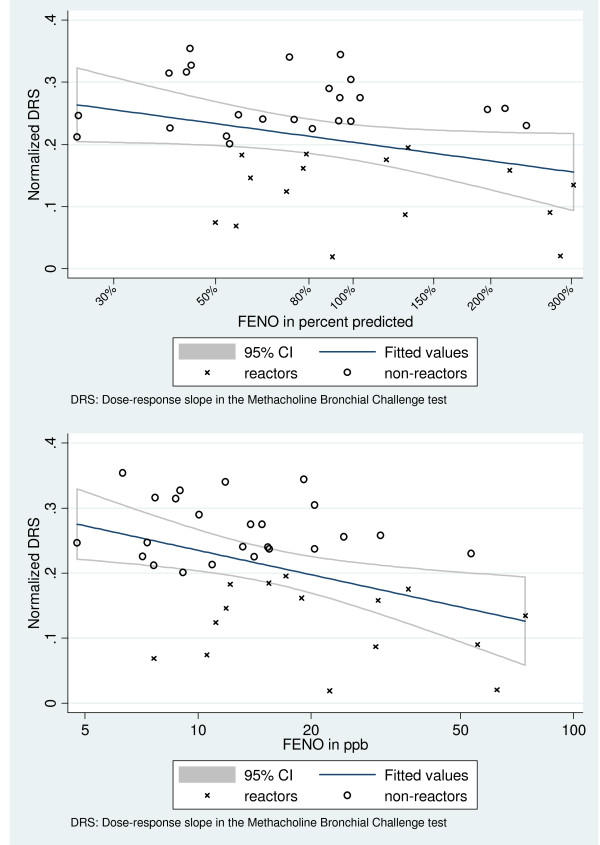
39 lifeguards at six indoor pools were given a respiratory health questionnaire, FENO measurements, spirometry, and a methacholine bronchial challenge (MBC) test. Subjects were labeled MBC+ if the forced expiratory volume (FEV1) fell by 20% or more. The normalized linear dose-response slope (NDRS) was calculated as the percentage fall in FEV1 at the last dose divided by the total dose given. The relation between MBC and FENO was assessed using logistic regression adjusting on confounding factors. The association between NDRS and log-transformed values of FENO was tested in a multiple linear regression model.
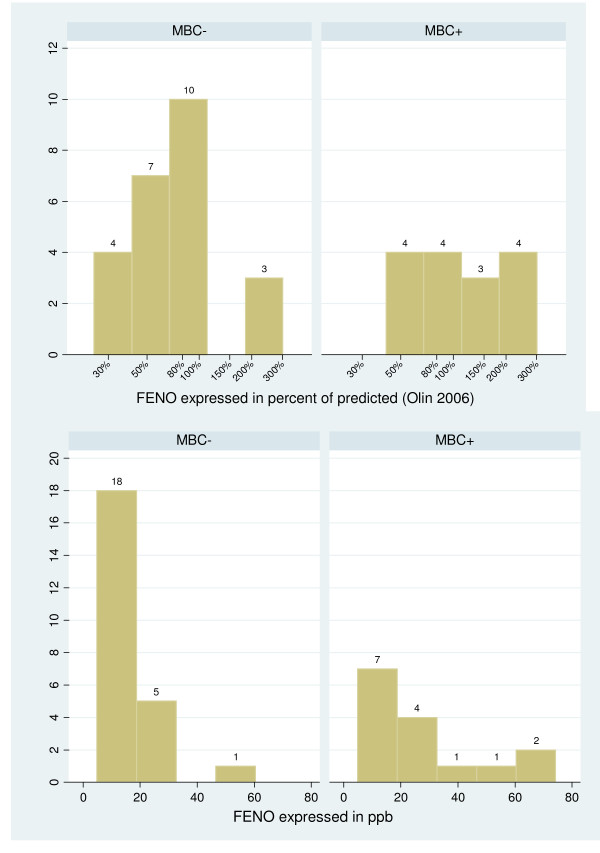
The prevalence of lifeguards MBC+ was 37.5%. In reactors, the median FENO was 18.9 ppb (90% of the predicted value) vs. 12.5 ppb (73% predicted) in non-reactors. FENO values >or= 60% of predicted values were 80% sensitive and 42% specific to identify subjects MBC+. In the logistic regression model no other factor had an effect on MBC after adjusting for FENO. In the linear regression model, NDRS was significantly predicted by log FENO.
In lifeguards working in indoor swimming pools, elevated FENO levels are associated with increased airway responsiveness.
气道炎症和气道高反应性(AHR)是哮喘的两个特征。呼出气一氧化氮分数(FENO)与哮喘患者的 AHR 具有良好的相关性。关于工作暴露引起的气道炎症的 FENO 标志物,相关信息较少。因此,我们研究了室内游泳池氯胺暴露的救生员中 FENO 与 AHR 的关系。
对 6 个室内游泳池的 39 名救生员进行了呼吸健康问卷、FENO 测量、肺活量测定和乙酰甲胆碱支气管激发试验(MBC)。用力呼气量(FEV1)下降 20%或更多的受试者被标记为 MBC+。将最后一剂时 FEV1 的百分比下降除以总剂量计算归一化线性剂量反应斜率(NDRS)。使用逻辑回归调整混杂因素评估 MBC 和 FENO 之间的关系。使用多元线性回归模型检验 NDRS 与 FENO 对数转换值之间的关联。
MBC+救生员的患病率为 37.5%。在反应者中,FENO 的中位数为 18.9 ppb(预测值的 90%),而非反应者为 12.5 ppb(预测值的 73%)。FENO 值>或=预测值的 60%可分别以 80%的敏感性和 42%的特异性识别出 MBC+的受试者。在调整 FENO 后,逻辑回归模型中没有其他因素对 MBC 产生影响。在线性回归模型中,NDRS 可由 log FENO 显著预测。
在室内游泳池工作的救生员中,升高的 FENO 水平与气道高反应性有关。