Bohadana Abraham, Michaely Jean-Pierre, Teculescu Dan, Wild Pascal
Institut National de la Santé et de la Recherche Médicale, INSERM, ERI 11, 54505 Vandoeuvre - lès-Nancy, France.
BMC Pulm Med. 2008 Feb 28;8:4. doi: 10.1186/1471-2466-8-4.
Currently, there is much interest in measuring fractional exhaled nitric oxide (FENO) in populations. We evaluated the reproducibility of FENO in healthy subjects and determined the number of subjects necessary to carry out a longitudinal survey of FENO in a population containing smokers and non-smokers, based on the assessed reproducibility.
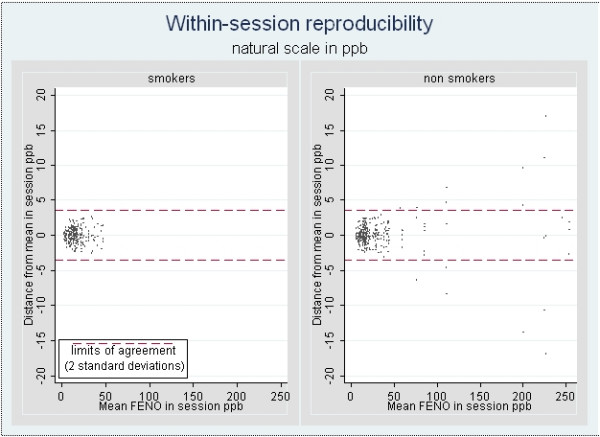
The reproducibility of FENO was examined in 18 healthy smokers and 21 non-smokers. FENO was assessed once at 9 AM on five consecutive days; in the last day this measurement was repeated at 2 PM. Respiratory symptoms and medical history were assessed by questionnaire. The within- and between-session repeatability of FENO and log-transformed FENO was described. The power of a longitudinal study based on a relative increase in FENO was estimated using a bilateral t-test of the log-transformed FENO using the between-session variance of the assay.
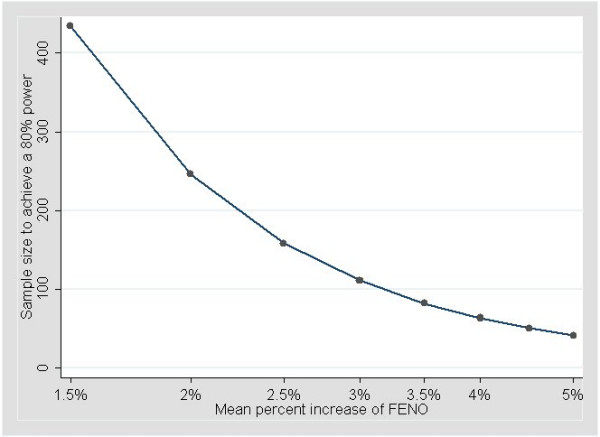
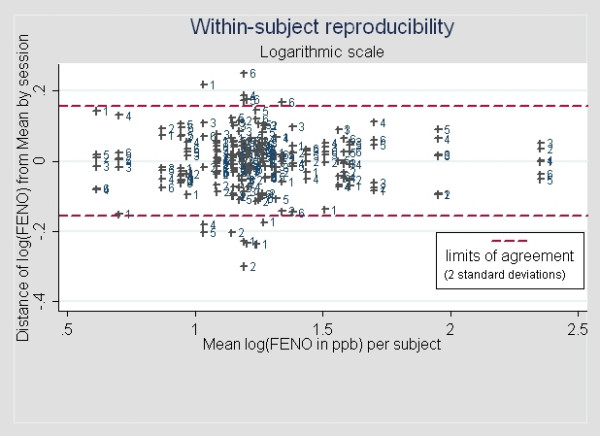
FENO measurements were highly reproducible throughout the study. FENO was significantly higher in males than females regardless of smoking status. FENO was positively associated with height (p < 0.001), gender (p < 0.034), smoking (p < 0.0001) and percent FEV1/FVC (p < 0.001) but not with age (p = 0.987). The between-session standard deviation was roughly constant on the log scale. Assuming the between-session standard deviation is equal to its longitudinal equivalent, either 111 or 29 subjects would be necessary to achieve an 80% power in detecting a 3% or a 10% increase in FENO respectively.
The good reproducibility of FENO is not influenced by gender or smoking habits. In a well controlled, longitudinal study it should allow detecting even small increases in FENO with a reasonable population size.
目前,人们对在人群中测量呼出一氧化氮分数(FENO)颇感兴趣。我们评估了FENO在健康受试者中的可重复性,并根据评估的可重复性确定了在包含吸烟者和非吸烟者的人群中进行FENO纵向调查所需的受试者数量。
在18名健康吸烟者和21名非吸烟者中检测FENO的可重复性。连续五天在上午9点对FENO进行一次评估;在最后一天,下午2点重复此测量。通过问卷评估呼吸道症状和病史。描述了FENO和对数转换后的FENO在各次测量之间以及不同测量时段之间的重复性。使用基于该检测方法不同测量时段之间方差的对数转换后FENO的双侧t检验,估计基于FENO相对增加的纵向研究的效能。
在整个研究过程中,FENO测量具有高度可重复性。无论吸烟状况如何,男性的FENO均显著高于女性。FENO与身高(p < 0.001)、性别(p < 0.034)、吸烟(p < 0.0001)和FEV1/FVC百分比(p < 0.001)呈正相关,但与年龄无关(p = 0.987)。在对数尺度上,不同测量时段之间的标准差大致恒定。假设不同测量时段之间的标准差等于其纵向等效值,分别需要111名或29名受试者才能在检测到FENO增加3%或10%时达到80%的效能。
FENO良好的可重复性不受性别或吸烟习惯的影响。在一项控制良好的纵向研究中,它应该能够在合理的样本量下检测到FENO即使很小的增加。