Minardi Giovanni, Pino Paolo Giuseppe, Manzara Carla Clotilde, Pulignano Giovanni, Stefanini Giulio Giuseppe, Viceconte Giuseppe Nicola, Leonetti Stefania, Madeo Andrea, Gaudio Carlo, Musumeci Francesco
Department of Cardiovascular Science, S Camillo-Forlanini Hospital, Rome, Italy.
Cardiovasc Ultrasound. 2010 Jan 1;8:1. doi: 10.1186/1476-7120-8-1.
This study was conducted to assess the accuracy of harmonic imaging 2D-transthoracic echocardiography (2D-TTE) segmental analysis compared to surgical findings, in degenerative mitral regurgitation (MR).
Seventy-seven consecutive patients with severe degenerative MR were prospectively enrolled. Preoperative 2D-TTE with precise localization of prolapsing or flailing scallops/segments was performed. All patients underwent mitral valve surgical repair. Surgical reports (SR), including valve description, were used as references for comparisons. A postoperative control 2D-TTE was performed.
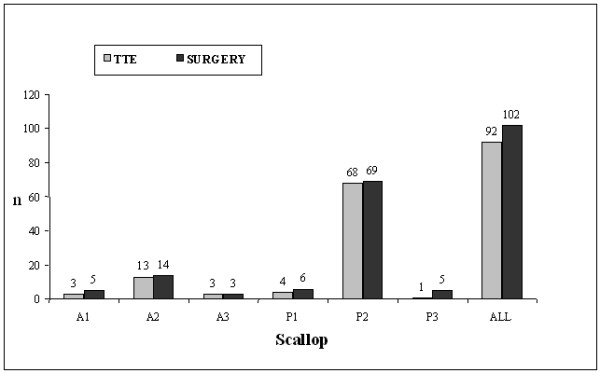
Out of 462 scallops/segments studied, surgical inspection identified 102 prolapses or flails (22%), 92 of which had previously been detected by 2D-TTE (90.2% sensitivity, 100% specificity). Agreement between preoperative 2D-TTE segmental analysis and SR was 97.8% (k = 0.93; p < 0.0001). Sixty-nine out of 77 2D-TTE reports were completely concordant with SR (89.6% diagnostic accuracy). None of the 8 non-concordant 2D-TTE reports were in complete disagreement with SR. P2 scallop was always involved in posterior leaflet prolapse or flail and was described correctly by 2D-TTE in 68 out of 69 patients (98,7% agreement, k = 0,93; 98.5% sensitivity). The anterior leaflet was involved in 14 patients (18%); A2 segment was involved in all of those cases and was correctly detected by 2D-TTE in 13 (98,7% agreement, k = 0,95; 92,8% sensitivity). Antero-lateral and postero-medial para-commissural prolapse or flail had a lower prevalence (14% and 10% respectively), with 2D-TTE sensitivity respectively of 64% and 50%.
2D-TTE, performed by an experienced echo-lab, has very good diagnostic accuracy in localizing the scallops/segments involved in degenerative MR, particularly for the middle ones (P2-A2), which represent almost the totality of prolapses. More invasive, time consuming and expensive exams should be reserved to selected cases.
本研究旨在评估在退行性二尖瓣反流(MR)中,与手术结果相比,二维经胸超声心动图(2D-TTE)谐波成像节段分析的准确性。
前瞻性纳入77例连续性重度退行性MR患者。术前进行2D-TTE检查,并精确确定脱垂或连枷样瓣叶/节段的位置。所有患者均接受二尖瓣手术修复。将包括瓣膜描述的手术报告(SR)作为比较的参考。术后进行2D-TTE对照检查。
在研究的462个瓣叶/节段中,手术检查发现102个脱垂或连枷样病变(22%),其中92个此前已被2D-TTE检测到(敏感性90.2%,特异性100%)。术前2D-TTE节段分析与SR之间的一致性为97.8%(k = 0.93;p < 0.0001)。77份2D-TTE报告中有69份与SR完全一致(诊断准确性89.6%)。8份不一致的2D-TTE报告中,没有一份与SR完全不一致。P2瓣叶总是累及后叶脱垂或连枷,69例患者中有68例被2D-TTE正确描述(一致性98.7%,k = 0.93;敏感性98.5%)。前叶累及14例患者(18%);所有这些病例均累及A2节段,2D-TTE正确检测出13例(一致性98.7%,k = 0.95;敏感性92.8%)。前外侧和后内侧瓣环旁脱垂或连枷的发生率较低(分别为14%和10%),2D-TTE的敏感性分别为64%和50%。
由经验丰富的超声心动图实验室进行的2D-TTE,在定位退行性MR累及的瓣叶/节段方面具有非常好的诊断准确性,特别是对于中间的瓣叶(P2-A2),它们几乎占了脱垂的全部。对于某些特定病例,应保留更具侵入性、耗时且昂贵的检查。