He Hong-Juan, Wang Qian, Zheng Wei-Wei, Wang Jin-Xing, Song Qi-Sheng, Zhao Xiao-Fan
School of Life Sciences, Key Laboratory of Plant Cell Engineering and Germplasm Innovation, Ministry of Education, Shandong University, Jinan 250100, Shandong, PR China.
BMC Cell Biol. 2010 Jan 2;11:1. doi: 10.1186/1471-2121-11-1.
Nuclear transport factor 2 and small GTPase Ran participate in the nucleo-cytoplasm transport of macromolecules, but their function in the 20-hydroxyecdysone (20E) signal transduction pathway are not well known.
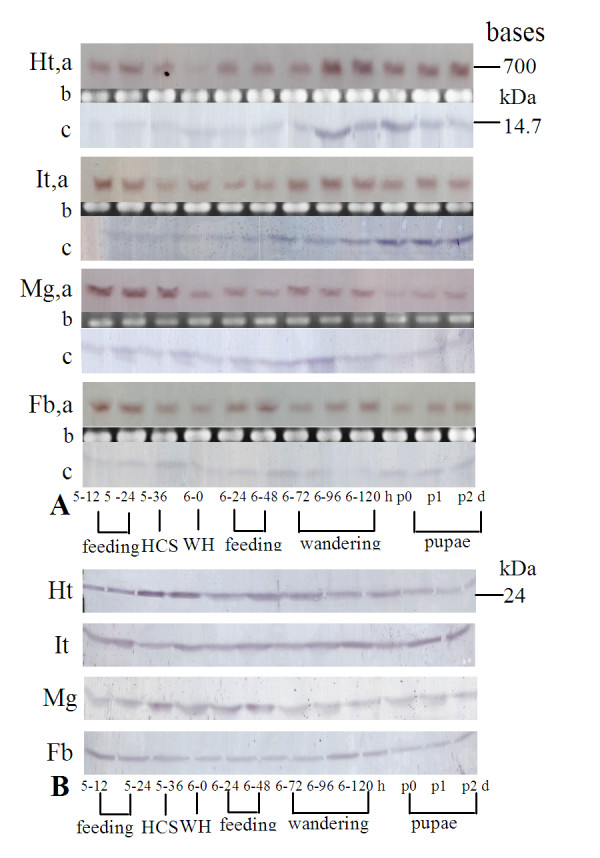
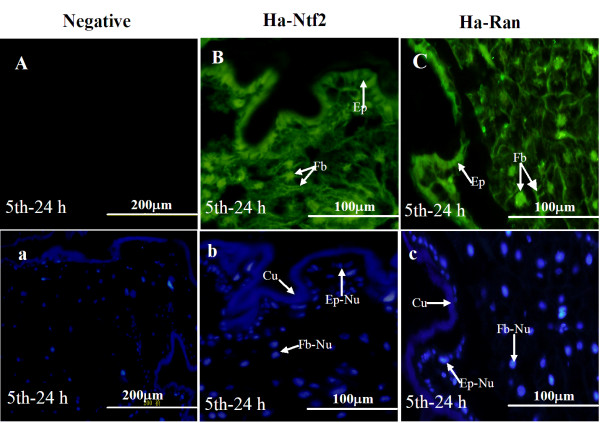
A 703 bp encoding Ntf2 and a 1233 bp encoding Ran full-length cDNAs were cloned from Helicoverpa armigera, and named Ha-Ntf2 and Ha-Ran, respectively. Northern blot and immunoblotting revealed that Ha-Ntf2 had an obviously higher expression levels in the head-thorax and integument of the metamorphically committed larvae. In contrast, the expression of Ha-Ran did not show obvious variation at various developmental stages in four tissues by immunoblotting analysis, except in the midgut, which showed increased expression from 5th-36 h (molting) to 6th-48 h. Both expressions of Ha-Ntf2 and Ha-Ran could be upregulated by 20E in vitro. Immunohistochemistry revealed that Ha-Ntf2 and Ha-Ran were primarily localized in the nucleus of various tissues. Protein binding assay and co-immunoprecipitation indicated that Ha-Ntf2 and Ha-Ran can combine with each other in vitro and in vivo. Knock down of Ha-Ntf2 or Ha-Ran by RNAi resulted in the suppression of other 20E regulated genes including EcR-B1, USP1, E75B, BR-CZ2, HHR3 and Ha-eIF5c. In addition, the knockdown of Ha-Ntf2 resulted in Ha-Ran being prevented in the cytoplasm. The nuclear location of the ecdysone receptor b1 (EcR-B1) was also blocked after the knockdown of Ha-Ntf2 and Ha-Ran.
These evidences suggested that Ha-Ntf2 and Ha-Ran participated in the 20E signal transduction pathway by regulating the location of EcR-B1.
核转运因子2和小GTP酶Ran参与大分子的核质运输,但其在20-羟基蜕皮酮(20E)信号转导途径中的功能尚不清楚。
从棉铃虫中克隆出编码Ntf2的703 bp和编码Ran的1233 bp全长cDNA,分别命名为Ha-Ntf2和Ha-Ran。Northern杂交和免疫印迹显示,Ha-Ntf2在变态期幼虫的头胸部和体表有明显较高的表达水平。相比之下,通过免疫印迹分析,Ha-Ran在四个组织的不同发育阶段表达没有明显变化,除了中肠,从第5天-36小时(蜕皮)到第6天-48小时表达增加。Ha-Ntf2和Ha-Ran的表达在体外均可被20E上调。免疫组织化学显示,Ha-Ntf2和Ha-Ran主要定位于各组织的细胞核中。蛋白质结合试验和免疫共沉淀表明,Ha-Ntf2和Ha-Ran在体外和体内均可相互结合。通过RNA干扰敲低Ha-Ntf2或Ha-Ran会导致其他20E调控基因(包括EcR-B1、USP1、E75B、BR-CZ2、HHR3和Ha-eIF5c)的表达受到抑制。此外,敲低Ha-Ntf2会导致Ha-Ran滞留在细胞质中。敲低Ha-Ntf2和Ha-Ran后,蜕皮激素受体b1(EcR-B1)的核定位也被阻断。
这些证据表明,Ha-Ntf2和Ha-Ran通过调节EcR-B1的定位参与20E信号转导途径。