Univ Paris-Sud, Institut de Biotechnologie des Plantes, Bât 630, F-91405 Orsay, France.
BMC Plant Biol. 2010 Jan 4;10:2. doi: 10.1186/1471-2229-10-2.
Kernel moisture at harvest is an important trait since a low value is required to prevent unexpected early germination and ensure seed preservation. It is also well known that early germination occurs in viviparous mutants, which are impaired in abscisic acid (ABA) biosynthesis. To provide some insight into the genetic determinism of kernel desiccation in maize, quantitative trait loci (QTLs) were detected for traits related to kernel moisture and ABA content in both embryo and endosperm during kernel desiccation. In parallel, the expression and mapping of genes involved in kernel desiccation and ABA biosynthesis, were examined to detect candidate genes.
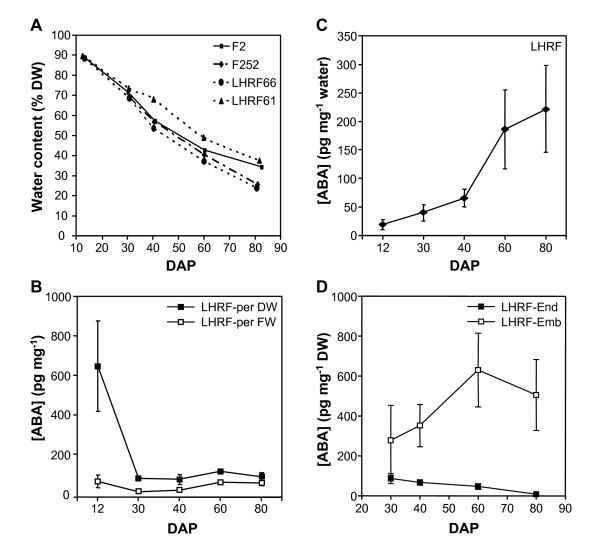
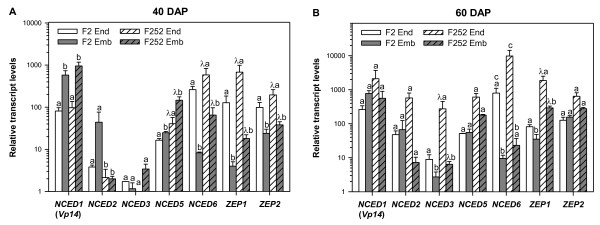
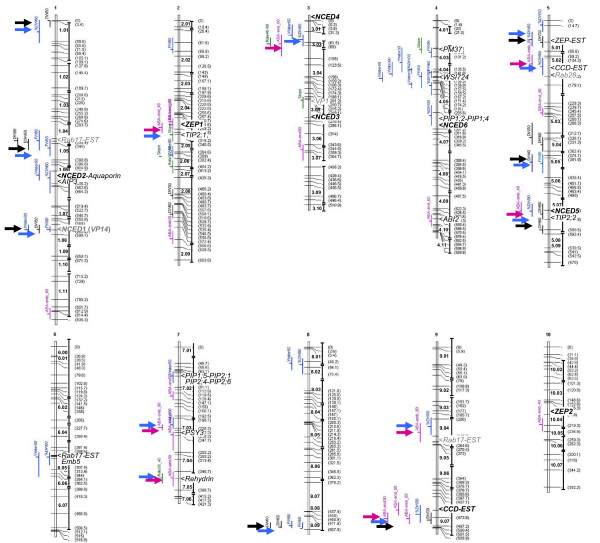
The use of an intermated recombinant inbred line population allowed for precise QTL mapping. For 29 traits examined in an unreplicated time course trial of days after pollination, a total of 78 QTLs were detected, 43 being related to kernel desiccation, 15 to kernel weight and 20 to ABA content. Multi QTL models explained 35 to 50% of the phenotypic variation for traits related to water status, indicating a large genetic control amenable to breeding. Ten of the 20 loci controlling ABA content colocated with previously detected QTLs controlling water status and ABA content in water stressed leaves. Mapping of candidate genes associated with kernel desiccation and ABA biosynthesis revealed several colocations between genes with putative functions and QTLs. Parallel investigation via RT-PCR experiments showed that the expression patterns of the ABA-responsive Rab17 and Rab28 genes as well as the late embryogenesis abundant Emb5 and aquaporin genes were related to desiccation rate and parental allele effect. Database searches led to the identification and mapping of two zeaxanthin epoxidase (ZEP) and five novel 9-cis-epoxycarotenoid dioxygenase (NCED) related genes, both gene families being involved in ABA biosynthesis. The expression of these genes appeared independent in the embryo and endosperm and not correlated with ABA content in either tissue.
A high resolution QTL map for kernel desiccation and ABA content in embryo and endosperm showed several precise colocations between desiccation and ABA traits. Five new members of the maize NCED gene family and another maize ZEP gene were identified and mapped. Among all the identified candidates, aquaporins and members of the Responsive to ABA gene family appeared better candidates than NCEDs and ZEPs.
收获时的内核水分是一个重要的性状,因为需要低值来防止意外的早期发芽并确保种子保存。众所周知, viviparous 突变体(在脱落酸(ABA)生物合成中受损)会发生早期发芽。为了深入了解玉米内核干燥过程中内核水分和 ABA 含量的遗传决定因素,在胚胎和胚乳的内核干燥过程中,针对与内核水分和 ABA 含量相关的性状,检测了数量性状基因座(QTL)。同时,检查了参与内核干燥和 ABA 生物合成的基因的表达和图谱,以检测候选基因。
使用互交重组自交系群体进行了精确的 QTL 作图。在授粉后天数的未复制时间过程试验中,对 29 个性状进行了检测,共检测到 78 个 QTL,其中 43 个与内核干燥有关,15 个与内核重量有关,20 个与 ABA 含量有关。多 QTL 模型解释了与水状态有关的性状的表型变异的 35%至 50%,表明遗传控制的幅度很大,适合于育种。控制 ABA 含量的 20 个位点中的 10 个与先前检测到的控制水胁迫叶片中水状态和 ABA 含量的 QTL 共定位。与内核干燥和 ABA 生物合成相关的候选基因的作图揭示了具有假定功能的基因与 QTL 之间的几个共定位。通过 RT-PCR 实验进行的平行研究表明,ABA 反应性 Rab17 和 Rab28 基因以及晚期胚胎丰富的 Emb5 和水通道蛋白基因的表达模式与干燥速率和亲本等位基因效应有关。数据库搜索导致了 Zeaxanthin epoxidase(ZEP)和五个新型 9-cis-epoxycarotenoid dioxygenase(NCED)相关基因的鉴定和作图,这两个基因家族都参与了 ABA 生物合成。这些基因在胚胎和胚乳中的表达似乎是独立的,与任何组织中的 ABA 含量都没有相关性。
内核干燥和胚胎及胚乳中 ABA 含量的高分辨率 QTL 图谱显示,干燥和 ABA 性状之间存在几个精确的共定位。鉴定并绘制了玉米 NCED 基因家族的五个新成员和另一个玉米 ZEP 基因。在所鉴定的所有候选基因中,水通道蛋白和 ABA 反应基因家族的成员似乎比 NCED 和 ZEP 更适合作为候选基因。