Service de Chirurgie Digestive, Thoracique et Cancérologique, Centre Hospitalier Universitaire du Bocage, 1, Bd. Jeanne d'Arc, 21079, Dijon Cedex, France.
World J Surg. 2010 Apr;34(4):808-14. doi: 10.1007/s00268-009-0367-x.
Nowadays, most patients who undergo colorectal surgery are discharged early. An early predictor of septic complications could avoid readmissions and decrease morbidity. CRP could be a good predictor allowing a safe discharge.
A prospective, observational study was conducted from November 2007 to October 2008. All patients who underwent elective colorectal surgery were included. Clinical (temperature, pulse, abdominal tenderness, bowel movements) and laboratory data (C-reactive protein, leukocyte count) were recorded and evaluated as early predictors of septic complications (namely, anastomotic leaks). All detected leaks were considered fistulas, independently of their clinical significance. Clinical and inflammatory parameters were analyzed with univariate and multivariate techniques; logistic regression was performed and areas under the receiver operating characteristic curve were compared.
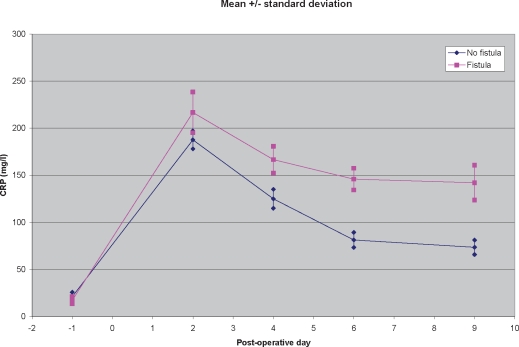
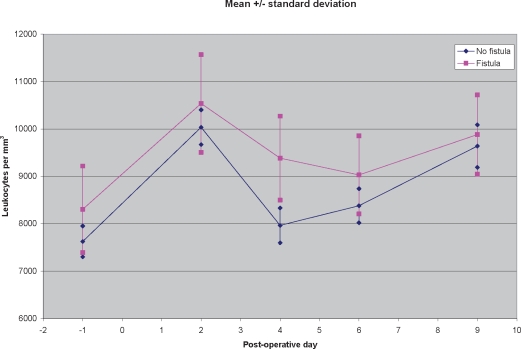
A total of 133 patients were included. The overall incidence of anastomotic leaks was 15.5% and mortality was 4.5%. C-reactive protein at postoperative days 2 and 4 was a good predictor of anastomotic leak (areas under the curve were 0.715 and 0.845, respectively) and other postoperative septic complications (areas under the curve were 0.804 and 0.787), showing the highest accuracy among clinical and laboratory data. A cutoff of 125 mg/l in the level of C-reactive protein at postoperative day 4 yielded a sensitivity of 81.8% and a negative predictive value of 95.8% for the detection of anastomotic leakage.
C-reactive protein is a simple way to ensure a safe discharge from hospital after elective colorectal surgery. Patients with CRP values >125 mg/l on the fourth postoperative day should not be discharged.
如今,大多数接受结直肠手术的患者都提前出院。早期预测脓毒症并发症可以避免再次入院和降低发病率。C 反应蛋白(CRP)可能是一种良好的预测指标,可以安全出院。
一项前瞻性、观察性研究于 2007 年 11 月至 2008 年 10 月进行。所有接受择期结直肠手术的患者均被纳入研究。记录并评估临床(体温、脉搏、腹部压痛、排便情况)和实验室数据(C 反应蛋白、白细胞计数),作为脓毒症并发症(即吻合口漏)的早期预测指标。所有检测到的漏口均被视为瘘管,无论其临床意义如何。使用单变量和多变量技术分析临床和炎症参数;进行逻辑回归,并比较受试者工作特征曲线下的面积。
共纳入 133 例患者。吻合口漏的总发生率为 15.5%,死亡率为 4.5%。术后第 2 天和第 4 天的 C 反应蛋白是吻合口漏的良好预测指标(曲线下面积分别为 0.715 和 0.845),也是其他术后脓毒症并发症的良好预测指标(曲线下面积分别为 0.804 和 0.787),在临床和实验室数据中表现出最高的准确性。术后第 4 天 C 反应蛋白水平>125mg/L 时,检测吻合口漏的灵敏度为 81.8%,阴性预测值为 95.8%。
C 反应蛋白是确保择期结直肠手术后安全出院的一种简单方法。术后第 4 天 CRP 值>125mg/L 的患者不应出院。