Câmara Joana, Jarai Gabor
Novartis Institutes for BioMedical Research, Respiratory Disease Area, Wimblehurst Road, Horsham, RH12 5AB West Sussex, UK.
Fibrogenesis Tissue Repair. 2010 Jan 5;3(1):2. doi: 10.1186/1755-1536-3-2.
Defective epithelial repair, excess fibroblasts and myofibroblasts, collagen overproduction and fibrosis occur in a number of respiratory diseases such as asthma, chronic obstructive pulmonary disease (COPD) and pulmonary fibrosis. Pathological conversion of epithelial cells into fibroblasts (epithelial-mesenchymal transition, EMT) has been proposed as a mechanism for the increased fibroblast numbers and has been demonstrated to occur in lung alveolar epithelial cells. Whether other airway cell types also have the capability to undergo EMT has been less explored so far. A better understanding of the full extent of EMT in airways, and the underlying mechanisms, can provide important insights into airway disease pathology and enable the development of new therapies. The main aim of this study was to test whether primary human bronchial epithelial cells are able to undergo EMT in vitro and to investigate the effect of various profibrotic factors in the process.
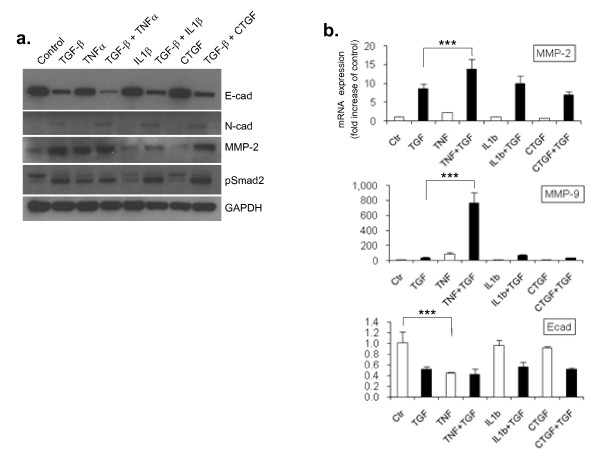
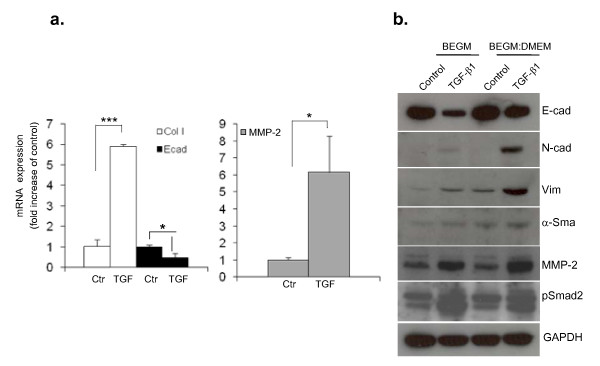
Our data demonstrate that primary human bronchial epithelial cells (HBECs) are able to undergo EMT in response to transforming growth factor-beta 1 (TGF-beta1), as revealed by typical morphological alterations and EMT marker progression at the RNA level by real-time quantitative polymerase chain reaction and, at the protein level, by western blot. By using pharmacological inhibitors we show that this is a Smad-dependent mechanism and is independent of extracellular signal-related kinase pathway activation. Additional cytokines and growth factors such as tumour necrosis factor-alpha (TNF-alpha), interleukin-1 beta (IL1beta) and connective tissue growth factor (CTGF) were also tested, alone or in combination with TGF-beta1. TNF-alpha markedly enhances the effect of TGF-beta1 on EMT, whereas IL1beta shows only a very weak effect and CTGF has no significant effect. We have also found that cell-matrix contact, in particular to fibronectin, an ECM component upregulated in fibrotic lesions, potentiates EMT in both human alveolar epithelial cells and HBECs. Furthermore, we also show that the collagen discoidin domain receptor 1 (DDR1), generally expressed in epithelial cells, is downregulated during the EMT of bronchial epithelium whereas DDR2 is unaffected. Our results also suggest that bone morphogenetic protein-4 is likely to have a context dependent effect during the EMT of HBECs, being able to induce the expression of EMT markers and, at the same time, to inhibit TGF-beta induced epithelial transdifferentiation.
The results presented in this study provide additional insights into EMT, a potentially very important mechanism in fibrogenesis. We show that, in addition to alveolar epithelial type II cells, primary HBECs are also able to undergo EMT in vitro upon TGF-beta1 stimulation via a primarily Smad 2/3 dependent mechanism. The effect of TGF-beta1 is potentiated on fibronectin matrix and in the presence of TNF-alpha, representing a millieu reminiscent of fibrotic lesions. Our results can contribute to a better understanding of lung fibrosis and to the development of new therapeutic approaches.
上皮修复缺陷、成纤维细胞和肌成纤维细胞过多、胶原蛋白过度产生以及纤维化出现在多种呼吸系统疾病中,如哮喘、慢性阻塞性肺疾病(COPD)和肺纤维化。上皮细胞向成纤维细胞的病理转化(上皮-间质转化,EMT)已被提出是成纤维细胞数量增加的一种机制,并且已证实在肺泡上皮细胞中会发生。到目前为止,对于其他气道细胞类型是否也有能力发生EMT的探索较少。更好地了解气道中EMT的全貌及其潜在机制,可为气道疾病病理学提供重要见解,并有助于开发新的治疗方法。本研究的主要目的是测试原代人支气管上皮细胞在体外是否能够发生EMT,并研究各种促纤维化因子在该过程中的作用。
我们的数据表明,原代人支气管上皮细胞(HBECs)能够在转化生长因子-β1(TGF-β1)的作用下发生EMT,这通过典型的形态学改变以及实时定量聚合酶链反应在RNA水平和蛋白质印迹在蛋白质水平上的EMT标志物进展得以揭示。通过使用药理学抑制剂,我们表明这是一种依赖Smad的机制,并且独立于细胞外信号相关激酶途径的激活。还单独或与TGF-β1联合测试了其他细胞因子和生长因子,如肿瘤坏死因子-α(TNF-α)、白细胞介素-1β(IL1β)和结缔组织生长因子(CTGF)。TNF-α显著增强TGF-β1对EMT的作用,而IL1β仅显示出非常微弱的作用,CTGF没有显著作用。我们还发现细胞与基质的接触,特别是与纤连蛋白(一种在纤维化病变中上调的细胞外基质成分)的接触,可增强人肺泡上皮细胞和HBECs中的EMT。此外,我们还表明,通常在上皮细胞中表达的胶原蛋白盘状结构域受体1(DDR1)在支气管上皮的EMT过程中下调,而DDR2不受影响。我们的结果还表明,骨形态发生蛋白-4在HBECs的EMT过程中可能具有依赖于背景的作用:既能诱导EMT标志物的表达,同时又能抑制TGF-β诱导的上皮转分化。
本研究结果为EMT提供了更多见解,EMT是纤维化形成中一个潜在非常重要的机制。我们表明,除了II型肺泡上皮细胞外,原代HBECs在TGF-β1刺激下也能够通过主要依赖Smad 2/3的机制在体外发生EMT。TGF-β1在纤连蛋白基质上以及在TNF-α存在的情况下作用增强,这代表了一种类似于纤维化病变的环境。我们的结果有助于更好地理解肺纤维化并开发新的治疗方法。