Special Medical Care, Department of Internal Medicine, Academic Medical Center, University of Amsterdam, Rm F7-205, PO Box 22700, 1100 DE Amsterdam, The Netherlands.
Eur J Appl Physiol. 2010 May;109(2):141-57. doi: 10.1007/s00421-009-1346-5. Epub 2010 Jan 7.
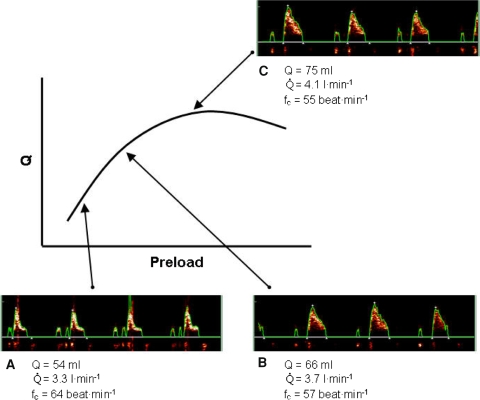
The Frank-Starling mechanism describes the relationship between stroke volume and preload to the heart, or the volume of blood that is available to the heart--the central blood volume. Understanding the role of the central blood volume for cardiovascular control has been complicated by the fact that a given central blood volume may be associated with markedly different central vascular pressures. The central blood volume varies with posture and, consequently, stroke volume and cardiac output (Q) are affected, but with the increased central blood volume during head-down tilt, stroke volume and Q do not increase further indicating that in the supine resting position the heart operates on the plateau of the Frank-Starling curve which, therefore, may be taken as a functional definition of normovolaemia. Since the capacity of the vascular system surpasses the blood volume, orthostatic and environmental stress including bed rest/microgravity, exercise and training, thermal loading, illness, and trauma/haemorrhage is likely to restrict venous return and Q. Consequently the cardiovascular responses are determined primarily by their effect on the central blood volume. Thus during environmental stress, flow redistribution becomes dependent on sympathetic activation affecting not only skin and splanchnic blood flow, but also flow to skeletal muscles and the brain. This review addresses the hypothesis that deviations from normovolaemia significantly influence these cardiovascular responses.
Frank-Starling 机制描述了心脏的每搏输出量(stroke volume)与前负荷(preload)或心脏可利用的血量(central blood volume)之间的关系。理解中央血容量(central blood volume)对心血管控制的作用很复杂,因为给定的中央血容量可能与明显不同的中央血管压力相关联。中央血容量随体位而变化,因此,每搏输出量和心输出量(Q)会受到影响,但在下斜位时中央血容量增加,每搏输出量和 Q 不再进一步增加,这表明在仰卧休息位置,心脏处于 Frank-Starling 曲线的平台上,因此,这可以作为正常血容量的功能定义。由于血管系统的容量超过了血液量,直立和环境压力(包括卧床休息/微重力、运动和训练、热负荷、疾病和创伤/出血)可能会限制静脉回流和 Q。因此,心血管反应主要取决于它们对中央血容量的影响。因此,在环境压力下,血流重新分配变得依赖于交感神经激活,这不仅影响皮肤和内脏血流,还影响到骨骼肌和大脑的血流。这篇综述探讨了这样一个假设,即偏离正常血容量会显著影响这些心血管反应。